You get a message that opens with “NGL Meaning in Chat, that was kind of awkward.” Your stomach drops. Should you worry?
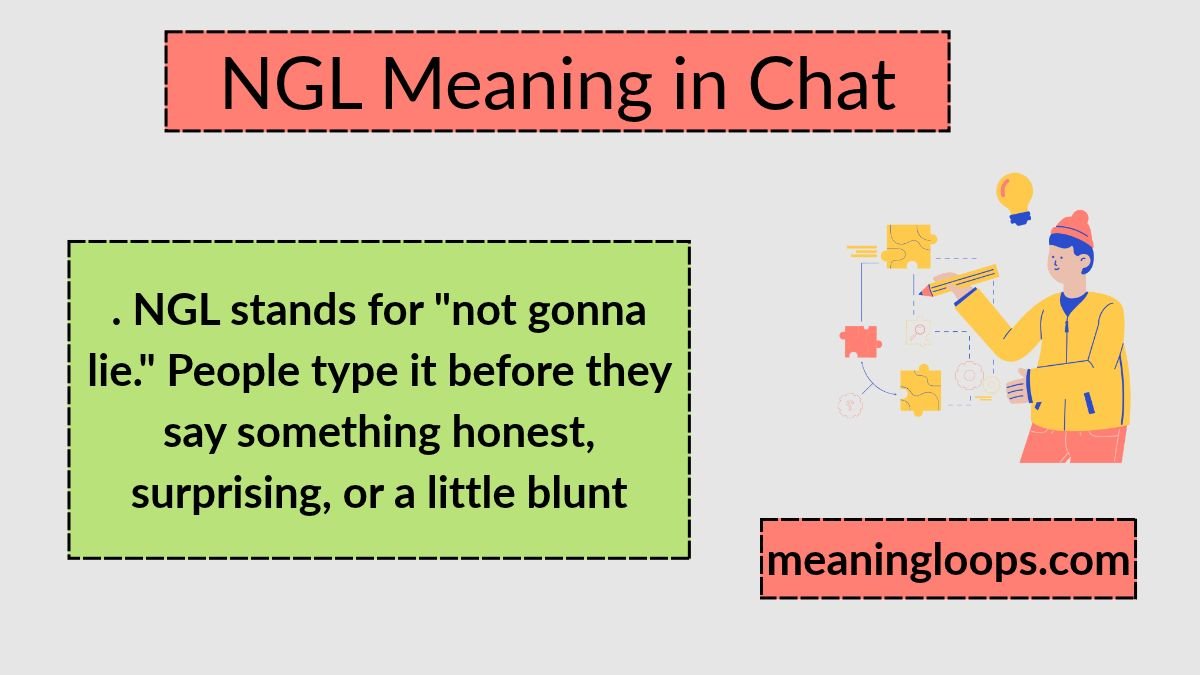
Relax. NGL stands for “not gonna lie.” People type it before they say something honest, surprising, or a little blunt. This guide explains the meaning of NGL in chat, where it came from, and how to use it. You’ll also learn how to reply when someone sends it your way.
What Does NGL Mean? (Quick Answer)
NGL Meaning in Chat “not gonna lie.” It’s an internet slang acronym that flags a candid statement. People use it in text messages, social media posts, and chat apps. The phrase signals that the speaker is about to share an honest opinion without sugarcoating it.
Full Form and Plain-English Definition
Think of NGL Meaning in Chat as a verbal drumroll. It tells the reader, “Here comes the real thought.” The abbreviation itself carries no judgment. The message after it sets the mood.
In short: NGL = not gonna lie = “I’m being straight with you.”
Example Sentences
Here are six common examples of NGL Meaning in Chat:
- Praise: “NGL, this pizza is incredible.”
- Criticism: “NGL, the ending felt rushed.”
- Confession: “NGL, I forgot we had plans.“
- Surprise: “NGL, I didn’t expect you to win.”
- Late-night confession: “NGL, I’ve been thinking about that all week.”
- Self-deprecating: “NGL, I cried at that commercial.”
Notice the pattern. Each line starts with NGL Meaning in Chat and then moves to a direct statement. That’s the whole trick.
NGL Meaning in Texts and Social Media
NGL stands for “not gonna lie.” Some people spell it out as “not going to lie.” You’ll spot it in text messages, DMs, and social media posts. Cambridge Dictionary lists it as a standard bit of informal chat shorthand.
How People Use NGL
Think of NGL Meaning in Chat as a heads-up. It tells your reader that something honest is coming. Here are the three most common jobs it does.
Softening a Critique
Blunt opinions can sting. Adding NGL Meaning in Chat takes off the edge. It works a bit like saying “to be honest” or “no offense.” Tubevocab and Parents both describe this softening role.
“NGL, that movie was way longer than it needed to be.”
Admitting Something Embarrassing
Got a guilty pleasure? A small flaw? NGL makes confessions feel lighter. Espresso English points out this use too.
“NGL, I ate the entire box of cookies myself.”
Giving Sincere Praise
NGL isn’t only for bad news. It also adds weight to a compliment. The honesty flag tells your friend you mean every word.
“NGL, your new haircut looks amazing.”
Quick Tips for Using NGL
- Pick your style. Lowercase (
ngl) and uppercase (NGL) both work fine. - Keep it casual. Save it for texts, DMs, and online chats. Formal emails, school essays, and job applications call for plainer wording.
- Know its cousins. NGL sits close to TBH (“to be honest”) and FR (“for real”). Parents covers these related terms for readers new to texting slang.
For more background, try Today and wikiHow. Both explain the term in simple language.
Want More Slang Decoded?
Texting shorthand keeps growing. Next up, you might explore TBH, IMO, or SMH. Tell me which one you’d like, and I’ll break it down the same way.
Where Did NGL Come From?
NGL is an acronym built from “not gonna lie.” That phrase is itself a relaxed form of “I’m not going to lie.” You’ll hear it all the time in everyday spoken English. Typing turned the spoken phrase into a shortened phrase with three letters.
Why did this happen? Early messaging pushed people to type less. Standard SMS texts capped out at 160 characters. Twitter launched with a 140-character limit and only doubled it to 280 in 2017. Short forms saved space and time.
Language evolves with its tools. Chat rooms and instant messengers in the late 1990s and early 2000s gave us LOL, BRB, and JK. Later, texting and social media pushed newer forms like NGL into the mainstream.
One honest caveat applies here. No dictionary names an inventor or an exact birth date for NGL. Anyone who claims to know the “true origin” is guessing. For the formal definition, you can check Merriam-Webster or Dictionary.com.
What Does NGL Signal in a Message?
People don’t use NGL by accident. It does real work inside a sentence. Here are its four main jobs.
- It softens a blunt opinion. “NGL, I’d skip that restaurant” lands gentler than “That restaurant is bad.” This is a form of softening honesty.
- It flags a confession. The reader knows something personal or unexpected is coming.
- It adds emphasis. “NGL, I loved it” sounds more sincere than “I loved it.”
- It works as filler. Sometimes people toss it in out of habit. It carries no weight at all.
Why People Connect With It
Behind the slang sits something human. Not gonna lie gives people a small doorway into vulnerability and emotional openness. It feels safer to say “NGL, I’m nervous” than “I’m nervous.” The prefix lowers the stakes.
It also builds authenticity. Friends who use NGL tend to sound like they’re being real. That sincerity explains why the term spread so fast among younger generations.
How People Use NGL on Different Platforms
The meaning stays the same everywhere. The tone shifts a bit by platform.
Text and WhatsApp
On WhatsApp and plain text messages, NGL often appears in quick back-and-forth chats.
Maya: Did you like the movie?
Jordan: NGL, I fell asleep halfway through 😅
Maya: Honestly, same.
Instagram DMs and TikTok Comments
Instagram DMs lean personal. People use NGL to share a late-night confession or react to a friend’s story. On TikTok comments, the term often shows up as a quick reaction: “NGL, this edit is fire.”
Snapchat, Twitter, and Reddit
On Snapchat, NGL usually rides along with a casual caption. On Twitter (now X) the short form saves characters. Reddit threads use it for sharing an opinion in replies, often lowercase as “ngl.”
Gaming Chat
Gamers use NGL to give blunt feedback to teammates. “NGL, that play was risky” is a typical line. The tone stays light as long as the speaker isn’t targeting a person.
Placement and Grammar: Where NGL Goes in a Sentence
You can place NGL in three spots.
| Position | Example | Effect |
|---|---|---|
| Start | “NGL, I’m tired.” | Most common. Sets up the honesty. |
| Middle | “I’m, NGL, a bit nervous.” | Adds a casual, spoken rhythm. |
| End | “That was great, ngl.” | Feels relaxed and afterthought-like. |
A few quick rules help:
- Capitalization: Both “NGL” and “ngl” work. All caps feel a bit louder.
- Punctuation: A comma after it is common but not required in chat.
- Spacing: Keep it short. One use per message is plenty.
Can You Use NGL at Work or in Formal Writing?

Should I use NGL at work? Usually, no. It’s informal communication, and it can sound careless in a serious setting. However, culture varies by company. A relaxed startup Slack may welcome it. A law firm won’t.
Safe vs. Risky Contexts
| Context | OK to Use NGL? | Better Alternative |
|---|---|---|
| Text to a friend | Yes | — |
| Team chats with close peers | Depends on culture | “Honestly,” |
| Client emails | No | “To be candid,” |
| Job applications | No | “Frankly,” or no filler at all |
| Formal reports | No | State the point directly |
| Social media post | Yes | — |
Professional Alternatives
When you need professional communication, swap in one of these:
- To be candid
- In my honest opinion
- Frankly speaking
- Truthfully
- Honestly
These keep your respectful communication intact. They also deliver the same message as NGL.
Case Study: A Workplace Misread
This is an illustrative scenario, not a real company.
A junior designer replied to a manager’s draft with, “NGL, I think the layout needs work.” The manager felt stung. The designer meant to offer constructive criticism. The slang made the note feel offhand.
The fix was simple. The designer rewrote it as: “To be candid, the layout needs more white space. Here’s a suggestion.” The feedback stayed direct but gained a formal tone. The manager accepted it right away.
Lesson: Match your tone to your audience.
Common Mistakes and Misunderstandings
Even a three-letter term causes trouble. Watch for these misuse patterns.
- Assuming it’s always negative. Not true. “NGL, you’re a great friend” is warm.
- Treating it as permission to be rude. Saying “NGL, you look terrible” doesn’t make it kind. Being rude with a slang prefix is still rude.
- Using it in formal situations. Skip it in client emails, cover letters, and formal reports.
- Assuming everyone understands. Older audiences and non-native English speakers may not know the term. Spell it out when in doubt.
- Overusing it. If every message starts with NGL, it loses its punch.
NGL vs. TBH, FR, and Other Similar Terms
Is NGL the same as TBH? Close, but not identical. TBH means “to be honest.” Both introduce candor. In practice, NGL often hints at something awkward or surprising. TBH tends to introduce a plain opinion. This difference is a usage tendency, not a rule.
| Term | Meaning | Tone | Example |
|---|---|---|---|
| NGL | Not gonna lie | Candid, slightly confessional | “NGL, I’m nervous.” |
| TBH | To be honest | Neutral, honest | “TBH, I liked the first one more.” |
| FR | For real | Agreeing or emphasizing | “That was wild, fr.” |
| IMO | In my opinion | Mild, opinion-based | “IMO, it’s overrated.” |
| Real talk | Serious honesty ahead | Serious | “Real talk, you should apologize.” |
| I can’t even lie | Same as NGL | Casual, dramatic | “I can’t even lie, I’m obsessed.” |
Terms People Confuse With NGL
Some slang looks similar but isn’t a substitute.
- No cap means “no lie.” It confirms a claim is true. It doesn’t introduce an opinion.
- Low-key means “somewhat” or “secretly.” Example: “I’m low-key excited.”
- High-key means “very” or “openly.” Example: “I’m high-key excited.”
Other Common Chat Abbreviations
Here’s a quick reference for related digital vocabulary.
| Abbreviation | Meaning |
|---|---|
| FYI | For your information |
| IDC | I don’t care |
| JK | Just kidding |
| LOL | Laughing out loud |
| BRB | Be right back |
Regional Usage and Cultural Differences

NGL began in English-speaking spaces. Today it travels worldwide through global internet usage. Still, cultural differences shape how people hear it.
Researchers often describe two broad styles. Anthropologist Edward T. Hall introduced the idea of “high-context” and “low-context” communication. Low-context speakers say things plainly. High-context speakers rely on tone and shared understanding.
What does that mean for NGL?
- Western culture: Many English-speaking users value directness. NGL fits right in.
- Asian culture: Some communities favor indirect communication. Blunt openers may feel strong. Younger users online often adopt the slang anyway.
- Middle Eastern culture: Politeness norms vary widely by country and setting. Context matters more than any single phrase.
These are broad patterns, not rules about individuals. Use regional usage as a clue and not a verdict. When you chat across borders, a short explanation avoids a misunderstanding.
NGL the App vs. NGL the Slang
Many searchers type “NGL” and mean the app. It’s worth separating the two.
NGL: ask me anything is an anonymous Q&A app. It launched in 2021 as an anonymous messaging service that let users receive anonymous messages from friends and social media followers. People shared links in Instagram Stories and waited for replies. The app’s name borrowed from the slang.
The FTC Action
The app drew serious legal attention. NGL Labs and its two co-founders entered a $5 million settlement with the Federal Trade Commission. The FTC said the app sent fake messages to users. The complaint alleges that in 2022, after the app failed to gain much interest, NGL began sending fake computer-generated messages that appeared to come from real people.
The agency also raised concerns about paid upgrades. Users who engaged saw ads pushing the NGL Pro version for as much as $9.99 a week. The settlement bans the app from offering or marketing to anyone under 18.
You can read more coverage at Scripps News and The Hill.
A Note for Parents
Anonymous messaging removes accountability. That raises the risk of cyberbullying. Talk with your teen about who sends the messages. Review privacy settings together. Encourage them to block and report abusive senders.
How to Respond When Someone Says NGL
How to respond to NGL depends on what follows it. Read the whole message first. Then match the mood.
| Situation | Reply Style | Example |
|---|---|---|
| Friendly opinion | Casual replies | “Haha fair.” |
| Light confession | Funny replies | “Honestly, same. We’re a mess.” |
| Serious feedback | Mature replies | “Thanks for being honest. I’ll think about it.” |
| Sensitive topic | Respectful replies | “I appreciate you telling me. Can we talk later?” |
If They Share an Opinion
Try one of these:
- “That’s valid.”
- “Fair point.”
- “I see it differently, but I get it.”
If They Share a Confession
Keep it warm:
- “Honestly, same.”
- “Thanks for being honest with me.”
- “No judgment here.”
If You Feel Stung
Pause first. Then ask a calm question. For example: “Can you tell me what you mean?” This shifts the chat toward keeping it real without a fight.
Is NGL Still Popular?
Yes. NGL remains a staple of online communication among teens and young adults. You’ll still spot it in TikTok comments, DMs, and group chats.
Popularity shifts over time though. Slang rises and fades fast. For hard numbers, check Google Trends and search “ngl.” The chart shows how interest has moved over any period you choose. Compare it with “tbh” for context.
Frequently Asked Questions
What does NGL mean in texting?
It means “not gonna lie.” Writers use it to introduce an honest, direct, or surprising statement in text messages and chats.
Is NGL the same as TBH?
They overlap. TBH means “to be honest.” NGL often leans toward confessions or awkward truths.
Can adults use NGL?
Of course. Adults use it in friendly chats too. Just skip it in formal settings.
Should I use NGL at work?
Only if your workplace culture is casual. For client emails, choose “to be candid” or “frankly.”
Why do people say NGL?
It softens blunt remarks. It also signals authenticity. Typing three letters beats typing three words.
What is the difference between NGL and “no cap”?
No cap means “no lie.” It backs up a claim. NGL introduces a candid thought.
Conclusion
NGL means “not gonna lie.” It signals honesty, softens blunt remarks, and invites trust. You can use it freely with friends. Skip it in formal communication, and explain it to anyone who might not know it.
Language keeps changing, but the need to speak plainly never does. So the next time a message starts with NGL, read on with curiosity. Then reply with kindness.
Read
What Does Defiant Mean in Text? The 2026 Guide to Defiant Slang, Examples & Replies
What Does STD Mean in Text? Meaning, Usage, and How to Reply
YOLO Meaning in Text: What It Really Means in Messages, Social Media, and Real Life

David Miller is the lead content writer at Meaning Loops, where he creates accurate and easy-to-understand content on word meanings, synonyms, antonyms, idioms, phrases, acronyms, abbreviations, and vocabulary. His goal is to help readers improve their English with reliable, well-researched, and SEO-friendly language resources.