Somebody leaves you on read for six hours. Then they post a selfie within minutes. You don’t text back. Petty Meaning You don’t even like the photo. Instead, you quietly mute their story and call it self-care.
That, friends, is being petty. Most of us have done it. Plenty of us have called someone else out for it.
So what does the word really say? Is it an insult or a joke? Does it describe a person or just one bad afternoon? This guide covers the petty meaning in plain language, from its Old French roots to petty meaning today on social media.
What Does Petty Mean? The Quick Petty Definition
Petty describes a small-minded attitude or action. A petty person fixates on trivial matters, often to score a point or settle a score. The issue itself is small. The reaction isn’t.
Merriam-Webster lists three senses of the adjective:
- Having secondary rank or importance (minor, subordinate)
- Having little or no importance or significance
- Marked by narrow interests and sympathies (small-minded)
The same dictionary offers a refreshingly honest example: “My behavior was petty and stupid. I apologize.”
Here’s a quick snapshot of the petty definition:
| Feature | Detail |
|---|---|
| Part of speech | Adjective |
| Related forms | pettier, pettiest, pettily, pettiness |
| Core idea | Caring too much about minor issues |
| Usual tone | Negative (though often playful online) |
| Everyday example | Refusing to share a Wi-Fi password over a joke |
The Origin of Petty: Word Etymology From the French Word “Petit”
From Old French to Middle English
The origin of petty sits in medieval France. According to Etymonline, English picked up peti in the late 14th century. That spelling reflected the sound of the Old French word “petit,” meaning “small.” The word also appeared as a surname as early as the late 12th century.
Nothing about it sounded insulting back then. It simply meant little.
How the 16th-Century Meaning Changed Everything
The shift happened gradually. Etymonline records the sense “of small or minor importance” from the 1520s. By the 1580s, English speakers used it to mean small-minded. In other words, the 16th-century meaning moved from size to character.
Here’s the timeline at a glance:
| Period | Development |
|---|---|
| Late 12th century | Appears as a surname |
| Late 14th century | Peti enters English, meaning small or minor |
| 1520s | Gains the sense of minor importance |
| 1570s | “Petty officer” appears |
| 1580s | Gains the sense of small-minded |
| 1834 | “Petty cash” recorded |
Neutral Meanings That Survived
Not every use turned sour. Petty cash and petty officer still carry the old, neutral sense of “small” or “lower.” Nobody insults a naval rank by using it.
Petty Meaning on Social Media: How Internet Slang Reshaped the Word
Black Twitter and the 2016 Spike
The word got a major second life online. Know Your Meme reports that its popularity spiked in 2016 on Black Twitter. Reaction images drove much of that growth. Many showed someone wearing a tight, close-mouthed smile.
Credit matters here. Much of today’s internet slang traces back to Black online communities before it spread elsewhere. Stacker’s overview of slang from Black Twitter explains how that process works.
“A State of Being,” Not Just an Action
VICE interviewed linguist Anne H. Charity Hudley about the term. She described the slang sense as an identity more than a one-time act. In her words: “You’re not being petty, you are petty.”
She also tied the word to a long tradition of Black verbal art, where phrases carry double meanings. Throwing shade and “reading” someone belong to the same family. She added that the meaning shifts when the word moves into mainstream use. It becomes about a single petty act instead of a whole attitude.
That’s a handy distinction. Keep it in mind as you read on.
Modern Usage and Trending Slang in 2026
The word hasn’t cooled off. Merriam-Webster’s recent examples from July 2026 pull from TV recaps, sports media, and political commentary. Reality-show fans use it. So do columnists. This is proof of modern usage far beyond group chats.
Where You’ll See Petty Online
The word shows up everywhere people talk. You’ll spot it in TikTok comments, Instagram DMs, a WhatsApp chat, and plain old text messages. The behaviors repeat across platforms:
- Subtweeting: posting about someone without naming them
- Unfollowing or muting after a minor disagreement
- Posting indirect quotes that everyone knows are aimed at one person
- Bringing receipts: screenshotting old messages to prove a point
- Leaving a message on read as a quiet signal
Every platform has its own flavor. The motive stays the same.
Petty Behavior in Real Life: Three Case Studies
These scenarios are composites. They don’t describe real people. They show how petty behavior plays out.
Case Study: The Group Chat Standoff
Maya forgets to reply to a birthday invite. Her friend Jordan waits a week. Then she skips Maya’s birthday post and stops reacting to her stories.
- What looks petty: the silent treatment over a missed reply
- What’s underneath: Jordan felt ignored
- A better move: a quick “Hey, that stung a little”
Case Study: The Workplace Email Chain
A coworker takes credit in a meeting. Dev responds by copying six people on every future email. He cites each deadline in bold.
- What looks petty: the subtle revenge through cc lists
- What’s underneath: Dev feels disrespected
- A better move: a direct, calm conversation with the coworker or manager
Case Study: The Social Media Pile-On
After a breakup, Sam posts a vague quote about “fake people.” She tags no one. Her ex sees it within minutes.
- What looks petty: posting indirect quotes as passive-aggressive commentary
- What’s underneath: unresolved emotions
- A better move: muting, journaling, or talking to a friend
Notice the pattern. Each case includes a real feeling. The pettiness is just the delivery method.
The Psychological Meaning of Being Petty
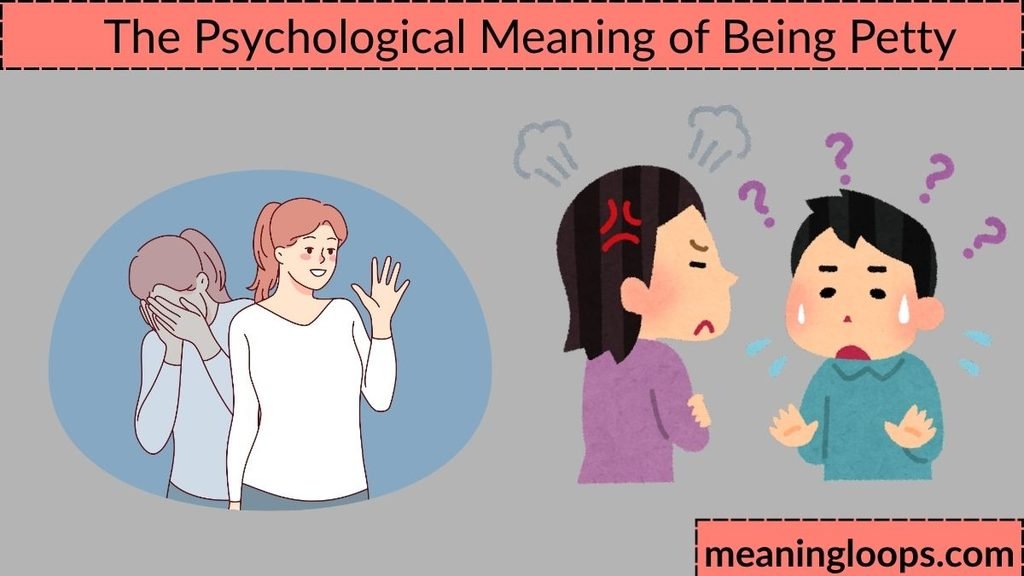
Why do people do this? The psychological meaning varies from person to person. Still, a few themes come up again and again.
- Feeling ignored: people want acknowledgment and don’t get it
- Feeling disrespected: a small slight feels like a big message
- Feeling powerless: a petty move can help someone regain control in a situation they can’t change
- Insecurity: small wins feel safer than honest vulnerability
- Unresolved emotions: old hurt leaks out as holding grudges
None of this excuses unkind behavior. It does explain it. An emotional reaction that looks oversensitive or like overreacting from the outside often feels completely logical from the inside.
Emotional intelligence is the skill that helps here. People who spot the feeling behind the urge can pause before acting. That pause makes all the difference.
Self-Aware Petty and “Petty With a Purpose”
Some people embrace the label on purpose. They call themselves “certified petty” or say they’re being “petty with a purpose.” This self-aware petty style turns the word into a joke. It works because the person admits the move is silly.
The risk? Humor can hide a real grievance. If you joke about a grudge for months, the grudge probably isn’t a joke.
Types of Petty: Common Variations
The labels below aren’t formal linguistic categories. They’re descriptive tags that fit real behavior.
| Type | What it looks like | Example |
|---|---|---|
| Silent petty | Withdrawal without explanation | Skipping someone’s calls without comment |
| Social media petty | Public hints and online shade | Unfollowing after a disagreement |
| Workplace petty | Small power plays at the office | Never “seeing” a rival’s message |
| Relationship petty | Keeping score in love | Counting who texted first |
| Competitive petty | Rivalry over tiny wins | Correcting a friend’s trivia answer to win |
| Emotional petty | Withholding warmth to send a message | Cold replies after an argument |
| Passive-aggressive petty | Indirect jabs with a smile | “Wow, thanks for remembering this time.” |
Petty vs. Similar Words: Petty Synonyms and Comparisons
Several words overlap with petty. They aren’t identical. Dictionary.com notes that petty, paltry, trifling, and trivial all describe insignificance. Petty adds a sense of contempt and smallness.
| Term | Core meaning | How it differs from petty |
|---|---|---|
| Trivial | Of little importance | Describes the issue, not the attitude |
| Immature | Behaving younger than your age | About maturity, not about size of issue |
| Spiteful | Wanting to hurt someone | Carries real malice |
| Small-minded | Narrow in outlook | A harsher dictionary synonym |
| Petulant | Sulky and irritable | About mood, not about caring over little things |
Petty vs. Immature
Immature describes a general pattern of childish behavior. Petty describes a specific kind of focus. An adult can be mature in most ways and still act petty after a bad day. So petty vs. immature isn’t an equal sign.
Petty vs. Spiteful
Petty vs. spiteful comes down to intent. A petty person might hide a coworker’s stapler as a joke. A spiteful person wants that coworker to suffer. The first is annoying. The second is cruel.
Petty vs. Trivial
Petty vs. trivial is about who or what you’re describing. A matter is trivial. A person is petty. “That’s a trivial issue” and “You’re being petty about it” can appear in one sentence.
What’s the Opposite of Petty?
The opposite of petty is forgiving, generous, and big-hearted. In practice, it also looks like big-picture thinking. Someone with that mindset asks one question: “Will this matter next month?”
Petty Meaning in Relationships, Friendships, and at Work
Petty Meaning in Relationships and Friendships
In relationships and friendships, pettiness often looks like score-keeping. Who paid last time? Who texted first?
Small tallies add up. They also signal something bigger. If you’re counting every favor, something feels unbalanced. That deserves an honest talk more than a silent protest.
Petty Meaning at Work and in Professional Settings
Workplace behavior carries higher stakes. Pettiness at the office usually looks like:
- Withholding information from a rival
- Sending needlessly formal emails as a jab
- Ignoring a colleague in meetings
In professional settings, these moves damage trust fast. Managers notice them. Teams feel them. Direct conflict resolution works much better.
Casual vs. Serious Use
Context decides everything. Among close friends, “you’re so petty” often lands as affection. In a performance review, it’s an accusation. Match the word to the room.
Formal Uses: Petty Cash, Petty Crime, and More
Not every use of the word involves feelings. These formal terms still matter:
- Petty cash: a small fund for minor expenses like stamps or coffee
- Petty officer: a lower-ranking officer in the navy
- Petty crime: low-level offenses such as minor theft
- Petty larceny: theft of property under a certain value. The cutoff varies by location
- Petty jury: an ordinary trial jury
Merriam-Webster’s legal definition describes a petty offense as one punishable by no more than six months in prison. Always check local law for exact thresholds. They differ between states and countries.
Common Misunderstandings and When Not to Use the Word Petty
Is Being Petty Always Bad?
Not always. Playful, harmless pettiness (like refusing to say “you’re welcome” to a friend who teases you) can be fun. Harm comes when pettiness replaces honest communication.
Petty Doesn’t Mean Angry
Angry is about intensity. Petty is about scale. You can be furious about something enormous without being petty at all.
Petty Isn’t Always Funny
Memes make it look cute. Real pettiness can sting. If someone’s hurt, the joke ends.
When Not to Use the Word
Skip it when:
- Someone shares a real grievance, such as discrimination or harassment
- You’re in a formal review or legal setting
- The person is already upset and needs support, not a label
- You don’t know the person well
Calling a valid complaint petty dismisses it. That’s the quickest way to lose trust.
How to Respond When Someone Calls You Petty
Pick the tone that fits the relationship.
Casual Replies
- “Yeah, fair.”
- “Guilty as charged.”
- “It’s a little petty. I’ll own that.”
Funny Replies
- “I prefer the term ‘detail-oriented.'”
- “I’m not petty. I’m in my feelings.”
- “Petty? I’m a professional.”
Mature Replies
- “You might be right. Let me think about why that bugged me.”
- “It’s small, but it mattered to me. Can we talk?”
- “It’s not that deep, and I’ll let it go.”
Private or Respectful Replies
- “Can we chat privately about this?”
- “I hear you. I’d rather talk than argue here.”
- “Thanks for telling me. I’ll reflect on it.”
A calm reply almost always beats a clever one.
Petty Across Cultures: Western, Asian, and Middle Eastern Communication
Here’s the honest picture. No major linguistic study tracks how petty specifically changes meaning across Western culture, Asian culture, and Middle Eastern culture. Anyone who claims otherwise is guessing.
What researchers do know is that communication styles differ. Anthropologist Edward T. Hall’s well-known framework splits cultures into high-context and low-context. High-context communication relies on hints and shared understanding. Low-context communication favors direct statements. Many scholars place the United States and Germany toward the low-context end. They often place many East Asian and Middle Eastern societies toward the high-context end.
Why does this matter? An indirect hint might look petty in one setting. In another, it might count as polite. These cultural differences in communication shape how people read the same behavior.
On the global internet, meme-driven meaning moves faster than any dictionary. A word that means one thing on TikTok in the United States might shift again when it crosses languages and subcultures.
FAQs About Petty Meaning
Is being petty always bad?
No. It depends on intent and impact. A harmless joke is fine. Hurting someone over a trivial matter isn’t.
Can petty be a joke?
Yes. Many people use “petty” with a wink. Tone and relationship decide how it lands.
Is petty the same as immature?
Not exactly. Petty describes a focus on small things. Immature describes broader behavior.
Is petty unprofessional?
In most workplaces, yes. Subtle jabs and passive-aggressive habits harm trust.
What’s the opposite of petty?
Forgiving, generous, and big-picture thinking. Magnanimous also fits.
Conclusion
The petty meaning has traveled a long road. It began as a plain French word for “small.” Sixteenth-century speakers turned it into a comment on character. Black Twitter and a wave of internet slang then gave it new energy in 2016. Today, it describes everything from a sulky silence to a certified petty group-chat roast.
Here’s what to remember:
- Petty means small-minded or fixated on trivial things
- The origin of petty lies in the Old French word “petit”
- Online, it can describe a person’s whole attitude or a single act
- Behind most pettiness sits a real feeling, like being ignored or disrespected
- Humor helps. Honest conversation helps more
Read
EMP Meaning in Text From a Girl: Real Meaning, Emotional Context & Examples
GM Meaning in Text: What It Really Means, How People Use It, and When to Reply

David Miller is the lead content writer at Meaning Loops, where he creates accurate and easy-to-understand content on word meanings, synonyms, antonyms, idioms, phrases, acronyms, abbreviations, and vocabulary. His goal is to help readers improve their English with reliable, well-researched, and SEO-friendly language resources.









1 thought on “Petty Meaning Today: What Does Petty Mean, Where Did It Come From, and How Do People Use It?”