A message lands on your phone. It says just “ta.” Is it a typo? A joke? A polite brush-off? Relax. Ta meaning in text is almost always simple: the sender is saying thanks.
This guide explains what does ta mean, where the word came from, and how people use it in chats. You’ll also find a few other meanings to watch for, plus replies you can copy.
What Does TA Mean in Text? (Quick Answer)
Ta means thanks. It’s casual British slang for “thank you,” and people now type it in text messages, WhatsApp chats, and social media replies. Written in capitals as “TA,” it usually means teaching assistant.
Four meanings cover most of what you’ll see:
| Meaning | Written as | Where you’ll see it | Example |
|---|---|---|---|
| Thanks | ta | UK, Ireland, Australia, New Zealand | “Ta for the lift!” |
| Teaching assistant | TA | Schools, colleges, class chats | “The TA posted the grades.” |
| Goodbye | ta-ta | Informal UK speech and texts | “Right, ta-ta for now.” |
| He / she / it (pinyin) | TA | Chinese-language chats | “TA lai le” (he/she came) |
Context tells you which one applies. Capitalization helps too.
In text messages and casual chat, “ta” most often means “thanks.” It’s a quick, friendly way to say thank you. (Quora, MeaningsChat)
Main Meanings
- Thanks or thank you: A short, informal way to show gratitude. People use it most in British, Australian, and Irish English.
- Teaching assistant (TA): In schools and universities, it names someone who helps a teacher or professor. (Reddit, YouTube)
Other Meanings by Subject
- Technical analysis: Traders use it in finance.
- Transaction acknowledgment: It shows up in business and operations.
- Tantalum: In chemistry, “Ta” is the element’s symbol. (Merriam-Webster)
Not sure which one fits your message? Check the topic and the capitalization. A casual chat points to thanks. A class or work thread points to one of the other meanings.
Ta Meaning and Origin: Where the Word Comes From
The origin of ta is charmingly small. Merriam-Webster labels it British and baby talk with a first known use in 1772. The Oxford English Dictionary agrees on the basics. As Grammarphobia explains, the OED calls it an infantile form of “thank you” first recorded in the late 18th century.
So TA Meaning in Text began as a childlike way of saying thank you. Adults picked it up and kept it. Today it sits firmly in informal English and everyday speech.
Two myths deserve a quick burial:
- Ta isn’t an acronym. It doesn’t stand for “thanks awfully.”
- It isn’t Cockney. It spread through general British English instead.
Case study: a birthday note from the 1700s. Mary Delany, an 18th-century letter writer, used “ta” playfully in a note to her one-year-old great-niece. She was mimicking baby talk. That small joke shows how the word worked then and still works now. It’s light, warm, and a bit playful.
Ta-ta has its own history. It also started as baby talk, this time for “goodbye.” It was first recorded in the 1820s. Despite the matching sounds, “ta” did not give birth to “ta-ta.”
Adults took up “ta” long ago. A 1981 mystery novel by Douglas Clark even has a character answer directions with a breezy “Ta, love.”
Ta Means Thanks: How People Really Use It
When ta means thanks, it carries a casual tone and a friendly tone. It’s an expression of thanks for small things. Someone holds a door. A friend sends a link. A coworker passes the salt.
It shows low-pressure politeness. You acknowledge the favor without making a speech. Think of it as a verbal nod.
Here’s how it compares with other casual thanks options:
| Expression | Tone | Formality | Best for |
|---|---|---|---|
| Ta | Warm, brisk | Very informal | Friends, family, quick favors |
| Thanks | Neutral | Works almost anywhere | Everyday use |
| Thank you | Polite | Fairly formal | Work, strangers, serious help |
| Thx | Rushed | Very informal | Fast text slang |
| Ty | Rushed | Very informal | Fast texting abbreviations |
| Cheers | Breezy | Informal | UK and Australian thanks |
| Much appreciated | Sincere | Semi-formal | When the favor was bigger |
The big difference between ta vs thanks? Register. “Thanks” travels everywhere. “Ta” stays in relaxed company.
Cheers works similarly in UK English. Many Brits use “cheers” and “ta” interchangeably. Neither one feels stiff.
Ta in Texting: Real Examples by Platform
TA Meaning in Text shows up wherever people type fast. Here’s how it looks across messaging apps.
Ta Meaning in WhatsApp
WhatsApp is hugely popular in the UK and many other countries. Chats there are quick and chatty.
- Sam: I’ve saved you a seat.
- Priya: Ta!
Ta Meaning in Instagram DMs
- Jess: Sent you the playlist.
- Tom: Ta, I’ll listen tonight 🎧
Ta Meaning in TikTok Comments
Comments move fast. Creators and fans often drop one-word replies.
- Fan: Great tutorial, the tip about washing first worked.
- Creator: Ta for watching!
Ta on Social Media and Gaming Communities
In gaming communities, players type short lines during matches. A quick “ta” after a teammate heals you saves precious seconds. It’s the same idea as “ty” but with a British twist.
The pattern holds across online chat. People pick short words for quick replies. “TA Meaning in Text” fits perfectly.
Ta Variations: Ta Very Much, Ta Mate, and More
People stretch the word in fun ways. Most variations just add warmth or emphasis.
| Variation | What it adds | Example |
|---|---|---|
| Ta very much | Extra politeness | “Ta very much for dinner.” |
| Ta mate | Friendly, pally feel | “Ta mate, cheers for the help.” |
| Ta heaps | Big thanks, Australian flavor | “Ta heaps for driving.” |
| Ta loads | Big thanks, UK flavor | “Ta loads for the notes.” |
| Ta for that | Thanks for a specific thing | “Ta for that, saved me hours.” |
| Ta again | A second thank-you | “Ta again for Friday.” |
| Big ta | Strong gratitude | “Big ta to everyone who came.” |
| Ta x | Thanks plus a kiss | “Ta x” |
The “x” in TA Meaning in Text x is a common UK way to end a message with affection. Use it with friends and family. Skip it with your boss.
Don’t mix this up with ta-da, the word people say when revealing something. Different word. Different mood.
TA Meaning: Teaching Assistant and Other Common Misunderstandings
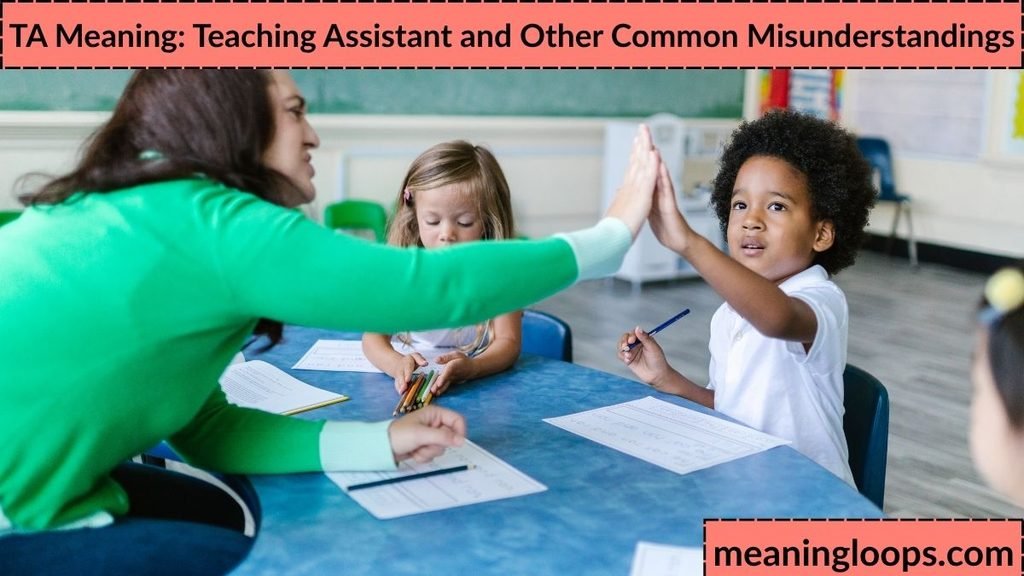
Capital letters change everything. TA often means teaching assistant. Colleges and schools use the term daily.
In the US, a TA is typically a graduate student who leads discussion sections and grades work. In UK schools, a teaching assistant supports the class teacher and helps pupils directly.
Clues you’re reading the school meaning:
- The word is capitalized.
- The message mentions grades, office hours, or a course.
- It appears in a class group chat.
Example: “Email the TA about the deadline.”
Merriam-Webster also lists another use. In psychology, TA can stand for transactional analysis. Some workplaces also use technical assistant as a job title. Those are common misunderstandings worth knowing about, though you’ll meet them rarely in casual texts.
TA in Chinese Texting
In Mandarin pinyin, the characters 他 (he), 她 (she), and 它 (it) all sound like “tā.” Many Chinese speakers type “TA” as a handy gender-neutral pronoun. This has nothing to do with gratitude.
For international chats, this matters. A Chinese-speaking friend who writes “TA” in a pinyin sentence means “he,” “she,” or “they.” They aren’t thanking you.
English learners can use a simple test. Look at the rest of the sentence. If it contains pinyin, “TA” is a pronoun.
How to Tell Which Meaning Someone Intends
Run through this short checklist:
- Is it capitalized? “TA” leans toward teaching assistant.
- Did you just do something helpful? Lowercase “ta” probably means thanks.
- Is the topic school or work? Think teaching assistant.
- Is the sender from the UK, Ireland, Australia, or New Zealand? Thanks is likely.
- Is the sentence in pinyin? Think pronoun.
When none of that settles it, just ask. A quick “Ta as in thanks?” costs you five seconds.
Is Ta Rude? and Slang?
Is ta rude? No. Is ta slang? Yes, mildly. It’s colloquial language and a staple of everyday expressions. Most people read it as friendly.
Tone still depends on the situation. A one-word “ta” after a long, thoughtful favor can feel brisk. In a heated chat, it may even land as a dismissive tone. Reading the relationship helps.
Can ta be used sarcastically? Yes. Imagine a friend who spilled coffee on your notes. You might type “Ta for that 🙄.” The sarcastic tone comes from punctuation, emojis, and context.
Can I Use Ta in Emails?
Mostly no. In a formal email or any professional communication, “ta” can seem too casual. Stick with “thank you” or “thanks” there.
The rule on informal vs formal is simple:
| Setting | Use ta? |
|---|---|
| Friends and family | Yes |
| Casual work or professional settings (close team chat) | Sometimes |
| Job applications | No |
| First email to a client | No |
| Messages to a professor | No |
Where Is Ta Commonly Used? Regional and Cultural Notes
Ta belongs to a handful of regions.
- UK English and British English: Common, informal, widely understood.
- Ireland: Familiar and used casually.
- Australian English and Australian slang: Used informally. “Ta heaps” has a distinctly Aussie ring.
- New Zealand English: Similar casual usage.
- US and Canada: Uncommon. Many people there read “ta” as a typo or as “TA” for teaching assistant.
- Chinese-speaking users: The pinyin pronoun meaning dominates.
In Western culture more broadly, “thanks” and “thx” remain the usual picks. Global internet usage has helped “ta” travel through pop culture, memes, and the way chat spread through texting. Still, it hasn’t become universal. Linguists who study short, playful forms of speech see it as one more example of baby talk becoming adult shorthand. Nothing suggests it’s taking over the world.
How to Respond When Someone Texts Ta
Keep it light. Match their energy. Here’s how to respond to ta:
| Style | Reply |
|---|---|
| Casual | “No worries!” |
| Friendly | “You’re welcome!” |
| Warm | “Happy to help.” |
| Relaxed | “All good.” |
| Easygoing | “Anytime.” |
| Very brief | “Np” |
If they sent “ta mate,” you can answer “No worries, mate.” If they sent a formal thank-you, a short “You’re welcome” suits better. Mirror their style and you’ll sound natural.
Common Misunderstandings About Ta
- Reading it as a typo. Some people assume “ta” means “to,” “tea,” or “ya.” Context usually clears that up.
- Assuming it’s rude. It isn’t. It’s brief.
- Using it with the wrong crowd. In a US business chat, “ta” may confuse people.
- Mixing it up with ta-da. One is gratitude. The other is a flourish.
- Overusing it. Peppering every message with “ta” can feel odd outside close circles.
FAQs
Is ta British slang?
Yes. Dictionaries label it British. It’s also used in Ireland, Australia, and New Zealand.
Is ta rude?
No. It’s informal but friendly. It simply suits casual chats better than formal ones.
What does TA mean in school?
It means teaching assistant. Context like grades or class sections confirms it.
Can I use ta in an email?
Only in relaxed emails to people you know well. Choose “thank you” for formal email.
What does ta-ta mean?
It means goodbye. The word began as baby talk in the 1820s.
What does TA mean in Chinese chats?
It’s a pinyin pronoun for he, she, or it. It has no link to thanks.
Conclusion
Ta meaning in text boils down to one friendly idea: thanks. It began as baby talk in the 1700s and stayed because it feels warm and quick. Lowercase “ta” usually signals gratitude. Capital “TA” usually points to a teaching assistant.
So next time a lone “ta” lights up your screen, don’t sweat it. Someone just said thanks. Reply with a quick “no worries” and move on.
Read
Glib Meaning: What “Glib” Really Means, How It’s Used, and Why It Matters Today
BBW Meaning: What It Really Means, Where It Came From, and How People Use It Today
What Does DMS Mean in Text? The Complete 2026 Guide to Understanding “DMS” in Messages

David Miller is the lead content writer at Meaning Loops, where he creates accurate and easy-to-understand content on word meanings, synonyms, antonyms, idioms, phrases, acronyms, abbreviations, and vocabulary. His goal is to help readers improve their English with reliable, well-researched, and SEO-friendly language resources.










2 thoughts on “TA Meaning in Text: What It Really Means and How People Use It Today”