If you’ve ever paused mid-sentence wondering whether to write Tought vs Taught: Which Word Is Correct” you’re not alone. This mix-up shows up constantly in emails, essays, and social media posts, and honestly, it’s one of the easiest spelling mistakes to make in the English language. The good news? There’s a clear, permanent answer, and by the end of this article you won’t second-guess it again.
Let’s settle the taught vs tought debate once and for all, and dig into why this confusion happens in the first place.
The Quick Answer
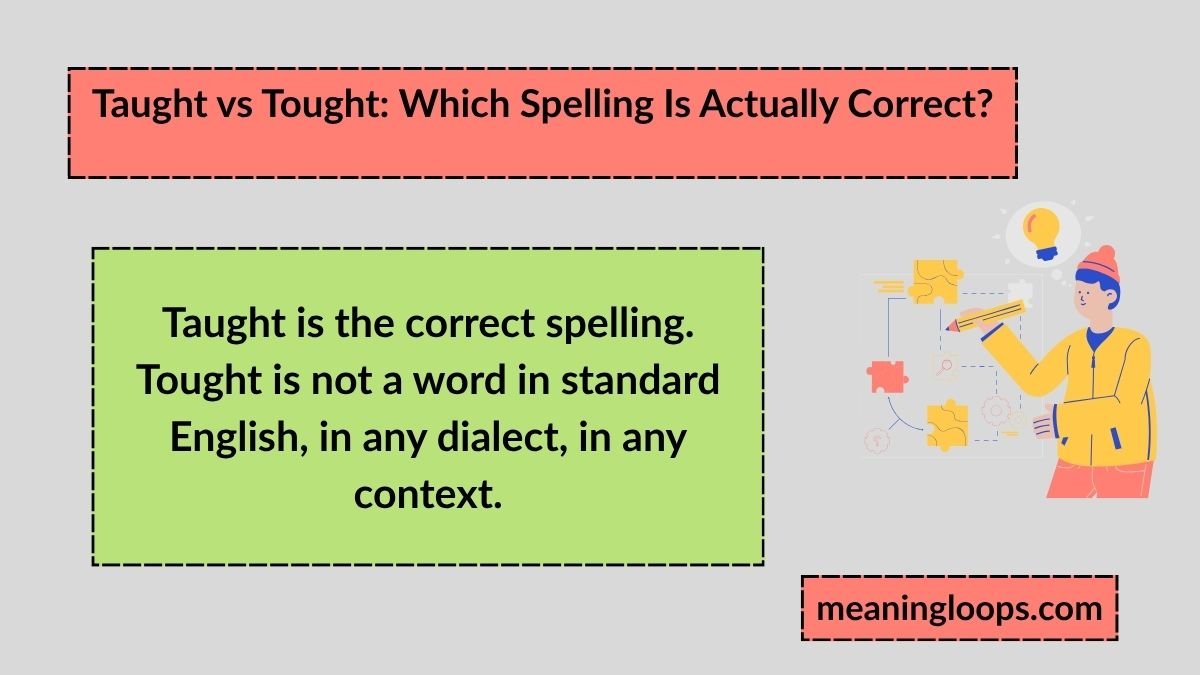
Taught is the correct spelling. Tought is not a word in standard English, in any dialect, in any context.
Taught is the past tense and past participle of the verb “teach.” Taught vs Tought doesn’t exist anywhere in a dictionary, a grammar textbook, or a style guide. It’s simply a common misspelling, usually born from how English handles the “-ought” and “-aught” sound patterns.
Here’s the short version in table form:
| Word | Correct? | Meaning |
|---|---|---|
| Taught | ✅ Yes | Past tense/participle of “teach” |
| Tought | ❌ No | Not a real word; a misspelling |
If you remember nothing else from this article, remember this: whenever you mean “instructed” or “educated,” the word you want is taught.
Why “Tought” Isn’t a Word
It’s worth explaining this clearly because English is full of odd exceptions, and learners sometimes assume that if a word “looks right,” it might be an accepted variant somewhere. That’s not the case here.
Tought isn’t:
- An archaic or old English spelling
- A regional or dialect variation
- An acceptable informal shorthand
- Used in any recognized English-speaking country
It’s simply an error, almost always caused by mixing up the letter order in “-aught” or blending it with similar-looking words like “Taught vs Tought Spell-checkers usually flag it immediately, which is one reason it doesn’t show up much in polished, professionally edited writing. But it’s incredibly common in first drafts, text messages, and quick typing.
What Does “Taught” Mean?
Definition and Part of Speech
Taught is a verb. Specifically, it’s the past tense and past participle form of “teach.” When someone taught you something, they gave you instruction, guidance, or training on a subject or skill.
The Merriam-Webster definition of “teach” centers on causing someone to know or understand something, or to give instruction. So “taught” simply places that action in the past.
Taught in a Sentence
Seeing the word in context makes it stick a lot faster than memorizing a rule. Here are several examples across different everyday situations:
- “My grandmother taught me how to bake bread from scratch.”
- “She has taught high school chemistry for over fifteen years.”
- “He taught himself to code using free online resources.”
- “The coach taught the team a new defensive strategy.”
- “I was taught to always double-check my work before submitting it.”
- “Life taught her patience in ways school never could.”
Notice how “taught” works whether the subject is a person, a school, or even an abstract experience like “life.” That flexibility is part of why it shows up so often in both formal writing and casual conversation.
The Grammar of “Taught”
Taught as Simple Past Tense
When you’re describing a completed action in the past, taught does the job:
“I taught yoga classes last summer.”
The action happened, it’s finished, and there’s no ambiguity about timing.
Taught as Past Participle
Taught also pairs with helping verbs like “has,” “have,” or “had” to form perfect tenses:
“She has taught over a thousand students during her career.” “By the time he retired, he had taught for three decades.”
This is the same pattern you’ll see with most irregular verbs in English: one form covers both the simple past and the past participle.
The Irregular Verb Pattern
Here’s where a lot of the confusion actually starts. Regular English verbs just add “-ed” for the past tense: walk becomes walked, talk becomes talked, and so on. Teach doesn’t follow that rule.
| Base Form | Simple Past | Past Participle |
|---|---|---|
| Teach | Taught | Taught |
Since teach is an irregular verb, your brain can’t rely on the usual “-ed” pattern, which is exactly why some people instinctively reach for something that “looks” past-tense, like tought, without realizing it’s not a recognized form at all.
Why People Misspell “Taught” as “Tought”

The “ough” Problem in English
English spelling has a well-earned reputation for being inconsistent, and the “-ough” letter combination is one of the biggest offenders. Consider how differently these words are pronounced despite looking similar:
- Though (rhymes with “go”)
- Through (rhymes with “true”)
- Cough (rhymes with “off”)
- Bought (rhymes with “hot”)
- Thought (rhymes with “hot”)
- Rough (rhymes with “cuff”)
With that much inconsistency baked into the language, it’s no surprise that people sometimes guess wrong when spelling a word like “taught,” which shares that “-aught” pattern with words like “caught” and “thought.” The brain reaches for a familiar-looking pattern, and “tought” ends up feeling plausible even though it’s incorrect.
Autocorrect and Typing Speed
There’s also a much simpler explanation: typos. When you’re typing quickly, it’s easy to swap the “a” and “o,” especially since both letters sit close together conceptually in words like “thought” and “bought.” Autocorrect tools catch this most of the time, but not always, especially on mobile keyboards where suggestions sometimes miss less common errors.
How to Pronounce “Taught”
Phonetic Breakdown
Taught is pronounced /tɔːt/, which sounds like “tawt.” It’s a single syllable, and the “augh” combination produces a broad “aw” sound rather than anything close to how it looks on the page.
Rhymes With
If you want a quick pronunciation anchor, taught rhymes with:
All of these share that same “aw” vowel sound, which is a helpful pattern to recognize since it applies to a whole family of irregular past-tense verbs.
Taught vs. Thought: Don’t Mix These Up
This is arguably the most common real-world confusion, since taught and thought look almost identical and share that “-ought” ending.
Side-by-Side Comparison
| Word | Base Verb | Meaning | Example |
|---|---|---|---|
| Taught | Teach | To have instructed or educated someone | “He taught economics at the university.” |
| Thought | Think | Past tense of “think”; a mental process or idea | “I thought about the offer for days.” |
Memory Trick to Tell Them Apart
Here’s a simple way to keep them separate: taught relates to teach (both start with “t-e” sounds if you say them slowly), while thought relates to think. If you can mentally swap in “teach” or “think” and the sentence still makes sense, you’ve picked the right word.
Quick test:
- “She taught me French.” → Works with “teach”: She teaches me French. ✅
- “I thought about it.” → Works with “think”: I think about it. ✅
Taught vs. Tought vs. Taut: A Three-Way Mix-Up
There’s a third word that occasionally gets tangled into this confusion: taut. Unlike tought, taut is a completely legitimate English word, just with a totally different meaning.
Taut describes something pulled tight, with no slack, whether that’s a rope, a muscle, or even a tense atmosphere in a room.
- “The tightrope walker checked that the wire was taut before stepping onto it.”
- “Years of training left her muscles taut and strong.”
So to recap the full picture:
| Word | Real Word? | Meaning |
|---|---|---|
| Taught | ✅ Yes | Past tense of “teach” |
| Taut | ✅ Yes | Tight, with no looseness |
| Tought | ❌ No | Misspelling; not a real word |
Simple Tricks to Never Misspell “Taught” Again
The “au” Memory Rule
One easy trick: remember that taught contains the letters a-u, in that order, just like “caught,” “bought,” and “fought.” If you find yourself writing “o-u” instead, stop and swap it.
Associate It With “Caught”
Since teach and catch are both irregular verbs that follow the same “-aught” pattern in their past tense (taught, caught), pairing them mentally can reinforce the correct spelling:
“I caught the ball” pairs with “I taught the class.”
If you can spell one confidently, you can usually spell the other the same way.
Is “Taught” Used the Same Way in British and American English?
Good news here: there’s no difference. Taught is spelled and used identically in British English, American English, Australian English, and every other major English dialect. Unlike words such as “colour” versus “color” or “realise” versus “realize,” this one doesn’t have regional spelling variants to worry about.
Frequently Asked Questions
Is “tought” ever correct?
No. Tought is not a recognized word in any standard English dictionary or style guide. It’s always a spelling error for “taught.”
What’s the difference between taught and thought?
Taught is the past tense of “teach” (to instruct). Thought is the past tense of “think” (a mental process or idea).
What’s the difference between taught and taut?
Taught relates to teaching. Taut describes something physically or figuratively tight, like a rope or a tense situation.
How do you pronounce taught?
It’s pronounced “tawt” (/tɔːt/), rhyming with caught, bought, and fought.
What’s the past participle of teach?
Taught. It’s the same word for both the simple past tense and the past participle, since teach is an irregular verb.
Does spell-check always catch “tought”?
Usually, yes, since it’s not a recognized word. But some quick-typing tools or informal messaging apps may not flag it right away, so it’s worth proofreading manually.
Is taught used the same way in UK and US English?
Yes. The spelling and usage are identical across all major English-speaking regions.
Conclusion
The rule here is refreshingly simple: taught is correct, and tought isn’t a word at all. The confusion mostly comes down to how unpredictable English spelling can be, especially with tricky letter combinations like “-ough” and “-aught.” Once you connect taught to its base verb “teach,” and remember that it rhymes with words like caught and bought, the correct spelling becomes second nature.
Next time you’re writing about a lesson learned, a skill picked up, or a teacher who made a difference, you’ll know exactly which word belongs on the page.
Read
Lifetime or Life Time: What’s the Real Difference?
HBU Meaning in Conversation: What Does HBU Stand For? (2026 Guide)
Later or Later On? How to Choose the Right One Every Time

David Miller is the lead content writer at Meaning Loops, where he creates accurate and easy-to-understand content on word meanings, synonyms, antonyms, idioms, phrases, acronyms, abbreviations, and vocabulary. His goal is to help readers improve their English with reliable, well-researched, and SEO-friendly language resources.