You’re scrolling through a group chat, and someone drops “that show was so PG.” Or maybe a friend texts “pg 45 has the answer” right after you asked about a study guide. Or, out of nowhere, someone replies to your story with just “pg.” Three totally different vibes, same two letters.
If you’ve ever paused mid-conversation wondering what does PG mean in text, you’re not overthinking it — PG genuinely is one of the more context-dependent abbreviations in modern texting. This guide breaks down every real meaning of PG in texting, shows you how to instantly tell which one someone means, and gives you real conversation examples so you never have to guess again.
By the end, you’ll know the three core meanings of PG, how they show up across platforms like WhatsApp, Discord, and TikTok, how PG differs from PG-13, and exactly when (or when not) to use it yourself.
What PG Means in Text
In most cases, PG in a text message means one of three things: Parental Guidance (borrowed from movie and TV ratings, used to describe something as clean or family-friendly), Pretty Good (casual slang used as a quick, mildly enthusiastic reply), or Page (shorthand used in notes, study guides, or document references, usually followed by a number).
Here’s the fastest way to remember it:
| If PG appears… | It usually means… |
|---|---|
| After a movie, show, or content description | Parental Guidance |
| As a one- or two-word reply to “how was it?” | Pretty Good |
| Before or after a number (pg 12, pg 45) | Page |
Now let’s look at each meaning in depth.
The 3 Main Meanings of PG in Texting
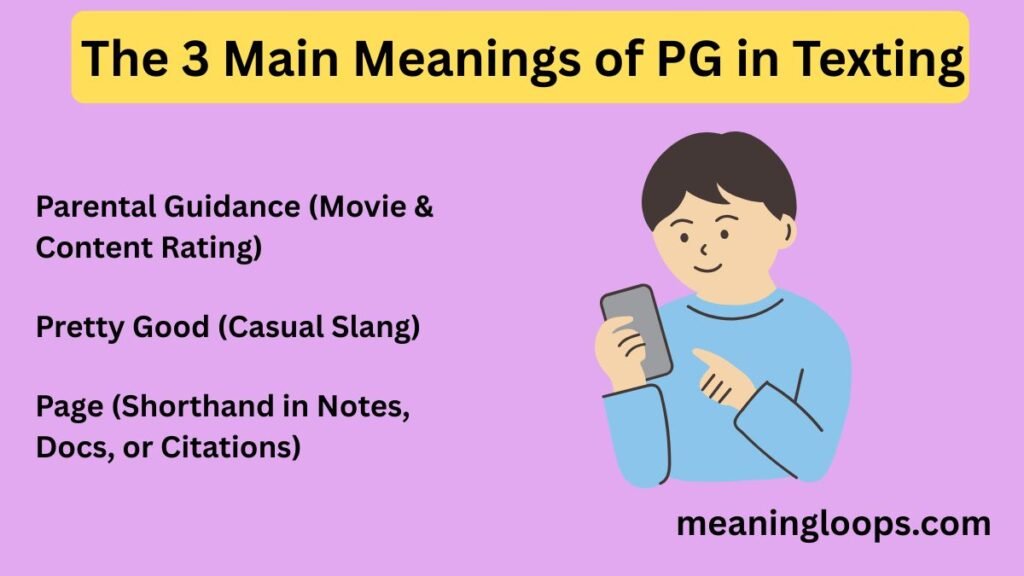
Parental Guidance (Movie & Content Rating)
The most widely recognized meaning of PG is Parental Guidance, a rating system used by the Motion Picture Association (MPA) in the United States and similar bodies internationally, like the British Board of Film Classification (BBFC) in the UK. A PG rating means a film or show may contain material that parents might find unsuitable for young children, but it’s not restrictive enough to require an outright warning.
This meaning has drifted directly from cinema into texting slang. When someone texts “that movie was pretty PG,” they’re not filing an official rating — they’re describing something as clean, mild, or appropriate for a general audience, often in a slightly joking or exaggerated way.
Key facts about PG as a content rating:
- The MPA introduced the PG rating in 1972, replacing the earlier “M” (Mature) rating, according to the Motion Picture Association’s rating history.
- PG sits between G (General Audiences) and PG-13 on the U.S. rating scale.
- The BBFC uses “PG” too, but its guidance criteria differ slightly from the MPA’s — a film rated PG in the UK isn’t automatically PG in the US.
- Streaming platforms like Netflix and Disney+ display PG ratings directly on title cards, which is part of why the term stays so present in everyday conversation.
Pretty Good (Casual Slang)
In casual texting slang, PG frequently stands for Pretty Good. This usage has nothing to do with movies — it’s a quick, low-effort way to respond positively to a question without sounding overly excited or writing a full sentence.
Think of it as a cousin to other short texting replies like “nm” (not much) or “k” (okay). It’s efficient, slightly understated, and very common among younger texters and in group chats where speed matters more than formality.
Example use case: Someone asks “how’d the interview go?” and you reply “pg tbh, could’ve been better.” Here, PG is doing the emotional work of “fine, not amazing, not bad” in two characters.
Page (Shorthand in Notes, Docs, or Citations)
The third common meaning is simply Page, almost always paired with a number. This shows up in academic contexts, study groups, and any conversation involving shared documents.
Common formats you’ll see:
- “check pg 12 for the diagram”
- “answer’s on pg. 45“
- “reread pg 3–5 before class”
This usage predates texting entirely — “pg.” has been standard academic and editorial shorthand for “page” for decades, especially in citation styles like MLA and APA. Texting just carried it over because it’s faster to type than the full word.
How to Tell Which Meaning Someone Means
Since PG has multiple meanings, context is everything. Here’s a simple way to figure it out fast.
Context Clues to Look For
- A number right next to it → almost certainly Page.
- A movie, show, or content description nearby → almost certainly Parental Guidance.
- A one-word or short-phrase reply to a question about quality, mood, or an experience → almost certainly Pretty Good.
- Capitalized “PG” standing alone with no other context → lean toward Parental Guidance, since it’s the most universally recognized meaning.
Quick Decision Guide
Ask yourself these questions in order:
- Is there a number attached to it? If yes → Page.
- Does the sentence mention a movie, show, book, or content warning? If yes → Parental Guidance.
- Is it answering a “how was it” or “how do you feel” type question? If yes → Pretty Good.
- None of the above? Ask the sender — genuinely, that’s faster than guessing wrong.
Where PG Shows Up in Real Conversations
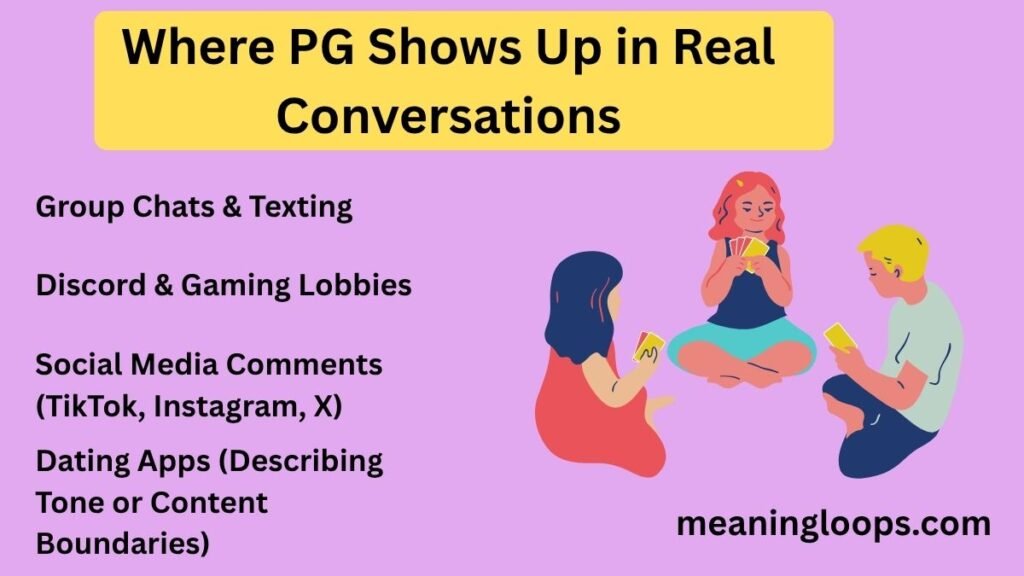
Group Chats & Texting
In everyday group chats, PG usually swings between Pretty Good and Parental Guidance, depending on what’s being discussed. If the chat’s talking about a show, PG is a rating reference. If it’s answering “how was your weekend,” it’s slang for decent.
Discord & Gaming Lobbies
In gaming spaces, PG takes on a slightly different flavor. It’s often used to describe chat behavior or content moderation — a “PG server” or “keep it PG” instruction means: no explicit language, no adult content, keep things clean. This is Parental Guidance in spirit, applied to community tone rather than a film.
Social Media Comments (TikTok, Instagram, X)
On TikTok, Instagram, and X (formerly Twitter), “keep it PG” is a common comment or caption instruction, usually meaning “don’t post anything explicit here.” PG meaning on Snapchat and PG meaning on Instagram typically follow this same content-tone logic rather than the “Pretty Good” slang sense, since these platforms revolve heavily around visual content moderation.
Dating Apps (Describing Tone or Content Boundaries)
On dating apps, someone might say their profile or conversation style is “pretty PG,” meaning they’re not looking for anything explicit or overly forward — it signals a wholesome, low-pressure tone upfront.
PG vs. PG-13 vs. Other Ratings in Slang
One of the biggest sources of confusion is mixing up PG and PG-13 in casual conversation. They’re related but distinct, and texters often use them loosely.
Comparison Table: PG, PG-13, NSFW, SFW
| Term | Full Meaning | Typical Use in Texting |
|---|---|---|
| PG | Parental Guidance | Mild content, generally clean, light joking tone |
| PG-13 | Parental Guidance – Under 13 | Content or jokes that are edgier but not fully explicit |
| NSFW | Not Safe For Work | Explicit, graphic, or inappropriate for public/work settings |
| SFW | Safe For Work | Clean, appropriate for any setting, opposite of NSFW |
Why People Confuse PG and PG-13 in Texting
Because both ratings share the “Parental Guidance” root, texters sometimes use them interchangeably to mean roughly the same thing: “not fully clean, but not explicit either.” Technically, though, PG-13 signals a noticeably higher tolerance for mature themes, language, or intensity than PG. If someone says a joke is “kind of PG-13,” they mean it’s edgier than something they’d call plain “PG.”
Real Example Conversations
Seeing PG in actual context makes the meaning click faster than any definition. Here are real-style conversation snippets for each sense.
“That Movie Was So PG” (Rating Sense)
Jordan: just watched that new family movie Sam: any good? Jordan: yeah but so PG, like barely any conflict lol
“Ngl That’s Pretty PG” (Slang Sense)
Alex: how was the party Taylor: honestly pretty pg, everyone left by 11
“Check PG 12 for the Answer” (Page Sense)
Mia: what’s the formula for question 4? Devon: it’s on pg 12, second paragraph
Where “PG” as Slang Came From
The slang sense of PG didn’t appear out of nowhere — it grew directly out of the movie rating system. Once Parental Guidance became a household term through decades of movie trailers and DVD covers, people started using “PG” loosely to describe anything mild, clean, or unremarkable, not just films. Over time, especially in texting and online chat where brevity rules, that loose descriptive use blended with the phonetically similar phrase “pretty good,” creating a second, unrelated slang meaning that now coexists alongside the original one.
This kind of semantic drift — where an official term picks up a casual, unofficial second meaning — is common in internet slang. Similar things happened with terms like “GG” (Good Game), which started in competitive gaming and expanded into general “well done” usage far outside gaming contexts.
When to Use PG — and When to Skip It
- Describing a movie, show, or piece of content’s tone (“the trailer looked PG”)
- Giving a quick, casual reply about how something went (“pg, nothing special”)
- Referencing a page number in shared notes or study material (“pg 8 has the summary”)
- Telling someone to keep a conversation or post appropriate (“let’s keep this PG”)
When It Reads as Vague or Confusing
- In a professional or formal message, where “Pretty Good” slang can look unpolished
- When there’s no context clue at all — sending just “PG” alone with nothing else forces the other person to guess
- In academic writing, where “Page” should be spelled out or use standard citation formatting (p. 12) instead of casual “pg”
- When talking to someone unfamiliar with texting shorthand, like an older relative or a new professional contact
Common Mistakes People Make With PG
- Sending PG without context. A lone “pg” text with nothing else forces the reader to guess which of three meanings you mean.
- Using PG in formal writing. Academic and professional documents should use “page” or the standard “p.” abbreviation, not casual “pg.”
- Confusing PG and PG-13 in serious conversations. If content tone actually matters (like recommending something to someone with kids), be precise rather than using PG loosely.
- Assuming everyone reads texting slang the same way. Younger and older texters don’t always share the same shorthand vocabulary — PG as “pretty good” is far more common among younger, casual texters.
Is PG Formal or Informal?
Acceptable Formal Use
PG is acceptable in semi-formal writing only when referring to an official movie or TV content rating — for example, in a review, a parenting blog, or a media recommendation. Even then, spelling out “Parental Guidance” once before using the abbreviation is good practice.
Informal/Texting-Only Use
Both the Pretty Good and Page shorthand uses of PG are strictly informal. They belong in texting, group chats, social media comments, and casual notes — not in emails, reports, resumes, or academic submissions.
Expert Tips for Using PG Correctly
If you want to use PG the way fluent texters do, a few small habits make a big difference:
- Pair it with context on the first mention. The first time you use PG in a conversation with someone, attach a hint — “that show was so PG (like, barely any swearing)” — so the meaning is locked in for the rest of the chat.
- Watch for regional and generational differences. Gen Z and younger millennials use “pretty good” PG far more casually than older texters, who are more likely to default to the movie-rating sense. If you’re texting an older relative or colleague, lean toward the Parental Guidance meaning by default.
- In moderation contexts, be specific. “Keep it PG” is a fine general instruction in a casual server or group chat, but if you’re actually setting rules for a community, spell out what “PG” covers (language, imagery, topics) so there’s no ambiguity.
- Don’t stack abbreviations. Piling PG next to other shorthand (“pg gg nm”) can make a message unreadable fast. One or two abbreviations per message keeps things clear.
Case Study: How Context Changes PG’s Meaning in One Chat
Here’s a real-style example showing how the same abbreviation shifts meaning within a single conversation, which is exactly the kind of situation that trips people up.
Riley: did you finish the reading yet Casey: almost, I’m stuck on pg 22 lol Riley: oh that whole chapter is kinda dry Casey: fr, honestly the book itself is only pg, nothing crazy happens Riley: lmk when you’re done, we can watch that new movie after Casey: bet, heard it’s rated PG so should be a light watch
In three messages, Casey uses PG for Page, then Pretty Good (describing the book’s tone), and Riley closes with Parental Guidance (the movie’s official rating). Nobody in this exchange gets confused, because each use is anchored by a nearby clue — a number, a description of tone, or the word “rated.” That’s the entire skill of reading PG correctly: catching the anchor word or number sitting right next to it.
Related Texting Slang Worth Knowing
PG isn’t the only short, context-dependent abbreviation floating around modern chats. Knowing a few neighbors helps you get better at reading shorthand generally.
| Abbreviation | Meaning | Typical Context |
|---|---|---|
| GG | Good Game | End of a match in gaming chat |
| OK / K | Okay | Quick acknowledgment |
| NM | Not Much | Reply to “what’s up” |
| IDK | I Don’t Know | Uncertainty in casual reply |
| SMH | Shaking My Head | Disapproval or disbelief |
| IMO | In My Opinion | Prefacing a personal take |
Like PG, most of these abbreviations only make sense in light of the sentence around them — which is really the core skill behind reading any modern texting abbreviation correctly, not just this one.
Frequently Asked Questions
What does PG mean in a text message?
In texting, PG most commonly means Parental Guidance when describing content tone, Pretty Good when replying casually to a question, or Page when followed by a number in notes or documents.
What does PG mean in movies vs. texting?
In movies, PG is an official content rating meaning Parental Guidance suggested — set by ratings boards like the MPA. In texting, PG keeps that same “mild/clean” connotation but is also used loosely as slang for “pretty good,” which has nothing to do with content ratings.
Does capitalization matter (PG vs pg)?
Not really. Both PG and lowercase pg are used interchangeably in texting, and capitalization doesn’t change the meaning — context does all the work, not case.
Is PG the same as PG-13 in slang?
No. PG in casual slang usually implies something mild or clean, while PG-13 implies content that’s noticeably edgier or more mature, even if it’s not fully explicit. People sometimes use them loosely, but they’re not identical.
What does PG mean on Discord or in gaming chat?
On Discord and in gaming chats, “keep it PG” is a common moderation instruction meaning “keep the conversation clean and appropriate,” directly borrowing from the Parental Guidance content-rating sense.
Is PG considered rude or dismissive?
Generally, no. As slang for “pretty good,” PG can occasionally read as unenthusiastic or low-effort if used as a one-word reply, but it isn’t inherently rude — it’s simply a brief, neutral-to-mildly-positive response.
Final Takeaway
PG is a small abbreviation carrying three genuinely different meanings, and the trick to understanding it isn’t memorizing a definition — it’s reading the context around it. A number nearby points to Page. A movie, show, or content mention points to Parental Guidance. A short reply to a “how was it” question points to Pretty Good. Once you’ve got that mental checklist, you’ll never have to second-guess a text with “PG” in it again — and now you can use it with confidence too.
Read more:
What Does IH Mean in Text? The Complete Beginner-Friendly Guide (2026)
What Does PTSO Mean in Text? Meaning, Uses, and Examples
What Does Story Mean on Instagram? The 24-Hour Feature Explained (2026)

Hi, I’m Andrew Wilson, the founder of Meaning Loops. I created this website to help people understand English words in a simple and easy way. Here, I share word meanings, synonyms, antonyms, idioms, phrases, grammar tips, and vocabulary guides. My goal is to provide clear, accurate, and useful content that helps students, writers, and English learners improve their language skills. Thank you for visiting Meaning Loops and being part of this journey.