You just got a text with a 💙 at the end, and now you’re stuck staring at your phone wondering what it actually means. Is it romantic? Is it just a friendly sign-off? Are they being polite, or are they trying to tell you something without saying it out loud?
Here’s the short answer: blue heart meaning almost never stands alone. It shifts depending on who sent it, what platform they used, and what came before it in the conversation. But there’s a strong, well-documented core meaning behind the color itself, and once you understand that, decoding any specific text gets a lot easier.
In this guide, you’ll learn exactly what a blue heart emoji means in texting, how the meaning changes based on your relationship with the sender, how it compares to other heart colors, and — most importantly — how to respond so you don’t send the wrong signal back. Let’s get into it.
What Does a Blue Heart Emoji Mean in Texting?
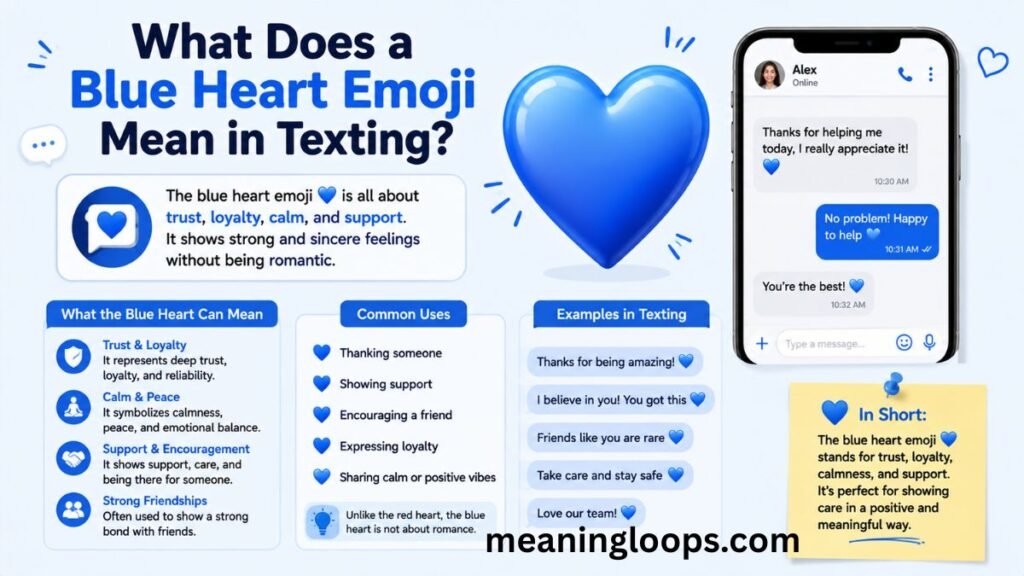
At its core, the 💙 blue heart emoji represents trust, loyalty, calm love, and platonic affection. It’s one of the “safer” heart emojis — the one people reach for when they want to show they care without turning up the emotional intensity.
Think of it this way: if ❤️ is a shout, 💙 is a steady hand on your shoulder. It says “I’ve got you” more than it says “I’m obsessed with you.”
Quick answer for anyone in a hurry: a blue heart in a text usually signals friendship, support, or calm affection. It can carry a light romantic undertone depending on context, but it’s rarely used the way a red heart is — as a bold declaration of passionate love.
That said, emoji meaning is never fixed in stone. Context and relationship between sender and recipient matter more than the emoji itself. A single 💙 from your best friend means something completely different from a 💙 that shows up after weeks of flirty texting with someone you’ve been seeing.
Where the Blue Heart Emoji Comes From
The blue heart emoji was approved as part of Unicode 6.0 in 2010 and has been available across major platforms since then. Like all colored heart emojis, it was designed as a variant of the standard red heart, giving users a way to add emotional nuance without switching to text.
Apple, Google, Samsung, and other vendors each render 💙 slightly differently in terms of shade and shape, but the Unicode Consortium’s official name for it is simply “Blue Heart,” and its semantic association with calm, trust, and stability has held steady across nearly every major emoji usage study since its release.
The Psychology Behind the Color Blue
Color psychology plays a real role here, and it’s not just internet folklore. Research on color perception consistently associates blue with calmness, trust, stability, and reliability — which is exactly why banks, tech companies, and healthcare brands lean so heavily on blue in their branding. Blue doesn’t trigger the same urgency or intensity that red does.
That psychological association carries directly into emoji use. When someone sends a blue heart symbol instead of a red one, they’re often (consciously or not) choosing a calm love signal over a passionate one. It’s affection with its volume turned down — present, genuine, but not overwhelming.
Key takeaway: the blue heart’s meaning isn’t random. It’s rooted in decades of color psychology research, and that’s exactly why it’s become the internet’s go-to symbol for trust, loyalty, and platonic affection.
Blue Heart Meaning by Relationship — Who Sent It Matters
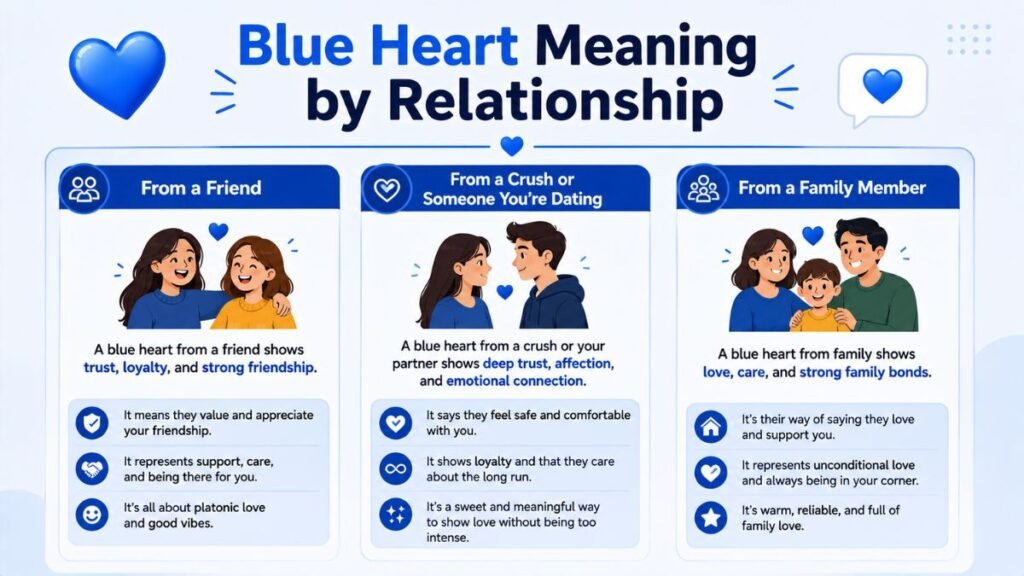
This is the part most guides skip, and it’s honestly the most useful section for you if you’re trying to decode an actual text you received. The blue heart emoji meaning shifts dramatically based on your relationship with the sender.
From a Friend
When a friend sends you 💙, it’s almost always about friendship, appreciation, and support. It’s the emoji equivalent of “I appreciate you” or “thinking of you.” Friends often use it to close out a supportive conversation, celebrate good news, or just say goodnight without anything romantic attached.
Example: “Thanks for listening to me vent earlier 💙” — this is a supportive gesture, nothing more.
From a Crush or Someone You’re Dating
This is where things get more nuanced. If you’re already dating someone or there’s mutual flirtation happening, a 💙 can carry a light romantic meaning — it’s affectionate, but it’s intentionally softer than a red heart. Some people use blue specifically because red feels “too much, too soon.”
If someone you’re into sends 💙 consistently, especially paired with attentive, engaged conversation, it’s often a sign they care but are pacing the relationship. It’s rarely used to signal disinterest.
From a Family Member
Family members frequently use 💙 to express family love and stable affection. A parent, sibling, or cousin sending a blue heart is expressing warmth and closeness, not romance (obviously) — but also often not the same intensity as a red heart, which can feel a bit dramatic in a family context.
From a Coworker or Acquaintance
In professional or semi-professional contexts, 💙 is a safe, low-risk way to express appreciation. A coworker might send it after you help them with a project or cover a shift. It reads as friendly and appreciative, never romantic, and it’s generally considered appropriate for professional communication in casual workplace chat tools like Slack or Teams — though it’s still worth reading the room before using it with someone above you.
In a Group Chat vs. a 1-on-1 DM
Context of the conversation itself matters too. A 💙 dropped into a group chat is almost always platonic — it’s a team support or group-appreciation signal (“love you guys 💙”). The same emoji sent in a private, 1-on-1 DM carries more personal weight, since it’s directed at one specific person rather than a crowd.
Blue Heart vs. Other Heart Emoji Colors — Comparison Table
One of the fastest ways to understand blue heart meaning is to see it next to the other heart colors. Here’s how the most common heart emoji meanings stack up:
| Emoji | Color | Primary Meaning | Emotional Intensity |
|---|---|---|---|
| ❤️ | Red heart | Passionate, romantic love | High |
| 💙 | Blue heart | Trust, loyalty, calm love | Low–Medium |
| 💚 | Green heart | Growth, nature, jealousy (playful) | Low–Medium |
| 💛 | Yellow heart | Friendship, happiness | Low |
| 💜 | Purple heart | Compassion, sometimes romantic curiosity | Medium |
| 🖤 | Black heart | Dark humor, edgy affection, sometimes sorrow | Varies widely |
| 🤍 | White heart | Purity, sincerity, minimalism | Low |
Blue heart vs. red heart is the comparison people search for most, and the difference comes down to intensity. Red heart meaning is direct and unmistakably romantic — it’s the emoji equivalent of saying “I love you.” Blue heart meaning is quieter and safer, which is exactly why so many people use it early in a relationship, in friendships, or when they want warmth without pressure.
Does the Emoji Sent With It Change the Meaning?
Yes — and this is an underrated part of decoding blue heart in messages. Emoji rarely travel alone, and the combination changes the emotional tone significantly.
💙 Alone
A standalone blue heart, especially at the end of a message, usually signals simple, genuine appreciation or affection. It’s clean and doesn’t add extra emotional weight.
💙 + 😂 or 😊
Paired with a laughing or smiling emoji, 💙 reads as casual and friendly. This combination is extremely common between friends and signals lighthearted warmth, not romantic interest.
💙 + 🥺
This pairing tends to signal emotional support or comfort — often used after someone shares something vulnerable or difficult. It says “I care about you and I’m here,” leaning more into comforting message territory than romance.
💙 + 🔥 or 😍
This combination is the exception to the “blue heart is calm” rule. When paired with 🔥 or 😍, the blue heart’s tone shifts toward genuine romantic or even flirtatious interest — the surrounding emoji do the heavy lifting here, pushing a normally calm symbol into more passionate territory.
Is a Blue Heart Romantic or Platonic? How to Tell
This is the single most searched question about this emoji, and the honest answer is: it depends on context, but there are real signals you can look for.
Signs It’s Platonic
- Sent in a group chat or to multiple people
- Used consistently in a friendship with no other flirtatious behavior
- Paired with casual language (“lol,” “haha,” “you’re the best”)
- Sent after a supportive conversation, not a romantic one
Signs There’s Romantic Interest
- Sent in a private 1-on-1 conversation with increasing frequency
- Paired with sustained, engaged conversation and quick replies
- Used alongside other soft romantic signals (compliments, late-night texting, asking personal questions)
- Sent after moments of vulnerability or personal sharing
Signs It’s Just a Habit
- The sender uses 💙 with everyone — friends, family, coworkers, alike
- There’s no notable change in tone or frequency around specific conversations
- It appears as a default sign-off, similar to “take care” or “talk soon”
Expert tip: If you’re genuinely unsure, look at the pattern over multiple conversations rather than reading too much into a single text. One 💙 tells you very little. A consistent pattern tells you a lot.
Other Common Meanings of the Blue Heart Emoji
Beyond personal relationships, the blue heart carries several widely recognized symbolic meanings tied to social movements and group identity.
Support for Autism Awareness
The blue heart (along with the puzzle piece symbol) has been used by some autism advocacy campaigns, most notably Autism Speaks, as a symbol of solidarity and support. It’s important to note this specific association is more common in certain regions and communities than others, and the broader autism community has an ongoing, publicly debated conversation about which symbols best represent the community.
Police / First Responder Support
In the United States particularly, the blue heart is frequently used online as a symbol of support for police officers and law enforcement, often alongside the “thin blue line” imagery. This usage is distinct from personal or romantic contexts and shows up mostly in social media posts and profile bios rather than private texting.
Sports Team or Fandom Symbol
Many sports teams whose primary color is blue see fans use 💙 in social media comments and posts to show team pride — think fans of teams like the Kentucky Wildcats, Chelsea FC, or the Los Angeles Dodgers. It functions as team or cause support, similar to how fans of other teams use hearts matching their team colors.
Identity and Community Use
Blue hearts also show up in various fandom and community contexts online — K-pop fan bases, for instance, frequently assign specific heart colors to specific artists or groups as part of fan culture, and blue is a common pick for several major acts.
How to Respond to a Blue Heart Text
Getting a 💙 is one thing — knowing how to respond without over- or under-reading it is another. Here’s a simple framework.
If You Want to Keep It Casual
Mirror the energy. Reply with a friendly message and, if it feels natural, send a 💙 or 😊 back. There’s no need to overanalyze it — treat it like the friendly gesture it most likely is.
If You Want to Signal Interest Back
You can escalate gently. Try replying with a warmer message and a slightly more affectionate emoji, like 😊 or even ❤️ if you’re genuinely feeling it. This tests the waters without being overwhelming.
If You’re Unsure What They Meant
Honestly, it’s okay to just ask — casually. Something like “aw, you’re sweet 😊 what’s got you feeling generous today?” opens the door for them to clarify their tone without putting either of you on the spot. Directness, delivered warmly, almost always beats guessing.
Blue Heart Usage by Platform
Digital communication habits vary a lot by platform, and 💙 usage shifts accordingly.
Instagram and TikTok Bios and Comments
On Instagram and TikTok comments, blue hearts are frequently used to show fandom support, team pride, or general appreciation in bios and comment sections. It’s common to see them stacked (“💙💙💙”) purely as a stylistic show of enthusiasm rather than deep personal meaning.
iMessage vs. Android vs. WhatsApp Rendering Differences
Emoji don’t always look identical across platforms. Apple’s 💙 render is a slightly deeper, richer blue, while Google and Samsung versions can appear a touch lighter or flatter. This rarely changes the meaning, but it’s worth knowing if you’re wondering why a screenshot from a friend’s Android phone looks slightly different from what you see on your iPhone. Across WhatsApp, Messenger, and SMS, the underlying meaning stays consistent even when the exact shade shifts.
Dating App Context
On dating apps like Bumble, Hinge, and Tinder, a 💙 tends to carry more direct romantic weight than it would in a casual friend text, simply because of the platform’s context — you’re both there with dating in mind, so even a “calm” emoji picks up more romantic implication than it would elsewhere.
Common Mistakes People Make With the Blue Heart Emoji
- Overusing it until it loses meaning. If you send 💙 to literally everyone in every conversation, it stops carrying any specific signal — people learn to read it as a verbal tic rather than genuine affection.
- Sending it in the wrong professional context. A blue heart to a close, casual coworker is usually fine; sending one to your boss or a client can come across as oddly personal.
- Misreading a habitual sender’s intent. If someone uses 💙 with everyone as their default sign-off, don’t assume it’s special just because they sent it to you.
- Assuming it always means “just friends.” While it often does, blue heart doesn’t automatically rule out romantic interest — check the surrounding context before drawing a firm conclusion.
Frequently Asked Questions
What does it mean when a guy sends you a blue heart?
It typically signals trust, appreciation, or calm affection rather than intense romantic interest. Context matters — a guy who’s consistently attentive and increasingly personal in conversation alongside the 💙 may be signaling early romantic interest, while one who uses it casually with everyone is likely just being friendly.
What does it mean when a girl sends you a blue heart?
Similarly, it usually reflects platonic affection or light romantic interest rather than a bold declaration. Girls often use 💙 specifically because it feels safer and less intense than a red heart, especially early in getting to know someone.
Is a blue heart flirty?
It can be, but it’s rarely flirty on its own. Blue heart romantic or platonic status depends heavily on the relationship, the conversation’s tone, and any accompanying emoji. Paired with 🔥 or 😍, it leans flirty. Sent alone after a casual conversation, it usually doesn’t.
What’s the difference between a blue heart and a red heart?
The blue heart vs. red heart distinction comes down to intensity and type of affection. Red heart meaning centers on passionate, romantic love — it’s direct and intense. Blue heart meaning centers on trust, loyalty, and calm love — it’s warmer but more restrained, making it appropriate for a much wider range of relationships.
Why do some people only use blue hearts and no other emoji?
Some people simply prefer blue as their go-to heart color because it feels safe, non-committal, and appropriate across nearly every relationship type — friends, family, and romantic interests alike. It’s a low-risk way to express warmth without over-committing to a specific emotional tone.
Does a blue heart mean “just friends”?
Not necessarily, but it’s often the safer, more neutral choice. Many people specifically pick 💙 over ❤️ because they want to keep things platonic or ease into a topic slowly. Still, it’s not a guaranteed “friend-zone” signal — always weigh it against the full conversation.
What does a blue heart mean on Instagram specifically?
On Instagram, 💙 commonly appears in bios, comments, and captions as a show of fandom support, team pride, or general appreciation, often used more casually and publicly than it would be in a private DM.
Conclusion
The blue heart 💙 is one of the most versatile symbols in texting. Now you know that this guide on What Does a Blue Heart 💙 Mean in Text? Full Meaning Guide (2026) shows it can mean trust, loyalty, calm friendship, or deep support, depending on who sends it. Context always matters more than the emoji itself. Look at the conversation, the relationship, and the words around it before deciding what someone truly means.
Texting is full of small symbols that carry big feelings, and the blue heart is a perfect example. This guide on What Does a Blue Heart 💙 Mean in Text? Full Meaning Guide (2026) gives you the confidence to read these messages correctly, whether it’s from a friend, a partner, or a family member. Use this knowledge to reply thoughtfully and avoid mixed signals. A simple blue heart can say a lot, and now you can understand exactly what it means.

Hi, I’m Andrew Wilson, the founder of Meaning Loops. I created this website to help people understand English words in a simple and easy way. Here, I share word meanings, synonyms, antonyms, idioms, phrases, grammar tips, and vocabulary guides. My goal is to provide clear, accurate, and useful content that helps students, writers, and English learners improve their language skills. Thank you for visiting Meaning Loops and being part of this journey.







1 thought on “What Does a Blue Heart 💙 Mean in Text? Full Meaning Guide (2026)”