Picture this: you’re halfway through an email, typing “we need to think…” and your fingers freeze. Different vs Differently You know both words exist. You’ve used both a thousand times. But right now, staring at the cursor, you genuinely can’t remember which one belongs.
If that’s ever happened to you, take comfort in the fact that you’re in very good company. This mix-up ranks among the most common grammar mistakes English speakers make, and not just English learners either. Native speakers slip on this one constantly, usually without even noticing.
The good news is that the rule behind different vs. differently isn’t some obscure grammar footnote buried in a textbook nobody reads. It’s actually one of the more logical patterns in English once you see how it works. This guide walks through the whole thing: what each word means, how to use it correctly, the common mistakes people make, and a few simple tricks that’ll make the decision automatic instead of a coin flip.
The Quick Answer (For Skimmers)
Let’s cut to the chase before diving into the details, because sometimes you just need the answer fast.
“Different” describes a noun. “Differently” describes a verb.
That’s the entire rule in one sentence. “Different” is an adjective, so it modifies things: people, places, objects, and ideas. “Differently” is an adverb, so it modifies actions: what someone does and how they do it.
- “They have different tastes in music.” (Different describes the noun “tastes.”)
- “They dress differently for every occasion.” (Differently describes the verb “dress.”)
Everything else in this article builds on that one distinction. Once it clicks, you’ll start spotting the pattern everywhere, in conversations, in articles, even in your own writing from years ago that you’ll suddenly want to go back and fix.
What Is “Different”? (Adjective)
“Different” belongs to a category of words called adjectives. If you remember anything from grammar class, it’s probably that adjectives describe nouns. They tell you something about a person, place, thing, or idea: its size, its color, its quality, or in this case, how it compares to something else.
Because “different” is fundamentally about comparison, noticing that one thing isn’t the same as another, it shows up constantly in everyday communication. Whenever you’re contrasting two options, describing variety, or pointing out that something has changed, “different” is usually the word doing the heavy lifting.
“Different” as an Adjective, Explained
Adjectives in English generally occupy one of two positions in a sentence. They can sit directly before the noun they describe, which grammarians call the attributive position, or they can follow a linking verb, known as the predicative position.
- Attributive: “She bought a different phone.”
- Predicative: “Her new phone looks different.”
Both sentences are grammatically sound, and both correctly use “different” because in each case, the word is attached to a noun (phone), not describing an action.
Common Sentence Structures With “Different”
Once you start paying attention, you’ll notice “different” tends to slot into a handful of recurring patterns. Here’s a breakdown of the most common ones:
| Structure | Example Sentence |
|---|---|
| Different + noun | “a different approach” |
| Article + different + noun | “a different perspective entirely” |
| Noun + linking verb + different | “The outcome seems different.” |
| Different from/than/to + noun | “This model is different from the last one.” |
| So/quite/very + different | “Their opinions are so different.” |
| Completely/totally + different | “It’s a completely different experience.” |
Notice how in every single structure, “different” attaches to a noun, either right before it or after a linking verb that circles back to describe it.
Examples of “Different” in Everyday Sentences
Real examples make the rule stick better than definitions ever could, so let’s look at how “different” shows up across a range of everyday contexts.
In daily life, you might hear things like “We’re trying a different grocery store this week” or “My neighbor has a completely different lifestyle than we do.” These sentences describe things, a store, a lifestyle, rather than actions.
In the workplace, “different” pops up constantly during meetings and planning sessions: “Let’s explore a different strategy for this quarter” or “The client requested a different color scheme.” Again, notice the pattern: strategy and color scheme are both nouns.
In academic settings, students and teachers alike lean on this word to compare ideas, texts, or theories: “The two historians present different interpretations of the same event” or “Each experiment produced different results.”
In casual conversation, “different” tends to show up in more relaxed, opinion-driven statements: “That movie had a really different vibe from the first one” or “Honestly, this restaurant just feels different since they remodeled.”
Across every single one of those examples, “different” is doing exactly one job: describing a noun. That consistency is what makes the rule so reliable once you internalize it.
What Is “Differently”? (Adverb)
Now let’s flip to the other side of the coin. “Differently” is an adverb, and adverbs have a different job entirely (pun very much intended). Instead of describing nouns, adverbs describe verbs, and sometimes adjectives or other adverbs too. Their main function is to answer questions like “how?”, “when?”, “where?”, or “to what degree?”
In the case of “differently,” the question it answers is almost always “how?” How did someone do something? How did an event unfold? How does one process, method, or behavior compare to another? Wherever there’s an action being described, “differently” is likely the correct choice.
“Differently” as an Adverb, Explained
Because adverbs modify verbs, “differently” typically sits close to the verb it’s describing, either directly after it or somewhere nearby in the sentence structure.
- “He solved the equation differently than his classmates.”
- “She reacted differently once she heard the full story.”
In both cases, “differently” isn’t describing a person or a thing. It’s describing how the action happened: how he solved the equation, how she reacted.
Examples of “Differently” in Sentences
Let’s run through the same range of everyday contexts we used for “different,” but this time watching for verbs instead of nouns.
In everyday situations, you might say “My dog behaves differently around strangers” or “I sleep differently when I travel.” Behaves and sleep are both verbs, actions being performed, so “differently” is the correct fit.
In business settings, this word shows up whenever processes, strategies, or performance are being discussed in terms of action: “Our team needs to communicate differently with remote employees” or “Sales performed differently across each region this quarter.”
In school and academic contexts, “differently” often describes learning styles, teaching methods, or problem-solving approaches: “Every student learns differently” or “The professor explained the concept differently than the textbook did.”
In relationships, this word frequently appears in conversations about communication and emotional expression: “We handle conflict differently” or “He expresses affection differently than I do.”
Handle, expresses, learns, communicate. Every one of these is a verb, and that’s exactly why “differently” belongs in each sentence.
Different vs. Differently: The Main Difference Explained
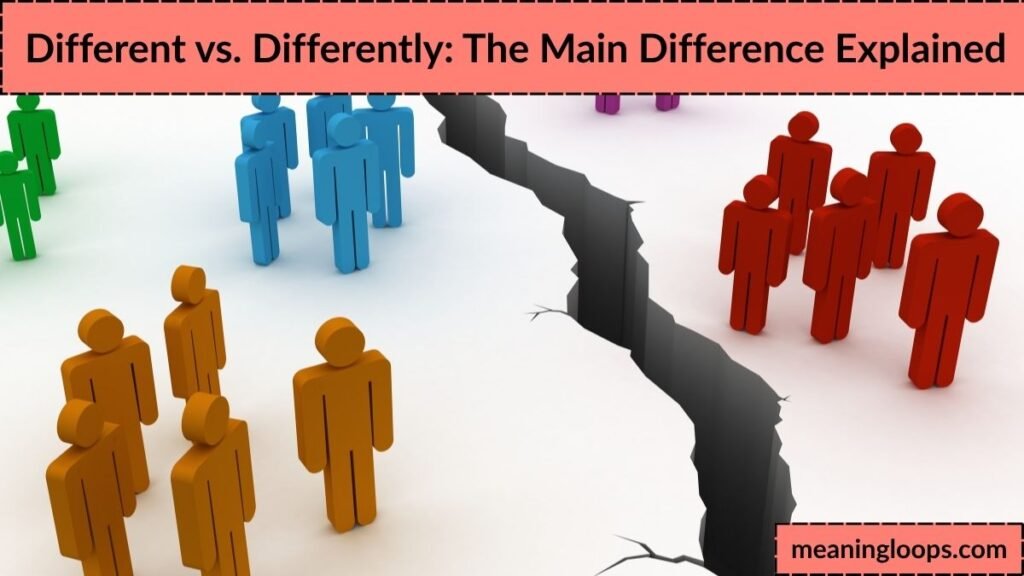
By now you’ve probably noticed the pattern repeating itself: nouns get “different,” verbs get “differently.” But let’s zoom out and look at why this distinction exists in the first place, because understanding the logic behind a rule makes it far easier to remember than just memorizing it by rote.
The Quick Grammar Formula
Here’s a simple formula you can keep in your back pocket:
Different = Adjective → Describes a THING (noun) Differently = Adverb → Describes an ACTION (verb)
This formula works because English, like most languages, sorts words into categories based on the job they perform in a sentence. Adjectives and adverbs might look similar (they often share a root word, as “different” and “differently” clearly do), but their grammatical function is completely different. One modifies things. The other modifies actions.
Example Breakdown
Let’s break down a few sentences piece by piece so you can see exactly how this formula plays out in practice.
Sentence 1: “They have different opinions.”
- Subject: They
- Verb: have
- Object: opinions (a noun)
- Modifier: different (describes “opinions”)
- Why “different” is correct: it’s modifying the noun “opinions,” not the verb “have.”
Sentence 2: “They think differently.”
- Subject: They
- Verb: think
- Modifier: differently (describes “think”)
- Why “differently” is correct: there’s no noun being modified here. The word is describing how the thinking happens.
Sentence 3: “This is a different situation, and we need to handle it differently.”
- This sentence actually uses both words correctly in the same breath. “Different” modifies “situation” (a noun), while “differently” modifies “handle” (a verb). It’s a great example of how both words can coexist naturally once you know which job each one is doing.
A Simple Trick to Never Confuse Them Again
Grammar rules are great, but sometimes what you really need in the moment is a fast mental shortcut. Here’s the one that works best for this particular pair of words.
The “-ly” Trick
Ask yourself: is this sentence answering the question “how?”
If yes, you need the “-ly” version: differently. If the sentence is instead describing a person, place, or thing directly, you need the plain version: different.
Let’s test this trick on a few sentences:
- “She approached the problem ___.” → How did she approach it? → differently
- “We had a ___ experience at the concert.” → What kind of experience? → different
- “He dances ___ than everyone else in the class.” → How does he dance? → differently
- “That’s a ___ perspective.” → What kind of perspective? → different
This trick works because it forces you to identify what’s actually being modified in the sentence, which is really the whole ballgame here. Most confusion around different vs. differently happens because people aren’t pausing to ask that question; they’re just going with whatever sounds vaguely familiar.
Different vs. Differently in Real Sentences
Let’s zoom out even further and look at why this particular mix-up happens so often, since understanding the root cause makes it much easier to avoid.
Why People Make This Mistake
There are a few overlapping reasons this error is so common, even among fluent and highly educated speakers.
First, “different” and “differently” share the same root, which makes them feel interchangeable even though they’re not. Your brain recognizes the shared spelling and assumes the words are more similar in function than they actually are.
Second, spoken English is forgiving. In casual conversation, dropping the “-ly” often doesn’t interrupt communication at all. If someone says “I think different about that now,” you’ll understand them perfectly, even though the sentence isn’t technically correct. Because the mistake doesn’t cause confusion, it doesn’t get corrected as often as it should, and it sticks around in people’s speech patterns.
Third, famous branding has muddied the waters. Apple’s decades-old slogan “Think Different” is probably the single biggest reason this mistake feels so natural to so many people. When a globally recognized brand uses a grammatically unconventional phrase millions of times over, it normalizes that phrase in the public consciousness, regardless of whether it’s technically correct.
Finally, linking verbs create genuine ambiguity. Verbs like “feel,” “seem,” “look,” and “taste” don’t describe actions in the traditional sense; they describe states of being. That makes it genuinely trickier to know whether “different” or “differently” belongs after them, which we’ll cover in detail in the next section.
Common Phrases With “Different”
Beyond the adjective-versus-adverb distinction, there’s a second layer of confusion worth addressing: the preposition that follows “different.” Do you say different from, different than, or different to? All three exist, and all three are used regularly, but which one sounds “correct” depends heavily on geography and context.
Different From
“Different from” is widely regarded as the most grammatically standard choice across both American and British English. It follows a logical structure, since you’re comparing one thing away from another, and it’s the version most style guides and grammar textbooks recommend by default.
- “This year’s results are different from last year’s.”
- “Her approach is different from her predecessor’s.”
Different Than
“Different than” is especially common in American English, particularly when what follows is a full clause rather than a simple noun phrase. It often sounds more natural than “different from” in these constructions because it avoids awkward phrasing.
- “This is different than I expected.” (compare to the clunkier “different from what I expected”)
- “The results were different than we predicted.”
Different To
“Different to” is primarily a feature of British English and Australian English. American readers may find it unfamiliar, but it’s completely standard and widely accepted in the UK and other Commonwealth countries.
- “Her opinion is different to mine.”
- “This year’s event feels different to last year’s.”
Which One Should You Use?
Here’s a simple table to help you decide:
| Phrase | Best Used In | Notes |
|---|---|---|
| Different from | American & British English | Most universally accepted; safest default |
| Different than | American English | Common before full clauses |
| Different to | British & Australian English | Rare in American writing |
For professional and academic writing aimed at a broad, international audience, “different from” remains the safest and most widely accepted choice.
Can “Different” Ever Replace “Differently”?
Formal vs. Informal English
Strictly speaking, no, the grammar rule doesn’t change based on how formal or casual the writing is. A verb still needs an adverb regardless of the setting. But in practice, informal and creative contexts allow for far more flexibility than formal writing does.
This is exactly why Apple’s “Think Different” slogan works as branding but wouldn’t fly in a business report. The slogan treats “different” almost like a concept or a noun phrase, similar to phrases like “think big” or “dream big,” rather than a strict grammatical modifier of the verb “think.” It’s a deliberate stylistic choice, made for punch and memorability, not a genuine grammar mistake slipping through unnoticed.
As one longtime copywriter put it: “In advertising, breaking a grammar rule on purpose is a tool. Breaking it by accident is just a mistake.” That distinction matters enormously.
In formal English, academic papers, business reports, professional emails, stick to the rule exactly as written. In informal English, texting, casual conversation, creative writing, some flexibility is culturally accepted, though it’s still worth knowing the “correct” version so you can make an informed choice rather than an accidental error.
Common Mistakes People Make With Different vs. Differently
Let’s take a closer look at the specific ways this mistake tends to show up, since recognizing the pattern in your own writing is the fastest way to eliminate it.
Using “Differently” After Linking Verbs
Linking verbs, like “be,” “seem,” “feel,” “look,” “taste,” and “smell”, don’t describe actions. Instead, they connect the subject of a sentence to a description of that subject. Because of this, they should be followed by an adjective, not an adverb.
- ❌ “This cake tastes differently than the last one.”
- ✅ “This cake tastes different than the last one.”
It’s easy to see why people get this one wrong: “tastes” looks like an action verb at first glance. But grammatically, it’s linking the subject (cake) to a description (different), not describing an action being performed.
Using “Different” Instead of “Differently”
This is the more famous version of the mistake, immortalized by that Apple slogan.
- ❌ “I think different about this now.”
- ✅ “I think differently about this now.”
“Think” is an action verb here, describing a mental process happening, so it needs the adverb “differently” to properly describe how the thinking is occurring.
Forgetting Context
Sometimes the error isn’t really about not knowing the rule; it’s about writing too quickly to apply it. Fast-paced communication, texting, dashing off an email, live conversation, leaves little room to pause and analyze sentence structure. The fix here isn’t more grammar knowledge; it’s simply building the habit of a quick re-read before hitting send.
Different vs. Differently in Professional Writing
In Business Writing
Business writing tends to favor precision and clarity above all else, which makes grammatical accuracy more important than it might be in casual conversation. Getting different vs. differently wrong in a report, proposal, or client-facing email can subtly undercut your credibility, even if the reader can’t quite articulate why the sentence feels off.
- “We recommend a different strategy going forward” (adjective, describing the noun “strategy”)
- “The team needs to approach onboarding differently” (adverb, describing the verb “approach”)
In Academic Writing
Academic writing holds an even higher bar for grammatical precision, since clarity and correctness are often directly tied to how credible and well-researched a paper appears to be.
- “The two studies produced different conclusions” (adjective)
- “Participants responded differently depending on the experimental condition” (adverb)
In both business and academic contexts, applying the different vs. differently rule consistently signals attention to detail, something that matters a great deal when your writing is being evaluated by colleagues, professors, or clients.
Memory Tricks to Never Forget the Difference
If the formal grammar explanation hasn’t fully cemented itself yet, here are a few mental shortcuts that tend to stick.
The Thing vs. Action Rule
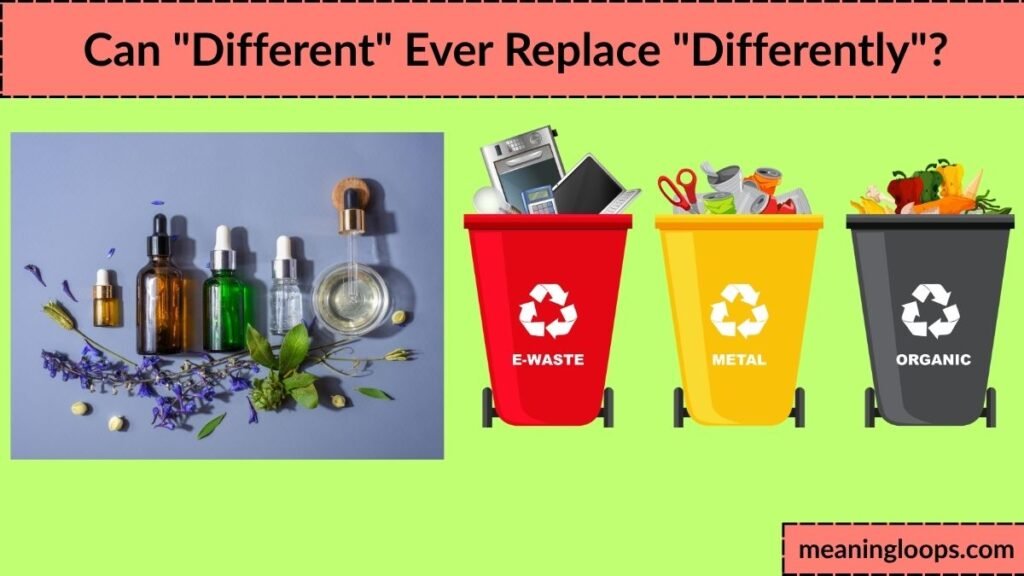
Picture two buckets: one labeled “Things” and one labeled “Actions.” Nouns go in the Things bucket. Verbs go in the Actions bucket. “Different” belongs exclusively to the Things bucket. “Differently” belongs exclusively to the Actions bucket. Whenever you’re unsure, just ask which bucket your sentence is dealing with.
The “How?” Test
Ask the sentence a question: does it answer “how?” If a sentence is explaining how something was done, “differently” is your answer. If it’s simply describing what kind of thing something is, “different” takes its place.
The “-ly” Reminder
Most adverbs in English end in “-ly”: quickly, slowly, quietly, differently. If you’re modifying a verb, that “-ly” ending is doing important grammatical work, don’t drop it just because it feels shorter or more casual without it.
Practice Quiz: Test Yourself
Time to put everything into practice. Fill in each blank with either “different” or “differently.”
- My two brothers have completely ___ personalities.
- She always solves problems ___ than her coworkers.
- This soup tastes ___ from how my mom used to make it.
- We need a ___ solution before the deadline hits.
- He behaves ___ whenever his parents are around.
- Every culture celebrates holidays ___.
- That’s a ___ opinion than the one you shared last week.
- The new manager runs meetings ___ compared to the old one.
Answer Key
- Different — describes the noun “personalities.”
- Differently — describes how she solves problems (verb: solves).
- Different — follows the linking verb “tastes,” describing the soup itself.
- Different — describes the noun “solution.”
- Differently — describes how he behaves (verb: behaves).
- Differently — describes how holidays are celebrated (verb: celebrates).
- Different — describes the noun “opinion.”
- Differently — describes how meetings are run (verb: runs).
If you got seven or eight correct, congratulations, you’ve officially mastered this rule better than the vast majority of native English speakers walking around today.
Quick Comparison Table: Different vs. Differently
Here’s a complete reference table pulling together everything covered in this guide:
| Feature | Different | Differently |
|---|---|---|
| Part of speech | Adjective | Adverb |
| Modifies | Nouns | Verbs |
| Answers the question | “What kind?” | “How?” |
| Typical position | Before a noun, or after a linking verb | Near the verb it modifies |
| Example sentence | “a different plan” | “planned differently” |
| Common prepositions | from, than, to | Rarely paired with prepositions |
| Formality flexibility | Occasionally bent in branding/slogans | Grammar rule applies more strictly |
FAQs
What is the main difference between Different and Differently?
“Different” is an adjective that describes nouns, things, people, ideas, or places. “Differently” is an adverb that describes verbs, telling you how an action was performed. The core distinction always comes down to grammatical role: thing versus action.
Is Different an adjective or an adverb?
“Different” is always an adjective. It never functions as an adverb, regardless of where it appears in a sentence. When you need to modify a verb, “differently” is the correct choice instead.
When should I use Differently in a sentence?
Use “differently” whenever you’re describing how an action happens or how something is done. If your sentence is answering the question “how?”, differently is almost certainly the word you need.
Why do people confuse Different and Differently?
The confusion largely stems from three factors: the words share the same root, spoken English often drops the “-ly” without causing confusion, and famous branding (like Apple’s “Think Different”) has normalized the grammatically unconventional version in everyday usage.
How can I remember the correct usage of Different vs. Differently?
The fastest method is the “how?” test: if your sentence answers “how?”, use differently. If it’s simply describing a noun, use different. Pairing that test with the thing-versus-action mental bucket makes the rule almost impossible to forget.
Conclusion
At its heart, the different vs. differently debate comes down to a single, reliable question: are you describing a thing, or are you describing an action? Nouns pair with “different.” Verbs pair with “differently.” Every exception, every stylistic bend, and every branding slogan built around breaking the rule still traces back to that one core distinction.
Grammar rules can feel intimidating in the abstract, but this particular one rewards you the moment you actually apply it. Next time you catch yourself hesitating mid-sentence, run the “how?” test, check whether you’re modifying a noun or a verb, and trust the pattern. It really is that straightforward once it clicks.
And Read
It Worth It or It Is Worth It? The Correct Way to Use “Worth” in English
What Does YU Mean in Text? Meaning, Uses & Examples (2026)
What Does RMB Mean in Text? Full Meaning, Uses & Real Examples (2026)

David Miller is the lead content writer at Meaning Loops, where he creates accurate and easy-to-understand content on word meanings, synonyms, antonyms, idioms, phrases, acronyms, abbreviations, and vocabulary. His goal is to help readers improve their English with reliable, well-researched, and SEO-friendly language resources.