You’re scrolling through a chat and someone types “miss yu” or “yu okay?” and for a second you pause. Is that a typo? A new slang word? Something you’re supposed to already know?
Here’s the short version: YU meaning in text almost always comes down to one thing — it’s a stylized, shortened way of typing “you.” Sometimes it also stands in for “why you,” depending on how it’s used in a sentence. That’s it. No secret code, no hidden meaning, just a fast, casual texting shortcut that’s taken over group chats, DMs, and comment sections.
In this guide, you’ll learn exactly what YU means in text, where it came from, which platforms use it most, how tone changes its meaning, and how to reply when someone sends it to you. By the end, you won’t just know the definition — you’ll know how to actually use it (or avoid it) with confidence.
What Does YU Mean in Text?
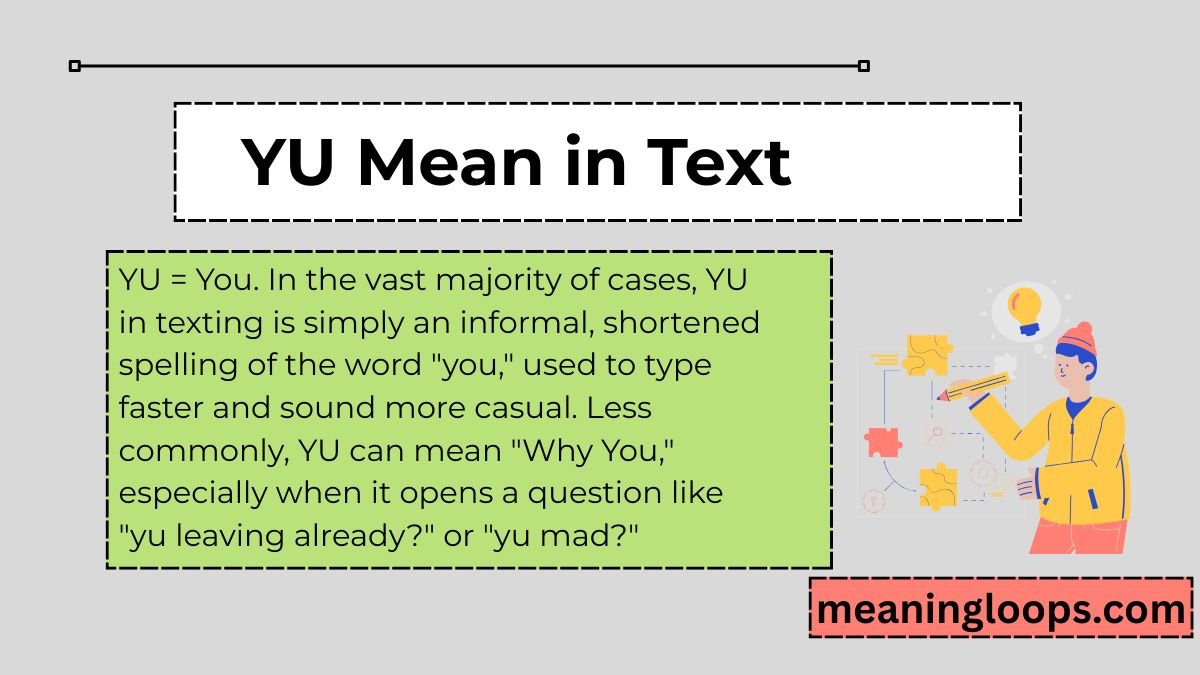
YU = You. In the vast majority of cases, YU in texting is simply an informal, shortened spelling of the word “you,” used to type faster and sound more casual. Less commonly, YU can mean “Why You,” especially when it opens a question like “yu leaving already?” or “yu mad?”
| Quick Facts | Details |
|---|---|
| Most common meaning | You |
| Secondary meaning | Why You (context-dependent) |
| Tone | Casual, friendly, sometimes flirty |
| Most common platforms | Snapchat, TikTok, Instagram, Discord, gaming chat |
| Formality level | Informal only — never use in professional writing |
| Typical users | Gen Z and younger Millennials |
This makes YU part of a much larger family of texting abbreviations — similar in spirit to “u,” “ur,” or “wyd” — that trade a little bit of clarity for speed and personality.
Where Did “YU” Come From?
Slang rarely has one clean origin story, and YU is no exception. It grew out of a mix of habit, convenience, and internet culture rather than a single viral moment.
Typo and Autocorrect Origin
A large share of “yu” messages started as accidents. On a mobile keyboard, it’s easy to drop or swap a letter when typing fast, and “you” missing its “o” becomes “yu” without anyone meaning to create slang at all. Over time, though, this “mistake” got noticed, repeated, and eventually adopted on purpose because it looked casual and quick.
Deliberate Slang Shortening
Texting culture has always rewarded speed. Shortening “you” to “yu” saves a keystroke, and in a culture built around rapid-fire replies, every keystroke saved adds up. This is the same logic behind “u” and “ur” — fast typing turned into a style choice, not just a shortcut.
Gaming and Discord Chat Culture
YU in gaming chats — think Discord, Roblox, and other in-game messaging systems — spread the term further. Gamers communicate under time pressure, often mid-match, so short, casual, typo-tolerant language became the norm. “yu there?” or “yu ready?” fits naturally into that fast-paced environment, and it carried over into everyday texting as gaming and social media audiences overlapped.
Is “YU” Always Slang? (Disambiguation)
Not every “YU” you see online is texting slang — context matters, and it’s worth ruling out the non-slang meanings first so there’s no confusion.
When YU Is Just a Typo, Not Slang
Sometimes “yu” really is just a typo with zero intended meaning. If it appears once in an otherwise normally-spelled message, it’s probably just a slipped keystroke rather than a deliberate stylistic choice. Context and repetition are the best clues — if someone uses “yu” consistently across many messages, it’s a style choice; if it shows up once in an otherwise formal message, it’s likely just YU typo territory.
Non-Slang Uses of “YU”
Outside of texting, “YU” also appears as a legitimate abbreviation in other contexts, and it’s worth knowing these so you don’t mix them up:
- Yale University — commonly abbreviated as YU in academic and sports contexts
- York University — a Canadian university that also uses the YU abbreviation
- Yeshiva University — a private university in New York
None of these have anything to do with YU slang meaning in texting — they’re simply institutional abbreviations that happen to share the same two letters.
Where Is “YU” Commonly Used?
YU meaning in chat shows up across nearly every major messaging and social platform, but its usage isn’t identical everywhere.
Popular Platforms
| Platform | How “YU” Typically Appears |
|---|---|
| Snapchat | Common in Snap captions and chat, often paired with emojis (“miss yu 🥺”) |
| TikTok | Frequent in comments and captions, especially on relationship or friendship content |
| Used in DMs and comment replies, often casual or flirty | |
| Less common, but still appears in casual group chats | |
| Messenger | Used similarly to WhatsApp, mostly among close contacts |
| Discord | Common in gaming servers and voice-chat-adjacent text channels |
YU on Snapchat and YU on TikTok tend to carry the most emotional or affectionate tone, since both platforms lean heavily into casual, close-relationship communication. YU on WhatsApp and Messenger, by contrast, show up more as a simple efficiency habit than a deliberate style statement.
Who Uses “YU” Most
The heaviest use comes from Gen Z and younger Millennial texters — groups that grew up typing on phones rather than computers, and for whom informal spelling is second nature rather than a rebellion against grammar. Non-native English speakers also use “yu” fairly often, sometimes because it visually mirrors phonetic spelling patterns from other languages.
Examples of “YU” in Real Conversations
Seeing YU in context makes the meaning click faster than any definition can. Here are realistic examples grouped by tone.
Friendly, everyday use:
A: yu around later? B: yeah, free after 6
Affectionate or romantic use:
A: i miss yu 💛 B: i miss yu too, can’t wait to see yu
Gaming chat use:
A: yu joining the next match? B: yeah gimme 2 min
Checking in on someone:
A: yu okay? haven’t heard from yu today B: yeah just busy, my bad
Playful or teasing use:
A: yu really said that 💀 B: i stand by it
Across these examples, the underlying word never changes — it’s always standing in for “you” — but the emotional tone shifts a lot depending on the relationship and the emojis attached to it.
Does Capitalization or Punctuation Change the Meaning?
Yes, subtly — and it’s a detail most guides skip.
“yu” vs “YU” vs “Yu”
- Lowercase “yu” is the default and most common form, reading as relaxed and low-effort in a good way.
- ALL CAPS “YU” tends to signal emphasis or heightened emotion — excitement, mock outrage, or a joking accusation (“YU DID NOT JUST SAY THAT”).
- Capitalized “Yu” (first letter only) is rare and often just a result of autocorrect capitalizing the start of a sentence, carrying no extra meaning on its own.
Emoji Pairing Effects
Emojis do most of the emotional heavy lifting. “miss yu 🥺” reads as sincere and soft, while “yu good?” with no emoji reads as neutral, everyday concern. Add a 😏 or 😉 and the same phrase suddenly reads as flirty. This is true of most texting shorthand, but it’s especially noticeable with YU because the word itself is emotionally neutral — the tone comes almost entirely from what surrounds it.
Is “YU” Friendly, Flirty, or Rude? (Tone Breakdown)
This is one of the most searched follow-up questions, and the honest answer is: it depends entirely on context.
Friendly Use
In most everyday chats, “yu” is simply a casual, warm way of addressing someone you’re comfortable with. “yu coming tonight?” or “yu funny” both read as light, easygoing, and friendly.
Flirty or Affectionate Use
Paired with soft language or heart emojis, “yu” becomes an affectionate tone marker. “yu cutie” or “i miss yu” leans romantic, especially between partners or people testing the waters of a relationship.
Neutral or Gaming Use
In gaming chats and fast-paced group conversations, “yu” is often just functional. “yu ready?” carries no emotional weight — it’s purely about coordination and speed.
When It Can Read as Rude
Used in a clipped, one-word reply — especially without punctuation or emoji, and especially in response to something serious — “yu” can come across as dismissive. “yu?” as a sole reply to a long, thoughtful message can feel curt or uninterested, so tone-matching the conversation matters.
Expert Tip: If you’re unsure how “yu” will land, mirror the energy of the person you’re texting. Casual, emoji-heavy conversations tolerate “yu” well; serious or vulnerable conversations usually call for the full word “you” instead.
When to Use (and Avoid) “YU”
- Texting close friends or a partner in a relaxed setting
- Fast-paced gaming or Discord chats
- Casual social media comments and captions
- Light, low-stakes conversations where tone is already established
When Not to Use YU
- Professional emails or workplace messaging
- Academic writing or school assignments
- First messages to someone you don’t know well
- Customer service or business communication
- Serious, emotional, or sensitive conversations where clarity matters most
In every one of these avoid-cases, the safer choice is always the formal alternative to YU — simply typing “you” in full.
“YU” vs Similar Texting Shortcuts
YU doesn’t exist in isolation — it’s part of a broader ecosystem of texting abbreviations that all trade formality for speed.
| Shortcut | Meaning | Typical Tone | Common Platform |
|---|---|---|---|
| YU | You | Casual, sometimes flirty | Snapchat, TikTok, Discord |
| U | You | Neutral, very common | All platforms |
| UR | Your / You’re | Neutral | All platforms |
| WYD | What You Doing | Casual, checking in | Snapchat, Instagram |
| WYB | Where You Been | Casual, checking in | Texting, Snapchat |
| HMU | Hit Me Up | Casual, inviting contact | Texting, social media |
| YH | Yeah | Casual affirmation | Texting, DMs |
U vs YU
Both mean “you,” and both are informal, but “U” is by far the more universally recognized most common abbreviation for you, while “yu” carries a slightly more stylized, intentional feel — it reads less like laziness and more like a deliberate texting personality.
YU vs WYD
These aren’t interchangeable. “YU” simply replaces the word “you,” while “WYD” asks a full question — “what you doing.” One is a pronoun swap; the other is a complete conversation-starter. You’ll often see them combined, as in “yu busy, wyd rn?”
Why Do People Use “YU” in Texting?
Faster Typing
Every dropped letter saves a fraction of a second, and across thousands of daily messages, that adds up to real time saved — a big part of why fast typing habits like this stick around.
Casual Communication
Informal spelling signals relaxed, low-pressure communication. Typing “yu” instead of “you” is a small but clear signal that a conversation isn’t formal.
Internet Culture
Modern internet slang rewards brevity and personality over textbook grammar. “YU” fits neatly into a broader culture of online shorthand that includes emoji, abbreviations, and intentional misspellings as style choices.
Gaming and Social Media
Fast-paced platforms — gaming chats, Discord servers, Snapchat streaks — reward quick replies over polished ones, which is exactly the environment where YU in gaming and YU on social media usage thrives.
Common Mistakes People Make With “YU”
- Using it in professional or academic writing — even in a casual-leaning workplace, “yu” reads as unprofessional in emails or reports.
- Assuming it always means “why you” — this meaning only applies in specific question contexts, not by default.
- Overusing it to the point of confusion — sprinkling “yu” into every sentence can make messages harder to read rather than more casual.
- Ignoring tone mismatches — sending a flirty-toned “yu” to someone in a professional or unfamiliar relationship can create awkwardness.
Best Practices for Using “YU”
- Match the formality level of the conversation before using it.
- Pair it with emoji or punctuation when you want to signal warmth, since the bare word carries little tone on its own.
- Default to full “you” with people you don’t know well, then follow their lead if they use shorthand first.
- Keep it consistent — switching between “you” and “yu” mid-conversation can look inconsistent or careless rather than stylistic.
Regional and Generational Differences
Gen Z vs Millennial Usage
Gen Z texters tend to use “yu” more freely and more often, treating it as a natural extension of typing rather than a deliberate slang choice. Millennials are more likely to use the fuller “u” or spell out “you” entirely, reserving “yu” for closer friends or romantic partners.
Non-Native English Speakers
Because “yu” visually resembles phonetic spelling in several languages, non-native English speakers sometimes adopt it naturally, associating it with how the word sounds rather than how it’s traditionally spelled in English.
Why Some People Get Confused by “YU”
YU slang confusion usually comes down to two things: unfamiliarity with the term itself, and the fact that its meaning shifts slightly with context. Older users or people outside heavy texting culture may not recognize it at all, mistaking it for a typo rather than an intentional abbreviation. This is common with most emerging texting shorthand — the gap between digital-native and less terminally-online communication styles.
Frequently Asked Questions About YU Meaning in Text
What does YU stand for?
YU most commonly stands for “you.” In certain question contexts, it can also stand for “why you,” but “you” is by far the more frequent meaning.
Is YU the same as U?
They’re very similar — both are informal texting abbreviations for “you” — but U is the more universally recognized and older shorthand, while YU has a slightly more stylized, deliberate feel.
Is YU rude?
Not inherently. YU is neutral to friendly in most contexts. It can read as dismissive only when used as a short, unpunctuated reply to something serious or emotional.
Is YU Gen Z slang?
It’s most heavily used by Gen Z and younger Millennials, yes, though it isn’t exclusive to any one generation — it’s simply most common among people who grew up texting on smartphones.
What does YU mean on Snapchat or TikTok specifically?
On both platforms, “yu” is typically used affectionately or casually, often paired with emojis, and appears frequently in captions, comments, and direct messages between close friends or partners.
Can I use YU in formal or professional messages?
No. Always use the full word “you” in professional emails, academic writing, or any formal communication where clarity and professionalism matter.
Why do people type YU instead of “you”?
Mostly for speed and casual style — it’s a small but recognizable way of signaling that a conversation is relaxed rather than formal.
Final Thoughts
At its core, YU meaning in text is refreshingly simple: it’s almost always just a casual, faster way of typing “you,” occasionally standing in for “why you” depending on the sentence. The real skill isn’t memorizing the definition — it’s reading the room. Match your platform, match your relationship with the person you’re texting, and let tone and emoji do the rest of the work.
Used well, “yu” is a small, low-stakes piece of modern texting slang that adds warmth and speed to casual conversation. Used in the wrong context — like a professional email — it can undercut you instead. Now that you know the difference, you’ll never have to wonder what “yu” means again.

Hi, I’m Andrew Wilson, the founder of Meaning Loops. I created this website to help people understand English words in a simple and easy way. Here, I share word meanings, synonyms, antonyms, idioms, phrases, grammar tips, and vocabulary guides. My goal is to provide clear, accurate, and useful content that helps students, writers, and English learners improve their language skills. Thank you for visiting Meaning Loops and being part of this journey.









1 thought on “What Does YU Mean in Text? Meaning, Uses & Examples (2026)”