You’re scrolling through a group chat, and someone drops a lone “frl?” in response to your last message. No context, no punctuation, just three letters staring back at you. Is it a typo? A new abbreviation you missed? Something you’re supposed to already know?
You’re not the only one who’s paused on this. FRL meaning in text is one of the more commonly searched texting abbreviations, especially among people who didn’t grow up chatting this way or who are just now seeing it pop up from younger friends, coworkers, or kids. By the end of this guide, you’ll know exactly what FRL means, where it came from, how to use it naturally, and — just as important — when to leave it out of a message entirely.
Key Takeaways
- FRL means “for real” (occasionally “for real life”) and is used to confirm truth, express agreement, or ask if someone is being serious.
- It traces back to AAVE, following the same path into mainstream texting slang as terms like “no cap” and “lowkey.”
- Tone depends heavily on punctuation, capitalization, and context — the same three letters can read as sincere, surprised, sarcastic, or flirty.
- FRL belongs in casual texting, social captions, and DMs — not professional or formal writing.
- It sits alongside FR, FRFR, NGL, and ONG in a small cluster of “confirm this is true” slang, each with a slightly different intensity and use case.
What Does FRL Mean in Text?
FRL stands for “for real.” Some people expand it to “for real life,” though “for real” is by far the more common reading. It’s a texting abbreviation used to confirm that something is true, to ask someone if they’re being serious, or to add sincerity and emphasis to a statement you genuinely mean.
Think of FRL as a texting-native stand-in for phrases like “seriously,” “no joke,” or “I’m not exaggerating.” If a friend tells you something wild and you reply with “frl?” you’re essentially asking, “Wait, are you actually serious right now?” If you use it to close out your own sentence — “that movie messed me up frl” — you’re telling the reader you mean it, not just being dramatic for effect.
Here’s the quick breakdown:
| Element | Detail |
| Full meaning | “For real” (sometimes “for real life”) |
| Function | Confirms truth, expresses agreement, or asks for confirmation |
| Formality | Strictly informal |
| Common on | TikTok, Instagram, Snapchat, iMessage, WhatsApp, Discord, Twitter/X |
| Typical users | Teens, Gen Z, and younger millennials |
| Capitalization | Both “FRL” and “frl” are correct — lowercase is more common in texting |
Understanding what FRL means in text is really about understanding intent, because the same three letters can land as agreement, disbelief, or genuine emphasis depending on what surrounds them. That flexibility is exactly what makes it useful, and exactly what makes it confusing the first time you see it.
Where Does FRL Come From?
Most texting slang doesn’t arrive out of nowhere, and FRL is no exception. The phrase “for real” has deep roots in African American Vernacular English (AAVE), where it’s long been used as a way to affirm honesty or challenge a claim in casual speech — essentially the spoken equivalent of “are you kidding me” or “I mean that seriously.”
As texting and social media took over as the primary way younger generations communicate, “for real” got compressed the way most frequently-typed phrases do. First it became “fr,” the shortest possible version. FRL added a letter back in — likely to preserve some of the rhythm of the spoken phrase, or simply because it felt like a more emphatic, deliberate version than the clipped “fr.”
This pattern isn’t unique to FRL. Texting culture consistently borrows heavily from AAVE and Black cultural expression, then adapts it for typing speed: “no cap,” “bet,” “lowkey,” and “highkey” all followed a similar path from spoken vernacular into mainstream digital slang. Recognizing that origin isn’t just trivia — it’s useful context for understanding why the phrase carries the tone it does, and why using it thoughtfully (rather than performatively) matters.
How People Actually Use FRL in a Text
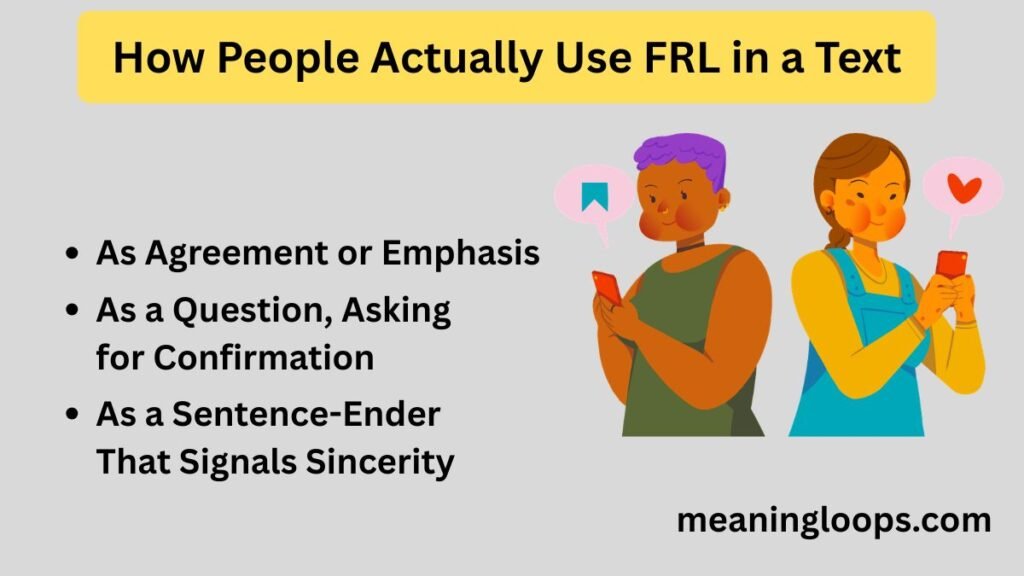
FRL isn’t a one-note word. Its meaning shifts slightly depending on where it sits in a sentence and what emotional weight the conversation already has. Here are the three main ways it shows up.
As Agreement or Emphasis
This is the most common FRL text meaning — a way to underline that you’re being genuine, not sarcastic or exaggerating.
- “That test was so much harder than I expected, frl.”
- “I’ve never seen a sunset like that frl.”
- “This is the best burger I’ve had all year, frl.”
In each case, FRL functions almost like punctuation. It’s a small verbal stamp that says “I mean this.”
As a Question, Asking for Confirmation
When someone sends a standalone “frl?” they’re asking you to confirm whether what you just said is actually true.
- A: “I got the job.“
- B: “wait frl??”
Here, FRL replaces a longer question like “are you being serious right now?” It’s quick, casual, and shows genuine surprise or excitement.
As a Sentence-Ender That Signals Sincerity
Sometimes FRL isn’t answering a question or reacting to news — it’s just closing out a thought with weight.
- “I really appreciate you, frl.”
- “This year has been rough, frl.”
Used this way, FRL softens into something closer to sincerity than emphasis. It tells the reader that despite the casual, lowercase, no-punctuation delivery, the sentiment behind it is real.
Real Conversation Examples
Seeing FRL in context makes the pattern click faster than any definition can. Here are a few natural exchanges:
A: this weather is way too hot today B: frl, i’m melting
A: that exam was harder than expected B: frl, my brain is fried
A: i think i left my phone at the restaurant B: wait frl?? go back and check
A: i finally finished the marathon B: no way, frl?? that’s insane, congrats
Notice how the tone stays casual and lowercase throughout — that’s typical of how FRL shows up in real texting, not just in dictionary-style examples.
Does FRL Ever Mean Something Else?
Occasionally, you’ll come across a claim that FRL stands for something entirely different — a username, a gaming tag, or a niche forum abbreviation from years ago. These alternate meanings do exist in small pockets of the internet, but they’re rare enough that they shouldn’t factor into how you interpret the word in a normal conversation.
If FRL shows up in a text message, a social media comment, or a group chat, “for real” is overwhelmingly the correct read. You don’t need to overthink it — outside of very specific, unrelated contexts (like a brand name or internal team shorthand), FRL in casual digital communication means exactly what this guide describes.
FRL vs. FR vs. FRFR vs. NGL vs. ONG: What’s the Difference?
FRL doesn’t exist in isolation. It’s part of a small family of texting abbreviations that all orbit the same idea: signaling honesty, agreement, or seriousness. Knowing how they differ helps you pick the right one — and helps you understand what someone means when they use one instead of another.
| Term | Full Meaning | Intensity | Best Used When |
| FR | For Real | Standard | Everyday agreement or emphasis — the most common, shortest version |
| FRL | For Real (Life) | Standard-to-strong | Same as FR, slightly more deliberate or emphatic feel |
| FRFR | For Real, For Real | Strong | Doubling down when you really want someone to know you’re serious |
| NGL | Not Gonna Lie | Moderate | Prefacing an honest, sometimes blunt or vulnerable opinion |
| ONG | On God | Strong (oath-like) | Swearing something is true, more emphatic than FR or FRL |
| No Cap | No Lie / Not Exaggerating | Strong | Confirming you’re not exaggerating, often after a big claim |
| TBH | To Be Honest | Moderate | Similar to NGL, but slightly softer in delivery |
| Facts | I Agree / That’s True | Standard | Short, punchy agreement, often used solo |
Key takeaway: FR and FRL are near-interchangeable, with FRL feeling marginally more deliberate. FRFR and ONG escalate the intensity when FR or FRL don’t feel emphatic enough. NGL and TBH aren’t really about confirming truth — they’re about prefacing an honest opinion, which makes them a different tool for a different job.
When to Use FRL — and When to Skip It
Like any piece of slang, FRL is a tone signal as much as it’s a word. Using it in the right setting makes you sound natural. Using it in the wrong one can undercut how seriously you’re taken.
Good Contexts for FRL
- Texting friends or close contacts
- Social media captions and comments (TikTok, Instagram, Twitter/X)
- Group chats with people who use similar casual language
- DMs where the overall tone is relaxed and informal
- Gaming chats and platforms like Discord or Twitch
Contexts to Avoid
- Professional emails or workplace Slack messages
- Job applications, cover letters, or resumes
- Texting someone you don’t know well, especially in a formal or first-contact setting
- Academic writing or formal correspondence
- Customer service or client-facing communication
Expert tip: If you wouldn’t say “for real” out loud in that setting, don’t type “frl” either. The abbreviation doesn’t change the formality level of the phrase — it just changes the typing speed.
Can FRL Sound Sarcastic or Flirty?
Yes, and this is where a lot of the confusion around FRL actually comes from. Context, punctuation, and accompanying emoji all shift the tone:
- “frl?” with no punctuation often reads as genuine surprise or a real question.
- “frl 😏” can shift the tone toward playful, sarcastic, or even flirty, depending on the conversation.
- “frl…” with trailing dots can read as hesitant, sarcastic, or unimpressed — almost like “sure, if you say so.”
- “FRL” in all caps tends to read as more intense or emphatic, sometimes bordering on disbelief or exasperation rather than calm agreement.
This is a nuance most explainers skip entirely, but it’s genuinely important: the letters “FRL” don’t carry a fixed emotional tone on their own. The surrounding punctuation, capitalization, and relationship between the texters do the heavy lifting. When in doubt, look at the full message, not just the abbreviation.
How to Reply When Someone Sends You Just “FRL?”
A standalone “frl?” is one of the more common — and more confusing — ways this abbreviation shows up. Here’s how to read and respond to it depending on the situation.
If your previous statement was true:
- “yeah frl, I’m not even joking”
- “100%, no cap”
- “yep, dead serious”
And If your previous statement was exaggerated or a joke:
- “lol nah I’m exaggerating a little”
- “okay maybe not THAT serious lol”
- “haha kind of, not fully”
If you’re not sure what they’re asking about:
- “frl about what specifically? lol”
The key thing to remember is that “frl?” is almost always a request for reassurance or clarification — it’s rarely meant as a challenge or an accusation. Responding naturally, in the same casual tone, keeps the conversation flowing the way it’s meant to.
FRL Across Different Platforms
FRL doesn’t behave identically everywhere it’s used. A quick look at how it shows up across platforms:
- TikTok: Common in comments and captions to express agreement or sincerity, often paired with reaction emoji.
- Instagram: Frequently used in DMs and comment replies, especially responding to surprising posts or stories.
- Twitter/X: Used to add emphasis to a take or reply, often standalone as a quote-tweet reaction.
- Discord and Twitch: Common in fast-moving chat, often shortened further or paired with “fr fr” for emphasis during live conversations.
- iMessage and WhatsApp: Used in everyday one-on-one and group texting, generally in the lowercase, low-punctuation style shown throughout this guide.
Across all of these, the underlying meaning stays consistent — it’s the delivery speed and surrounding culture of each platform that shifts slightly.
Common Mistakes People Make with FRL
- Using it in professional contexts. FRL instantly signals casual, informal tone — it has no place in a work email.
- Misreading it as always serious. Because of tone shifts from punctuation and emoji, FRL can be playful or sarcastic, not just earnest.
- Assuming it always means agreement. As a standalone question (“frl?”), it’s requesting confirmation, not stating one.
- Overusing it. Like any emphasis word, FRL loses its impact if it’s attached to every single sentence.
Best Practices for Using FRL Naturally
- Keep it lowercase in casual texting — it matches the tone better than all caps.
- Use it sparingly, saving it for moments that actually call for emphasis or confirmation.
- Pair it with context clues (punctuation, emoji) if you want to control the tone precisely.
- Match the formality of the person and platform you’re texting on — if they’re casual, FRL fits naturally; if they’re formal, skip it.
Frequently Asked Questions About FRL Meaning in Text
Is FRL rude or offensive?
No. FRL is a neutral slang term with no offensive connotation. It’s simply informal, and its only real “risk” is sounding too casual in a formal setting.
Is FRL the same as FR?
Essentially, yes. Both mean “for real,” and they’re used interchangeably by most people. FRL is sometimes seen as slightly more deliberate or emphatic than the shorter FR, but the difference is subtle and largely a matter of personal texting style.
Should FRL be capitalized?
Capitalization isn’t required. You’ll see it written as both “FRL” and “frl” — lowercase is more common in day-to-day texting, while all caps can add extra emphasis or intensity.
Can FRL be used as a question?
Yes. “frl?” is a very common way to ask someone if they’re being serious, expressing surprise or mild disbelief about what they just said.
What does FRL mean on TikTok?
The meaning doesn’t change by platform — on TikTok, FRL is used the same way it is in texting, typically in comments or captions to express genuine agreement or sincerity.
Can FRL be flirty?
Depending on context, tone, and the emoji or punctuation around it, yes. “frl 😏” reads very differently than a plain “frl” confirming a fact.
Is FRL still popular in 2026?
Yes. FRL, along with FR, NGL, and ONG, remains part of the everyday texting vocabulary of Gen Z and younger millennials, and continues to show up regularly across TikTok, Instagram, and group chats.
What’s the difference between FRL and No Cap?
Both express sincerity, but “no cap” specifically emphasizes that you’re not exaggerating or lying, while FRL more broadly confirms something is true or asks for confirmation.
The Bottom Line
FRL is a small piece of texting shorthand carrying a simple job: telling the person on the other end of the conversation that you mean what you’re saying, or asking them to confirm that they do. Once you understand where it fits — casual, sincere, context-dependent — you’ll never have to pause over a stray “frl?” in your messages again. Use it the way you’d use “for real” out loud, keep it out of anything formal, and you’ll sound exactly as natural as everyone else already using it.

Hi, I’m Andrew Wilson, the founder of Meaning Loops. I created this website to help people understand English words in a simple and easy way. Here, I share word meanings, synonyms, antonyms, idioms, phrases, grammar tips, and vocabulary guides. My goal is to provide clear, accurate, and useful content that helps students, writers, and English learners improve their language skills. Thank you for visiting Meaning Loops and being part of this journey.

1 thought on “What Is FRL in Texting? Meaning, Examples & Usage (2026)”