You’re scrolling through a group chat, and someone drops a lone “wgo?” with no other context. No punctuation, no explanation, just three letters sitting there waiting for a reply. If you’ve paused to figure out what does WGO mean in text, you’re not alone — it’s one of those texting abbreviations that shows up constantly but rarely gets explained clearly.
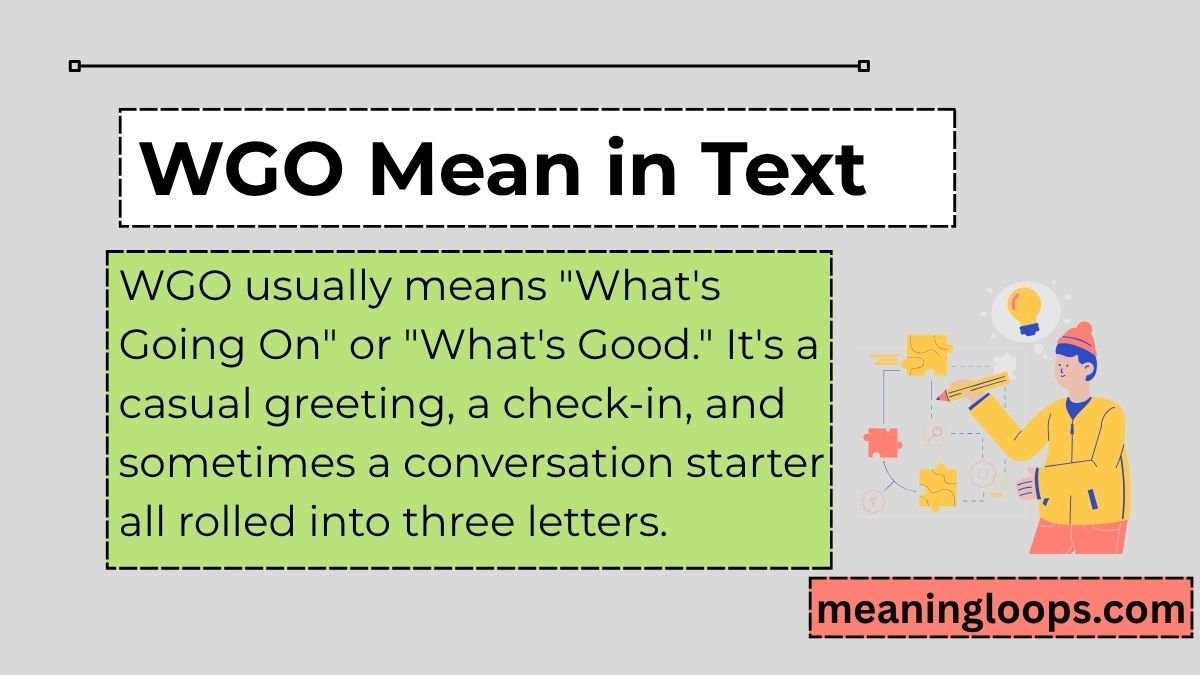
Here’s the short version: WGO usually means “What’s Going On” or “What’s Good.” It’s a casual greeting, a check-in, and sometimes a conversation starter all rolled into three letters. But the full picture is a bit more layered than that, because tone, platform, and context all shape how WGO actually lands. By the end of this guide, you’ll know exactly what WGO means, when to use it, how to reply to it, and how it’s different from lookalikes like WYD and WYA.
What Does WGO Mean?
In texting and online chat, WGO is short for “What’s Going On” — and less commonly, “What’s Good.” Both versions do the same basic job: they open a conversation or ask someone for an update on their day, mood, or plans.
Think of WGO as a lightweight cousin of “what’s up.” It’s not usually a literal request for a detailed report on someone’s life. Most of the time, it functions the way a casual “hey” does — it’s an invitation to talk, wrapped in a question.
The Two Core Meanings
“What’s Going On?” This is the dominant meaning of WGO. It’s used to ask what’s happening — in someone’s day, in a group chat, at an event, or in a general sense. It works as both a greeting and a genuine request for information, depending on context.
“What’s Good?” This version leans slightly more toward a friendly greeting than a literal question. It’s common in casual, upbeat exchanges, especially among younger texters and on social platforms where a quick, breezy tone is the norm.
Both meanings overlap enough that most people don’t distinguish between them consciously. The letters are identical; the intent behind them is read from context, much like how “sup” can mean either “what’s up” or just “hello.”
Where WGO Came From
WGO belongs to a much older family of chat abbreviations that trace back to early instant messaging platforms like AIM, MSN Messenger, and Yahoo Chat, where character limits and typing speed shaped how people communicated. As texting and mobile messaging took over, these shorthand habits carried forward and evolved alongside new platforms.
WGO specifically gained traction as gaming chats, group texts, and social media DMs pushed people toward faster, lower-effort ways to start a conversation. It didn’t require a dictionary entry to catch on — it spread the way most slang does, through repetition in real conversations rather than formal definition.
Other Meanings of WGO (Non-Slang)
Texting slang isn’t the only place WGO shows up, and this is where a lot of guides stop short. If you see WGO in a professional, academic, or industry-specific context, it almost certainly isn’t slang at all.
| Context | What WGO Likely Means |
|---|---|
| Text message or DM | “What’s Going On” or “What’s Good” |
| Medical or health publication | World Gastroenterology Organisation, an international body focused on digestive health standards and education |
| Gaming or strategy context | World Go Federation, the governing body for the board game Go |
| Business or finance document | Occasionally used as a company or stock abbreviation, depending on the organization |
| Formal or academic document | Almost never slang — assume an institutional or organizational meaning |
The practical rule here is simple: the platform tells you the meaning before the letters do. A text from a friend, a WhatsApp thread, or a TikTok comment section points to slang. A journal article, a nonprofit’s website, or a formal memo points to an organizational acronym. Once you know where you saw WGO, the correct meaning usually becomes obvious.
Where and How WGO Is Used
WGO lives almost entirely in informal digital spaces. It’s built for speed, not formality, which shapes exactly where you’ll run into it.
Platforms Where It’s Common
- Text messages and SMS — quick check-ins between friends or family
- Instagram and Snapchat DMs — opening a conversation or replying to a story
- TikTok comments — casual engagement on videos, especially ones inviting reaction
- Discord and gaming chats — checking who’s active or what’s happening in a server
- WhatsApp and Messenger group threads — starting a group conversation or checking for updates
Each platform nudges the tone slightly. In a private text, WGO tends to read as a genuine check-in. And in a TikTok comment, it often functions more like a reaction or a way to signal presence in the conversation. In Discord, it frequently doubles as a way to ask what’s happening in a server or game session right now.
Who Uses It
WGO skews younger, and it’s most common among Gen Z and younger millennial texters, though it’s crossed over into broader casual digital communication. It’s not tied to a specific platform algorithm or trend cycle the way some slang is — it’s more of a steady, low-key staple of everyday informal messaging rather than a viral phrase with an expiration date.
WGO vs. Similar Slang (Comparison Table)
WGO shares space with a handful of similar-sounding abbreviations, and mixing them up is easy if you’re new to texting slang. Here’s how they actually differ.
| Abbreviation | Full Meaning | Typical Use | Tone |
|---|---|---|---|
| WGO | What’s Going On / What’s Good | General check-in, greeting, or status request | Casual, open-ended |
| WYD | What You Doing | Asking about someone’s current activity | Casual, slightly more specific |
| WYA | Where You At | Asking for someone’s location | Casual, plan-focused |
| HMU | Hit Me Up | Inviting someone to reach out or make contact | Casual, action-oriented |
| SUP | What’s Up | Simple greeting or light check-in | Very casual, minimal |
The key difference: WGO is broader than WYD or WYA. WYD asks specifically about an activity, and WYA asks specifically about location. WGO can cover mood, recent events, plans, or just serve as an opener — it’s less about pinning down one detail and more about opening the door to a reply of any kind.
WGO in Conversation (Real Examples)
Seeing WGO in context makes the meaning click faster than any definition. Here are a few realistic exchanges:
Casual greeting:
Person A: “wgo” Person B: “not much, just got home. you?”
Checking on plans:
Person A: “wgo tonight? you still coming?” Person B: “yeah I’ll be there around 8”
Genuine check-in:
Person A: “hey wgo, haven’t heard from you in a bit” Person B: “just been busy with work, all good though”
Group chat status check:
Person A: “wgo in here, y’all still meeting up?” Person B: “yep, same spot as last time”
A common mix-up worth flagging:
Person A: “you passed the exam?? wgo” Person B: “wait, what does that mean lol”
That last example matters. Some readers momentarily confuse WGO with “Way to Go,” especially when it follows good news. The letters overlap in a way that creates real ambiguity, so if the context is a celebration or achievement, double-check which meaning actually fits before replying.
Is WGO Friendly, Neutral, or Rude? (Tone Guide)
WGO itself isn’t inherently rude or overly friendly — the punctuation, emojis, and surrounding words do most of the work in shaping how it lands.
Friendly / Warm
Adding a greeting, emoji, or follow-up softens WGO into a genuinely warm check-in.
“heyyy wgo 😊 miss talking to you”
Neutral / Just Checking In
On its own, with no punctuation or emoji, WGO reads as low-key and non-committal — not cold, just efficient.
“wgo”
Annoyed / Impatient
Repetition, capital letters, or a clipped follow-up can shift WGO into frustration.
“WGO?? you never answered me”
Key takeaway: tone in text messaging rarely lives in the words alone. The same three letters can read as friendly, indifferent, or irritated depending on what surrounds them — a pattern that applies to most short-form slang, not just WGO.
How to Reply to WGO
Because WGO is open-ended, replies can go in several directions depending on what’s actually true for you.
- If you’re busy: “not much rn, kinda swamped, hmu later”
- If you’re free and want to talk: “nothing much, just chilling, wgo with you?”
- If there’s actual news: “omg so much happened, tell you in a sec”
- If you’re unsure what they mean: “wgo like what’s up, or wgo like the meeting?” (asking for clarification is completely normal)
There’s no wrong way to answer WGO as long as the reply acknowledges the question — leaving it completely unanswered is generally read as ignoring the person, not as a stylistic choice.
When to Use (and Avoid) WGO
Good Contexts
- Texting friends or close contacts
- Casual social media comments or DMs
- Group chats with an established informal tone
- Gaming chats or Discord servers
Contexts to Avoid
- Formal or professional messages — WGO reads as unpolished in a work email or client message
- First-time professional contact — using slang before a relationship is established can come across as careless
- Workplace Slack or Teams channels, unless the team culture is already very casual
A simple test: if you wouldn’t say “what’s going on” out loud to this person in this setting, WGO probably isn’t the right fit in text either.
Common Mistakes People Make With WGO
Confusing WGO with “Way to Go.” Context around good news or an achievement should be a signal to double-check meaning before assuming sarcasm or confusion.
Using WGO in formal or professional writing. It’s texting shorthand, not a professional greeting — swap it for “How are things going?” or “What’s the latest?” in work contexts.
Assuming it always means the exact same thing. WGO shifts slightly based on platform: a Discord “wgo” during a game session isn’t quite the same as a “wgo” text from a friend checking in after a few quiet days.
Best Practices for Using WGO
- Match the tone of the person you’re texting — mirror their level of casualness rather than escalating it
- Add an emoji or a follow-up line if you want the message to read as warm rather than neutral
- Reserve it for people you already have a casual relationship with
- Use full phrasing (“what’s going on?”) in any context where professionalism matters, even slightly
Frequently Asked Questions
What does WGO stand for?
WGO most commonly stands for “What’s Going On” or “What’s Good.” In non-slang contexts, it can also refer to organizations like the World Gastroenterology Organisation or the World Go Federation.
Is WGO the same as WYD?
Not exactly. WYD (“What You Doing”) asks specifically about someone’s current activity, while WGO is broader and can cover mood, recent events, plans, or just serve as a general opener.
Is WGO rude to say?
No, WGO isn’t inherently rude. Its tone depends entirely on context, punctuation, and accompanying words — the same three letters can read as friendly, neutral, or impatient depending on how they’re framed.
Can WGO mean something other than slang?
Yes. Outside of texting, WGO can refer to the World Gastroenterology Organisation, the World Go Federation, or occasionally a business or stock abbreviation, depending on where it appears.
Can I use WGO in formal or work messages?
It’s best avoided in formal communication. WGO is casual texting slang, so professional emails or first-time work contacts should use a full phrase like “What’s the latest?” instead.
How do you respond when someone texts you WGO?
Any reply that acknowledges the question works — sharing a quick status update, saying you’re busy, or asking what they mean if the context is unclear are all reasonable responses.
Final Thoughts
WGO is a small piece of digital shorthand that does a surprising amount of work: greeting, checking in, and opening a conversation, all in three letters. The core meaning — “What’s Going On” or “What’s Good” — stays fairly constant, but tone and platform shape how it actually reads in any given exchange.
The next time “wgo” shows up in your messages, you won’t need to pause. You’ll know it’s an invitation to talk, read the tone from what surrounds it, and reply in whatever way actually fits the conversation.
Read more:
What Does TD Mean in Text? Meaning, Uses & Examples (2026)
What Does YWT Mean in Text? Simple Meaning Explained (2026)
Minoot or Minute? The Real Story Behind English’s Trickiest Small Word

Hi, I’m Andrew Wilson, the founder of Meaning Loops. I created this website to help people understand English words in a simple and easy way. Here, I share word meanings, synonyms, antonyms, idioms, phrases, grammar tips, and vocabulary guides. My goal is to provide clear, accurate, and useful content that helps students, writers, and English learners improve their language skills. Thank you for visiting Meaning Loops and being part of this journey.