You’re scrolling through a text or a Snapchat conversation, and there it is: ONS Mean in Text. No context. No explanation. Just three letters sitting there like they own the place.
So what does ONS mean in text? Let’s clear it up right now, then dig into the details that actually matter.
What Does ONS Mean in Text?
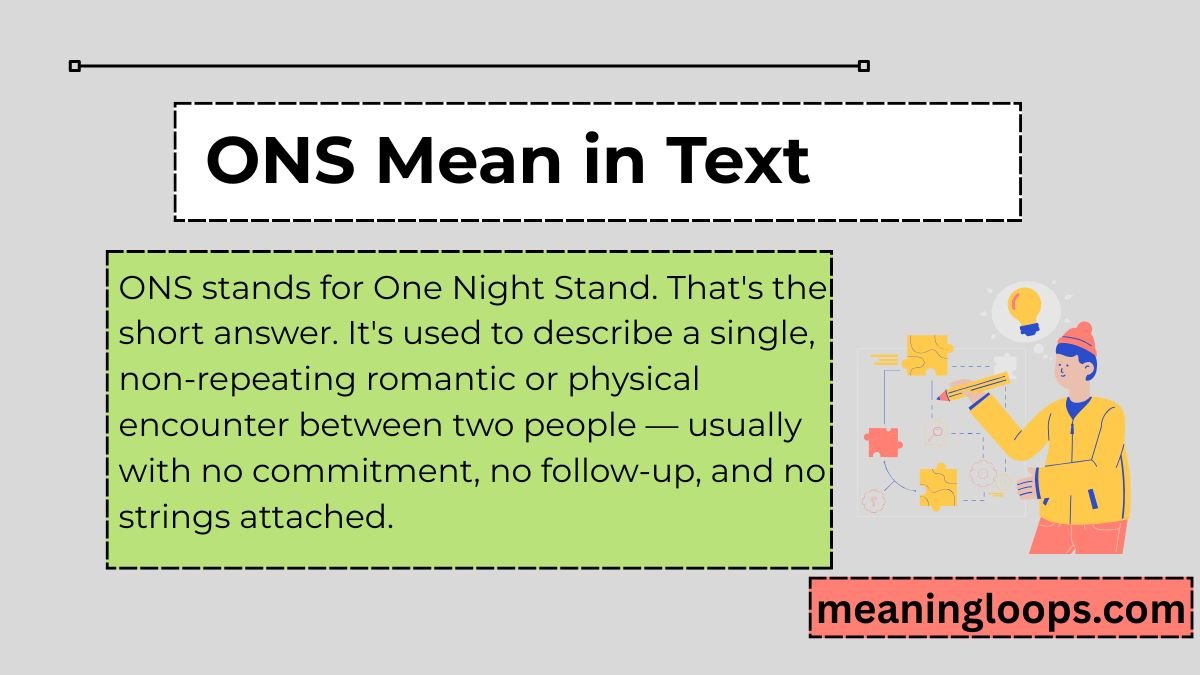
ONS stands for One Night Stand. That’s the short answer. It’s used to describe a single, non-repeating romantic or physical encounter between two people — usually with no commitment, no follow-up, and no strings attached.
You’ll mostly see it in private text messages, dating app chats, or casual conversations between friends who are being upfront about their intentions. It’s not a term you’d casually drop into a work email (please don’t), but in the right setting, it communicates a lot in very few characters.
The Short Answer
If someone texts you “it was just an ONS Mean in Text,” they mean it was a one-time casual encounter — nothing more, nothing less. No expectation of a second date. No promise of exclusivity. Just a single moment that both people (ideally) agreed was temporary from the start.
Think of it as the texting world’s way of setting expectations without writing a paragraph. Instead of typing out “hey, just so we’re clear, this was a one-time thing and I’m not looking for anything serious,” people compress that entire conversation into one acronym.
Where the Term Comes From
The phrase “one night stand” isn’t new — it’s been part of everyday language for decades, originally describing exactly what it sounds like: a romantic encounter that lasts one night and doesn’t continue. What’s changed is the delivery method.
As dating apps and texting replaced a lot of face-to-face flirting, people started shorthanding everything. ONS is really just the natural evolution of a phrase that was already common — it got compressed the same way “laughing out loud” became “lol.” Nothing mysterious about it. Texting culture just doesn’t have patience for spelling things out.
How to Use ONS in a Sentence
Seeing a definition is one thing. Seeing it in action is where it actually clicks. Here are a few realistic examples of ONS showing up in everyday conversations:
- Casual texting between friends: “Ngl that guy from the bar was cute but I think it was just an ONS for both of us.”
- Dating app opener: “Just to be transparent, I’m not looking for anything serious right now — more of an ONS kind of situation.”
- Group chat gossip: “Wait so was it a real date or just an ONS??”
- Snapchat conversation: “lol it was fun but let’s be real, total ONS energy 😅”
- Clarifying intentions: “I don’t want to lead you on, I think this was more of an ONS than the start of something.”
- Reflecting after the fact: “Honestly? Best ONS I’ve had all year lol.”
Notice the pattern. In almost every example, ONS shows up when someone’s trying to set boundaries or clarify dating intentions without an awkward, drawn-out conversation. It’s blunt, but it’s efficient.
Where You’ll See ONS Used
ONS isn’t evenly spread across the internet. It clusters in very specific places, and knowing where helps you read the tone correctly.
Dating Apps
This is really its home turf. On apps like Tinder, Hinge, and Bumble, people use ONS in bios or opening messages to filter out mismatched intentions early. If someone’s bio says “not looking for ONS,” they’re telling you they want something with more emotional commitment. If it says the opposite, well — now you know too.
Texting & DMs
Private conversations are the most natural habitat for this kind of adult slang term. It’s casual, a little vulnerable, and not something most people want broadcast publicly — so it lives in one-on-one chats.
Twitter/X and Reddit Threads
Public platforms get a slightly different flavor. Here, ONS shows up more in storytelling or advice threads — people recapping experiences or asking for opinions, often with a joking or self-deprecating tone.
Where You Won’t See It
Some places are just off-limits, and honestly, common sense mostly covers this:
| Context | Appropriate? |
|---|---|
| Dating apps | ✅ Very common |
| Texting close friends | ✅ Common |
| Snapchat conversations | ✅ Common |
| Reddit relationship threads | ✅ Common |
| Workplace Slack | ❌ Absolutely not |
| Family group chats | ❌ Don’t do this to yourself |
| Formal emails | ❌ Just no |
If you wouldn’t say “one night stand” out loud in that setting, don’t type ONS either. The acronym doesn’t make it more professional — it just makes it more confusing to anyone who doesn’t already know the slang.
ONS vs. Similar Terms — Don’t Mix These Up
ONS slang often gets lumped in with other casual dating terms, but they’re not interchangeable. Mixing them up can genuinely cause miscommunication, so here’s a clean breakdown:
| Term | Meaning | Repeats? | Commitment Level |
|---|---|---|---|
| ONS | One night stand — a single encounter | No | None |
| FWB | Friends With Benefits — ongoing physical relationship, no romance | Yes | Low, but recurring |
| Situationship | Undefined relationship with romantic elements but no label | Sometimes | Ambiguous |
| Hookup | General term for a casual physical encounter | Can vary | None to low |
| NSA | No Strings Attached — similar to FWB, emphasizes freedom | Yes | Very low |
The biggest difference between ONS vs FWB comes down to repetition. An ONS is, by definition, a one-time thing. FWB implies an ongoing arrangement. Confuse the two in a text and you might accidentally suggest a relationship structure you didn’t mean to propose — which, ironically, is exactly the kind of mixed signal these acronyms exist to prevent.
ONS vs hookup is a subtler distinction. “Hookup” is the broader term — it doesn’t specify whether it’s a one-time thing or a recurring one. ONS is more precise. It locks in the “just once” part.
When It’s Fine to Use ONS — and When It’ll Backfire
Like most slang, context is everything here. Use it in the right moment and it reads as honest and low-drama. Use it in the wrong one, and it can come across as careless or even hurtful.
Appropriate Contexts
- Talking with close friends about your own dating life
- Setting expectations early on a dating app
- Reflecting on a past encounter in casual conversation
- Asking someone directly what they’re looking for
Contexts Where It’ll Backfire
Here’s where a lot of people trip up. Typing “it was just an ONS” to someone who thought the connection meant more can land like a slap, even if that wasn’t your intention. The acronym feels casual to you, but the person reading it might be sitting with real feelings on the other end.
Timing matters too. Dropping ONS mid-argument, or using it to end a conversation abruptly, tends to feel dismissive — even if the underlying truth (it was casual) is accurate. If there’s any chance the other person invested more emotionally than you did, it’s worth having an actual conversation instead of leaning on a three-letter shortcut.
And obviously — professional settings, family chats, anywhere formality is expected. Save it for the conversations where it actually fits.
Is ONS a Loaded or Offensive Term?
Short answer: not inherently, but it depends heavily on who’s using it and how.
On its own, ONS is a neutral description of a common human experience. It’s not slang designed to insult anyone. But because it touches on relationship discussions and personal intimacy, it counts as a sensitive slang term — meaning tone and context change everything.
Used respectfully, between people who both understand and accept the situation, it’s just honest shorthand. Used carelessly, or to brush off someone else’s feelings, it can feel cold or reductive. The acronym itself isn’t the problem. How it’s deployed usually is.
There’s also a generational layer here. Older readers unfamiliar with texting abbreviations might read ONS and assume it’s crude simply because they don’t recognize it — confusion breeds discomfort. Younger, more terminally-online audiences tend to see it as pretty standard social media slang, no more scandalous than FWB or DTF.
Other Slang Terms Worth Knowing
If ONS is part of your vocabulary now, you’ll likely run into its cousins too. Here’s a quick rundown:
- FWB (Friends With Benefits): A recurring physical relationship without romantic attachment.
- DTF (Down To F*):** Blunt shorthand indicating openness to a physical encounter, often used on dating apps.
- Situationship: A relationship that has romantic or physical elements but lacks a clear label or defined commitment.
- NSA (No Strings Attached): Emphasizes freedom from obligation — similar to FWB but often shorter-term.
- Hookup: A general, flexible term for any casual physical encounter, one-time or recurring.
Knowing these helps you read dating app slang fluently instead of guessing at meanings mid-conversation.
Why This Kind of Shorthand Exists at All
It’s worth stepping back and asking why terms like this exist in the first place. The honest answer is that texting compresses vulnerable topics into something less exposing. Typing out “I only want this to happen once, and I’m not interested in anything more” feels heavy — almost confrontational. Typing “ONS” feels lighter, even though it communicates roughly the same thing.
Modern texting slang does this constantly. It takes emotionally loaded topics — rejection, boundaries, intentions — and turns them into something quick and low-stakes on the surface. That’s part of what makes texting culture so different from face-to-face conversation. You get distance. A buffer. A few letters instead of a whole explanation.
It’s not that people using ONS don’t care about honesty. It’s that acronyms let them be honest faster, with less emotional friction on both ends.
FAQs
What does ONS mean in a text?
ONS stands for One Night Stand — a single, non-repeating romantic or physical encounter with no ongoing commitment.
Is it rude to say ONS?
Not inherently. It’s a neutral term, but tone and context matter. Using it dismissively toward someone who has stronger feelings can come across as cold.
What’s the difference between ONS and FWB?
ONS refers to a one-time encounter. FWB (Friends With Benefits) describes an ongoing, recurring physical relationship without romantic attachment.
Can ONS mean something other than “one night stand”?
Rarely, and only if context makes it obvious (like abbreviations for organizations in unrelated fields). In texting and dating contexts, it almost always means one night stand.
How do I respond if someone texts me ONS?
Be direct. If you’re fine with that arrangement, say so plainly. If you want something more, it’s worth having an honest conversation rather than letting the acronym set the terms for you.
Bottom Line
ONS is simple once you know it: one night stand, nothing more coded than that. It shows up most in online dating spaces and private texts, where people use it to set clear, low-drama expectations. Use it thoughtfully, read the room before you type it, and you’ll navigate modern texting abbreviations like someone who’s actually fluent — not just guessing at what the letters mean.
And Read
YW Mean After Thank You: What It Means in Text, Uses, and Examples
What Does HMU Mean in Text? The Easy, No-Fluff Explanation (2026)
What Does ASL Mean in Text? Meaning, Uses, and Examples (2026)

David Miller is the lead content writer at Meaning Loops, where he creates accurate and easy-to-understand content on word meanings, synonyms, antonyms, idioms, phrases, acronyms, abbreviations, and vocabulary. His goal is to help readers improve their English with reliable, well-researched, and SEO-friendly language resources.

1 thought on “What Does ONS Mean in Text With Examples and Usage 🔥 (2026)”