You’re scrolling through a group chat and someone drops a message that just says “imp, call me back.” No punctuation, no context, just three letters staring back at you. So what does IMP mean in text? Is it a typo? A nickname? Something you’re supposed to already know?
Relax. It’s not complicated once you know the rules. This guide breaks down every real meaning of IMP mean in text, chat apps, and social media, so you never have to guess again.
IMP Usually Means “Important”
In the vast majority of cases, IMP stands for important. It’s an informal texting abbreviation people use to flag a message that needs your attention fast. Think of it as a verbal red flag, planted right at the start (or end) of a sentence so you don’t scroll past it.
Here’s what that looks like in real life:
Text message: “imp — meeting moved to 9am, don’t be late”
That’s it. That’s the whole trick. No hidden meaning, no riddle. The sender is telling you: this one actually matters, pay attention.
A quick note on style: capitalization doesn’t change the IMP meaning in texting. Whether someone writes IMP, Imp, or imp, they almost always mean the same thing. Texting culture doesn’t care much about capitalization rules, and honestly, neither should you when you’re just trying to figure out what your friend wants.
Where the Abbreviation Comes From
This part gets skipped in most breakdowns, but it’s worth knowing. Shorthand like this didn’t appear out of nowhere.
Back when SMS messages were capped at 160 characters, every letter counted. People trimmed words down to their bones just to fit a thought into one text. “Important” became imp. “Nevermind” became nvm. “As soon as possible” became ASAP. It was practical, not lazy.
Smartphones eventually removed that character limit, but the habit stuck around. Fast typing, split-second thumbs, and a culture that rewards brevity kept these texting shortcuts alive long after the technical reason for them disappeared. That’s really the story of most internet slang: it starts as a workaround and survives as a style.
The 3 Real Meanings of IMP in Text (Not Just One)
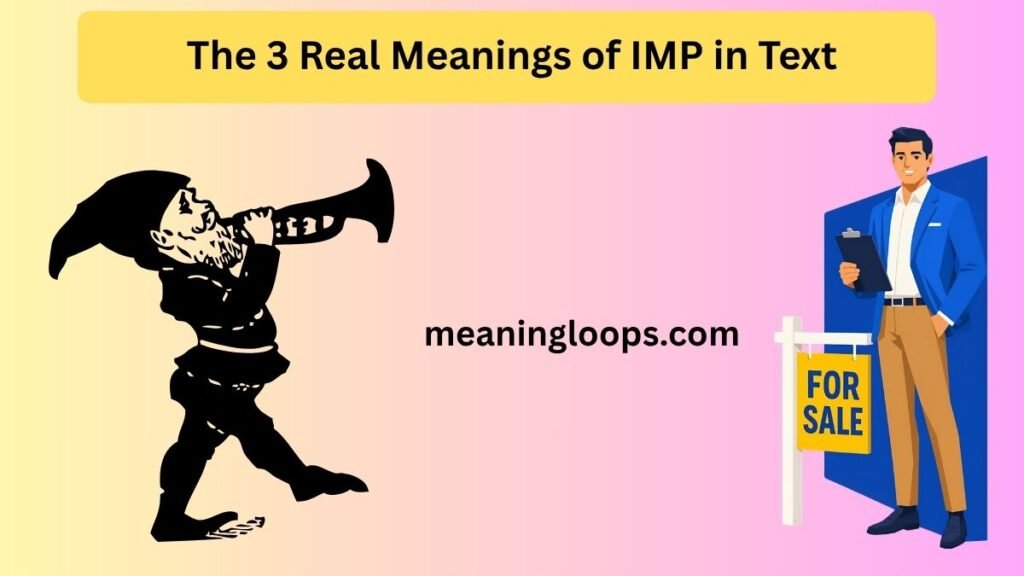
Here’s where a lot of guides oversimplify things. IMP doesn’t have just one meaning, it has a small handful, and mixing them up can genuinely cause confusion in a conversation. Let’s go through each one.
IMP = Important
This is the IMP text meaning you’ll run into 90% of the time, across nearly every platform. It shows up in casual chats, quick task reminders, and even informal workplace messaging when someone needs to flag urgency without writing a whole sentence about it.
Real conversation example:
Sam: hey you around? Jordan: yeah what’s up Sam: imp — landlord called, rent due date changed. check email
Notice how it works. Sam doesn’t waste time explaining why it’s important first. The word itself does that job, then the details follow.
imp = Imp (the Mythical Creature)
Lowercase, and almost always used in a completely different context. This is the mythical creature imp — small, mischievous, a little devilish, often winged, and a staple of folklore, fantasy fiction, and tabletop games. Think of a miniature trickster demon, more prankster than villain.
You’ll mostly see this meaning pop up in gaming slang, Discord servers built around fantasy games, or Dungeons & Dragons chats.
Discord message: “watch out for the imp in that dungeon room, it casts fireball at low HP”
It also shows up as a playful nickname, usually aimed at someone acting a little sneaky or mischievous. If a friend pulls a harmless prank on you, don’t be surprised if someone calls them a “little imp” afterward. It’s teasing, not an insult.
That’s Really It
Some slang guides try to pad out a third or fourth meaning just to look thorough. Honestly, there isn’t a widely used third meaning of IMP beyond these two. If you see it in a text, it’s either flagging something important, or referencing the imp fantasy creature. Everything else is context dressing around those two core ideas.
Quick Comparison Table
| Form | Meaning | Common Context |
|---|---|---|
| IMP / imp | Important | Texting, Slack, email subject lines, group chats |
| imp | Mythical creature / playful nickname | Gaming, Discord, fantasy fandom, teasing between friends |
How to Tell Which One Someone Means
You don’t need a decoder ring for this. Context does almost all the work.
Look at the sentence structure. “Imp, call me back” reads like an instruction, which points to important. “You’re such an imp” reads like a description of a person, which points to the mythical creature meaning.
Look at the platform. If you’re chatting on a work Slack channel or texting a coworker, it’s almost certainly the important abbreviation. If it’s inside a Discord server dedicated to a fantasy game, it’s probably the creature or a nickname.
Look at what came before it. Conversations have momentum. If the last three messages were about deadlines, IMP means important. If the last three messages were about a boss fight, imp means the little winged troublemaker.
Here’s the same word used two completely different ways, side by side:
Version 1 (Important): “imp — don’t forget the package pickup closes at 6” Version 2 (Creature/nickname): “haha you’re an imp for hiding my charger like that”
Once you see them next to each other, the difference is obvious. The confusion usually only happens for a split second, right before the rest of the sentence clears things up.
Where You’ll Actually See IMP Used
The IMP meaning in chat doesn’t stay confined to one app. It shows up across a wide range of digital communication tools, though the tone shifts slightly depending on where you are.
- Texting and SMS – The most classic use case, especially for imp in SMS reminders between friends and family
- WhatsApp – Common for imp in WhatsApp group chats, particularly for scheduling and last-minute changes
- Slack and workplace chat – Yes, this happens, especially in quick task handoffs between coworkers who already have a casual rapport
- Discord – Frequently used for imp in Discord and imp in gaming contexts, where it can mean either meaning depending on the server
- Snapchat and TikTok – Occasionally shows up in captions or comments, usually as shorthand for important update content or a joke referencing the creature
One honest note: not every platform sees heavy use of this abbreviation. You won’t find much evidence of it dominating, say, LinkedIn, because that platform leans formal by nature. Don’t expect IMP in social media to show up everywhere equally; it clusters around casual, fast-paced spaces.
Is IMP Okay to Use in Formal or Professional Writing?
Short answer: no, not in anything formal.
IMP is built for speed and casual tone, and that’s exactly what makes it wrong for professional or client-facing writing. An abbreviation that reads as friendly shorthand in a text can come across as sloppy in an email, especially to someone who doesn’t already know you well.
Where it’s fine to use:
- Quick Slack messages to coworkers you’re already casual with
- Texts between friends or family
- Gaming chats and Discord servers
- Personal social media captions or comments
Where you should avoid it:
- Client-facing emails
- Resumes, cover letters, or any formal application material
- Reports, proposals, or anything meant to outlive the conversation
- First-time messages to someone in a professional context
Here’s a real “before and after” to show the difference:
Unprofessional: “hey just flagging this is imp, need signoff by eod” Professional: “Hi Sarah, flagging this as a priority item — I’ll need your sign-off by end of day to stay on schedule.”
Same important message, delivered in a way that respects the setting. When in doubt, spell out “important” in formal writing. It costs you three extra syllables and saves you from looking careless.
Similar Shorthand Worth Knowing
IMP doesn’t operate alone. It belongs to a small family of common text abbreviations built around speed and urgency. Knowing the neighbors helps you read tone faster.
| Abbreviation | Meaning | Typical Use |
|---|---|---|
| ASAP | As soon as possible | Requesting urgent action |
| NVM | Nevermind | Cancelling or downplaying a previous request (the opposite signal of IMP) |
| FYI | For your information | Sharing something without urgency |
| BTW | By the way | Adding a side note mid-conversation |
| URG | Urgent | Similar to IMP but leans slightly more intense |
| NOTE | Note | Flagging something worth remembering, lower stakes than IMP |
Notice how these terms form a rough scale. FYI and BTW sit on the low-urgency end. IMP and URG sit closer to “drop what you’re doing.” NVM is basically the eject button, telling the reader they don’t need to act at all. Once you understand where a word sits on that scale, reading tone in a fast-moving chat becomes second nature.
Why Shorthand Like IMP Caught On
It’s worth stepping back and asking why this kind of shorthand exists at all, beyond the old character-limit explanation.
Mobile keyboards reward brevity. Typing on a phone screen is slower and more error-prone than typing on a physical keyboard. Shaving a word down to three letters saves real time, especially in fast back-and-forth conversations where speed matters more than polish.
Texting culture treats formality as friction. A perfectly punctuated, fully spelled-out sentence can actually feel distant in a casual chat. Shorthand like IMP signals familiarity. It says, we don’t need full sentences with each other.
There’s a generational layer here too. Younger texters, particularly Gen Z, tend to lean on casual chat abbreviations more heavily and more fluidly than older generations, who sometimes stick closer to full words even in informal settings. Neither approach is wrong, they’re just different comfort levels with informal abbreviations, shaped by how each generation grew up communicating.
None of this is really about laziness, despite what some critics of texting culture claim. It’s about matching your language to the speed and intimacy of the conversation you’re actually having.
Frequently Asked Questions
What does IMP mean in a text message?
In nearly every case, IMP is shorthand for important. It’s used to flag a message that needs quick attention, usually followed by the actual detail the sender wants you to notice.
Is imp always about the mythical creature?
No. The imp full form as a mythical, mischievous creature only applies in specific contexts, mainly gaming, fantasy chats, and playful nicknames. Outside of those settings, it almost always means important instead.
Can IMP mean something rude or inappropriate?
There’s no widespread evidence of IMP carrying a rude or inappropriate secondary meaning in standard texting culture. If you ever see it used strangely in a specific group or community, that’s more likely an inside joke unique to that chat rather than a broader slang trend.
Should I use IMP in a work email?
Generally, no. Save it for casual internal chats with coworkers you already know well. For anything formal, client-facing, or written communication meant to be taken seriously, spell out “important” in full.
What’s the difference between IMP meaning from a girl versus IMP meaning from a guy?
There isn’t one. The IMP meaning from a girl and IMP meaning from a guy are identical, this abbreviation doesn’t carry gendered meaning or flirtatious subtext on its own. Context around the message determines tone, not who sent it.
Why do people use IMP instead of just typing “important”?
Mostly speed. Quick communication matters more than formality in casual chats, and three letters type faster than nine. It’s also just become a natural part of casual texting habits at this point, passed along through everyday use rather than any single deliberate choice.
Bottom Line
At the end of the day, the IMP meaning in text comes down to context, not mystery. Nine times out of ten, it’s simply flagging something that needs attention, a priority worth noticing before you scroll past it. The rest of the time, it’s a nod to a small mischievous creature from folklore, or a lighthearted nickname for someone acting a little sneaky.
Read the sentence around it, consider where the conversation is happening, and you’ll never second-guess it again.
And read
What Does OHP Mean in Text? Full Slang Guide (2026)
What Does OHRD Mean in Text? The Real Story Behind This Confusing Acronym (2026)
What Does HYB Mean in Text? Slang Meaning Explained (2026)

David Miller is the lead content writer at Meaning Loops, where he creates accurate and easy-to-understand content on word meanings, synonyms, antonyms, idioms, phrases, acronyms, abbreviations, and vocabulary. His goal is to help readers improve their English with reliable, well-researched, and SEO-friendly language resources.