You got a text that just says “wanna RP?” and now you’re stuck. Is this a hobby invite? A gaming thing? Something you should Google before you reply? You’re not alone — RP is one of those abbreviations that shows up everywhere from group chats to Discord servers to movie trailers, and it doesn’t always mean the same thing twice.
Here’s the short version: RP most commonly stands for “roleplay,” a form of collaborative, in-character storytelling done through text. But depending on where you see it, RP can also mean Rating Pending (in gaming and film), Reputation Points (in games and forums), or Received Pronunciation (a British English accent). This guide breaks down every real meaning of RP, shows you exactly how to tell which one applies, and gives you word-for-word examples of how to respond — whether you’re into it, not interested, or a little unsure about the person asking.
By the end, you’ll never have to guess what RP means in a text again.
What Does RP Mean in Text?
In the vast majority of texting, Discord, and social media contexts, RP means “roleplay.” It refers to two or more people creating a story together by writing as characters, back and forth, almost like co-writing a script in real time.
Here’s a quick-reference table so you can identify the right meaning fast:
| RP Meaning | Where You’ll See It | Example Usage |
|---|---|---|
| Roleplay | Texting, Discord, social media, gaming | “Do you RP? I have a plot idea.” |
| Rating Pending | Movie trailers, game listings, ESRB previews | “This trailer is Rated RP.” |
| Reputation Points | Gaming, forums, MMORPGs | “I need 500 more RP to level up.” |
| Received Pronunciation | Linguistics, British English discussions | “He speaks with a Received Pronunciation (RP) accent.” |
If someone texts you “RP” with no other context, roleplay is the safest first guess — it accounts for the overwhelming majority of everyday use. The other meanings show up in narrower, more specific settings, which we’ll cover below.
Where “RP” Came From
Roleplay itself isn’t new. It has roots in tabletop games like Dungeons & Dragons, where players take on character personas and make decisions “in character” rather than as themselves. When online forums, chatrooms, and instant messaging exploded in the late 1990s and 2000s, that same concept moved to text.
Communities built entire platforms around it — sites like Gaia Online, Quotev, and later Tumblr and Wattpad became hubs where people wrote extended, collaborative fiction with strangers and friends alike. The abbreviation “RP” was simply faster to type than “roleplay” in a fast-moving chat, and it stuck.
Discord’s rise in the 2015–2020 era gave RP a second wind. Dedicated RP servers — some built around fandoms, some entirely original — turned text-based roleplay into a structured hobby with its own etiquette, vocabulary, and community norms. Today, RP culture overlaps heavily with fanfiction communities, fandom spaces, and even certain multiplayer games where players stay in character during matches.
The 4 Real Meanings of RP (and How to Tell Which One Applies)
Context is everything with RP. Here’s a breakdown of each meaning and the signals that point to it.
RP = Roleplay (Most Common in Texting/Gaming)
This is what RP means at least 90% of the time in casual texting, DMs, and chat apps. It refers to writing out a story collaboratively, usually with each person controlling one character.
Signal words that point to this meaning: “plot,” “character,” “story,” “wanna,” “server,” “OOC,” “IC,” “starter.”
RP = Rating Pending (Movies, Trailers, Game Listings)
In the entertainment industry, “Rating Pending” is a placeholder used by the Motion Picture Association (MPA) and the Entertainment Software Rating Board (ESRB) when a film or video game hasn’t been officially rated yet. You’ll see “RP” stamped on early trailers or pre-release game listings.
Signal words that point to this meaning: “trailer,” “rated,” “ESRB,” “release date,” “coming soon,” any context involving a movie or video game product page.
RP = Reputation Points (Gaming/Forums)
In many multiplayer games and online communities, RP stands for Reputation Points — a score that tracks your standing, trust level, or progress within a system. This is common in MMORPGs, forums with reputation systems, and some competitive games.
Signal words that point to this meaning: “points,” “level up,” “reputation,” “score,” “grind,” “leaderboard.”
RP = Received Pronunciation (Linguistics)
This one is far less common in day-to-day texting but shows up in academic, linguistic, or British-culture-focused conversations. Received Pronunciation refers to a specific, historically prestigious accent of British English — sometimes called “BBC English” or “the Queen’s English.”
Signal words that point to this meaning: “accent,” “British,” “linguistics,” “pronunciation,” “dialect.”
How Context Clues Reveal the Right Meaning
If you’re still unsure which RP someone means, ask yourself these three questions:
- What platform is this on? Discord and texting skew heavily toward roleplay. Game store pages and trailers skew toward Rating Pending.
- What words surround “RP”? Look for the signal words above — they almost always settle it.
- What’s the relationship context? A stranger DMing “do you RP?” out of nowhere is almost certainly asking about roleplay, since that’s the phrase’s standard idiomatic use.
Key takeaway: When in doubt, roleplay is the default meaning. The other three are context-locked to specific industries or subject areas.
RP (Roleplay) in Different Platforms
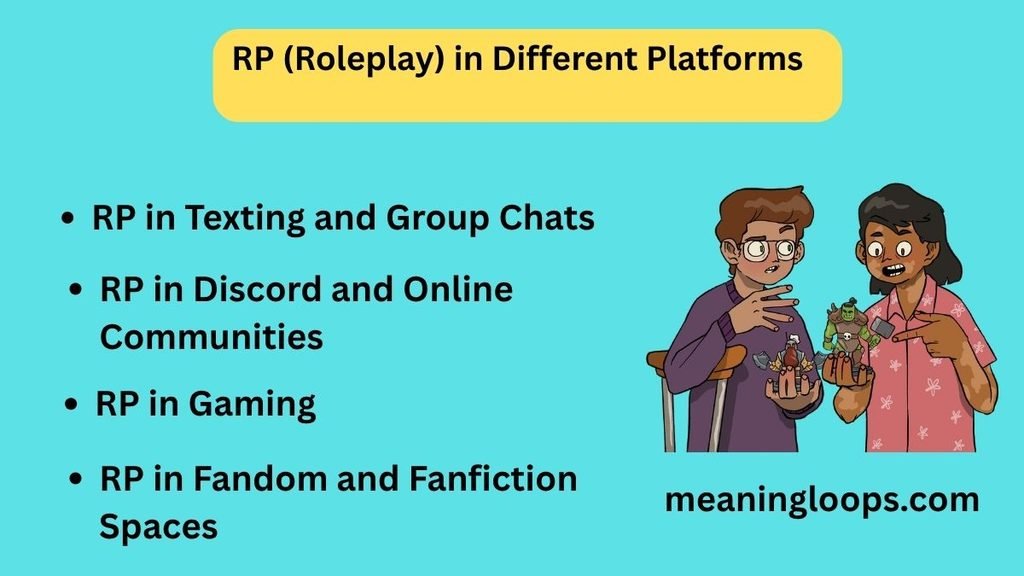
Roleplay isn’t a single, uniform activity — it looks different depending on where it happens.
RP in Texting and Group Chats
Between friends, RP in a regular text thread is often casual and low-commitment. It might be a quick, joking exchange (“I roll a natural 20 to steal your fries”) or a longer story that unfolds over days. There’s usually less structure than in a dedicated RP community — no strict rules, just friends having fun with a shared fictional bit.
RP in Discord and Online Communities
Discord is arguably the biggest home for organized RP today. Dedicated RP servers often have:
- Character bio channels
- Separate “in-character” and “out-of-character” (OOC) chat rooms
- Moderators who enforce content rules
- Structured plots or “arcs” that run over weeks or months
These servers can be built around existing fandoms (anime, books, movies) or entirely original worlds that members create together.
RP in Gaming
RP shows up in gaming in two distinct ways. First, some games are literally built around it — story-driven, role-playing games (RPGs) like Final Fantasy or Skyrim put you in a character’s shoes by design. Second, in multiplayer games like Grand Theft Auto RP servers or World of Warcraft, players voluntarily stay in character while playing, layering a social roleplay experience on top of standard gameplay.
RP in Fandom and Fanfiction Spaces
RP and fanfiction are close cousins. Both involve writing original scenes for existing characters, but RP is interactive and improvised in real time between two or more people, while fanfiction is typically written solo and shared as a finished piece. Fandom communities frequently host both side by side.
Real Conversation Examples of RP
Seeing RP in context makes it far easier to recognize. Here are realistic examples across different situations.
Someone Asking “Wanna RP?”
Alex: hey do you wanna RP tonight? I have a plot idea with a haunted house
Sam: ooh yes! send me the starter
RP Used Jokingly Mid-Chat
Jordan: dramatically kicks down your door “WHERE WERE YOU LAST NIGHT”
Taylor: lmao okay I’ll RP with this — “I was getting tacos, calm down”
Inside a Dedicated RP Server
[IC] Elowen_the_Ranger: The forest grows quiet as she nocks an arrow, eyes fixed on the shadow between the trees.
[OOC] Mod_Kira: reminder, no combat without a dice roll in this server, thread it in #rp-rules
RP Between Friends vs. Strangers
Between close friends, RP invitations tend to be short and casual, relying on shared inside jokes. Between strangers — especially on Discord or social media — RP invitations are usually more formal, often including a character bio, a genre, or a specific plot pitch upfront, since there’s no existing rapport to lean on.
How to Respond If Someone Asks “Do You RP?”
Getting an RP request doesn’t obligate you to anything. Here’s how to handle it depending on how you feel.
If You’re Interested
Keep it simple and show a little enthusiasm — RP communities generally respond well to genuine interest:
- “Yes! What kind of plot did you have in mind?”
- “I’m down, do you have a character already or should we build one together?”
If You’re Not Interested
A polite, direct decline is completely normal and expected in RP spaces:
- “Thanks for asking, but RP isn’t really my thing!”
- “I appreciate it, but I’ll pass on this one.”
If the Request Feels Off
If an RP request comes from someone you don’t know, especially on a platform where strangers can message you directly, trust your instincts. It’s fine to:
- Ignore or decline without an explanation
- Block or report if the conversation turns inappropriate quickly (this is sometimes labeled ERP, or explicit roleplay, which is against the terms of service on most mainstream platforms)
- Avoid sharing personal information regardless of how the “story” is framed
Expert tip: Legitimate RP partners respect a “no” immediately and without pushback. Pressure to continue after you’ve declined is a clear red flag.
RP Etiquette and Best Practices
Text-based roleplay has developed its own informal rulebook over the years. Following it makes the experience smoother for everyone involved.
Best practices:
- Establish boundaries early — genre, content limits, and pacing expectations should be discussed before starting
- Use OOC tags (“out of character”) when you need to step outside the story to clarify something
- Match your partner’s writing length where possible, so the exchange feels balanced
- Give a heads-up before dropping a thread rather than disappearing mid-story
Common mistakes to avoid:
- Jumping into intense or mature content without checking the other person is comfortable with it
- “God-modding” — controlling another person’s character without permission
- Ghosting a long-running RP without any communication
- Ignoring a server’s posted rules around content or pacing
Is RP Appropriate in Professional or Work Messages?
Short answer: no, RP has no place in professional or work communication. The abbreviation carries specific hobbyist and gaming connotations that don’t translate to a business setting, and using it in a work Slack channel or client email would likely cause confusion rather than clarity. If you need to reference “Rating Pending” in a professional context — say, you work in game development or entertainment marketing — spell it out on first use, then abbreviate afterward if it fits your industry’s internal style.
RP vs. Similar Terms
RP sits inside a cluster of related abbreviations that often confuse newcomers to online and gaming communities.
| Term | Meaning | Typical Use |
|---|---|---|
| RP | Roleplay | General term for collaborative in-character writing |
| RPG | Role-Playing Game | A genre of video or tabletop game built around character-driven stories |
| OOC | Out of Character | Marks a message as the real person speaking, not the character |
| IC | In Character | Marks a message as part of the roleplay story itself |
| ERP | Explicit Roleplay | Roleplay involving explicit/mature content; against most platforms’ rules |
| LARP | Live Action Role Play | Physical, in-person roleplay, often with costumes and props |
This is the most commonly confused pair. RP is the activity — the act of writing or acting as a character. RPG is a genre of game built around that activity, like Dungeons & Dragons or The Elder Scrolls. You can RP without ever touching an RPG, and you can play an RPG without ever engaging in freeform RP with another person.
Common Points of Confusion
- Assuming RP always means gaming. RP is a broader creative-writing activity that happens to overlap heavily with gaming culture, but plenty of RP takes place purely through text with no game involved at all.
- Mixing up RP and RPG. As covered above, one is an activity, the other is a game genre — they’re related but not interchangeable.
- Misreading RP in a product or trailer context. Seeing “Rated RP” on a game listing has nothing to do with roleplay — it simply means the official rating hasn’t been assigned yet by the ESRB.
- Assuming every RP invitation has bad intent. The vast majority of RP requests, especially within established communities and servers, are genuine invitations to a text-based creative hobby.
Frequently Asked Questions
What does RP mean in a text message?
In a text message, RP almost always means roleplay — an invitation to write a collaborative, in-character story with the sender.
Is RP only used in gaming?
No. While RP is common in gaming communities, it’s just as widely used in Discord servers, fandom spaces, and casual texting between friends who have nothing to do with games.
What’s the difference between RP and RPG?
RP is the act of roleplaying — writing or acting as a character. RPG stands for Role-Playing Game, a specific genre of video or tabletop game built around that concept.
Does RP always mean role play?
Not always. In gaming and entertainment contexts, RP can mean Rating Pending, and in some games or forums, it stands for Reputation Points. Context determines which meaning applies.
Is it safe to RP with someone you don’t know online?
It can be, as long as you keep personal information private, stick to platforms with moderation, and disengage immediately if the conversation feels pressuring or inappropriate.
What does RP mean in a movie or game rating?
In that context, RP stands for Rating Pending, meaning the official age or content rating from a body like the ESRB or MPA hasn’t been assigned yet.
The Takeaway
RP is one of those abbreviations where context does all the heavy lifting. In nearly every text, DM, or Discord message you’ll encounter, RP means roleplay — an invitation into a shared, in-character story. Outside of everyday chatting, keep an eye out for gaming and entertainment contexts where it might instead mean Rating Pending or Reputation Points, or linguistic discussions where it refers to Received Pronunciation.
Now that you know all four meanings and exactly how to spot which one applies, you’ll never have to send back a confused “wait, what do you mean?” text again.
Read more:
What Does Story Mean on Instagram? The 24-Hour Feature Explained (2026)
What Does YU Mean in Text? Meaning, Uses & Examples (2026)
What Does IMP Mean in Text? The Full Slang Breakdown (2026)

Hi, I’m Andrew Wilson, the founder of Meaning Loops. I created this website to help people understand English words in a simple and easy way. Here, I share word meanings, synonyms, antonyms, idioms, phrases, grammar tips, and vocabulary guides. My goal is to provide clear, accurate, and useful content that helps students, writers, and English learners improve their language skills. Thank you for visiting Meaning Loops and being part of this journey.
3 thoughts on “What Does RP Mean in Text? Meaning, Uses & Examples (2026)”