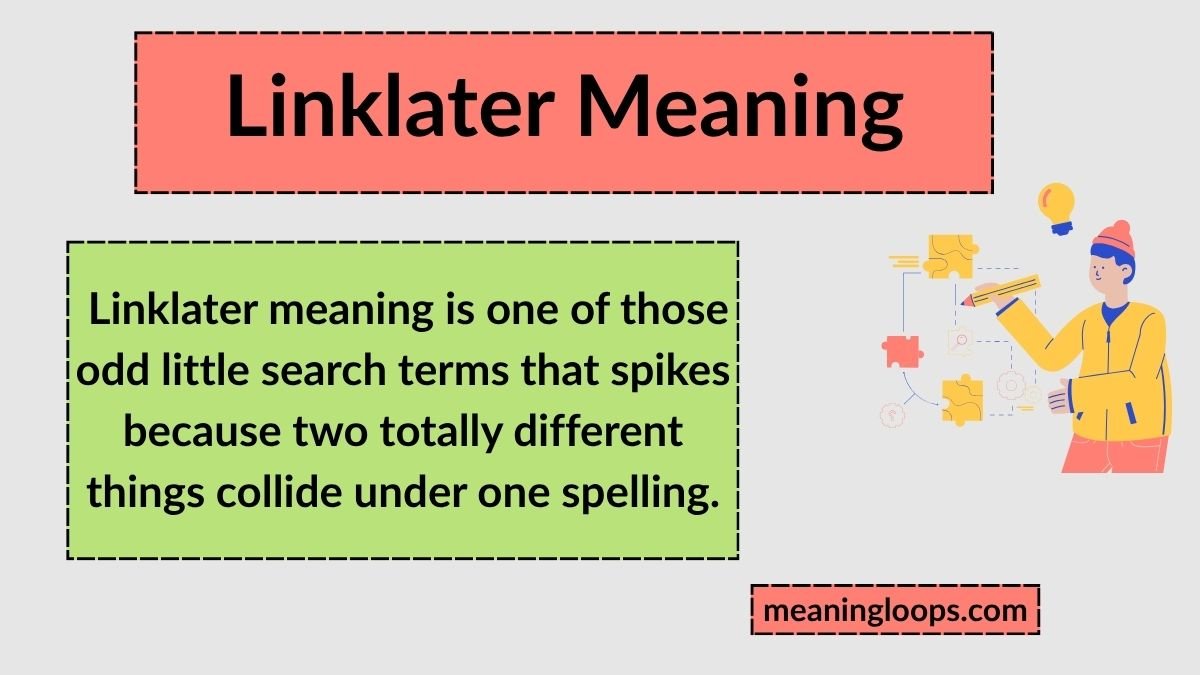
You typed a text, hit send, and then stared at the screen wondering why autocorrect turned your message into “Linklater.” Or maybe you saw the name in movie credits and wondered if it’s a real word at all. Either way, you’re not alone — Linklater meaning is one of those odd little search terms that spikes because two totally different things collide under one spelling.
Here’s the short version: Linklater is a genuine Scottish surname with deep roots in the Orkney Islands. Separately, link later is a piece of texting slang that means “I’ll meet up with you at some point today or this week.” These two things have nothing to do with each other. They just happen to look identical once you remove the space between the words — which is exactly what phones do when you’re typing fast.
This guide breaks down both meanings in full, shows you how to use each one correctly, and clears up the spelling confusion that sends thousands of people to Google every month.
Quick Answer
If you only have ten seconds, here’s what you need to know:
- Linklater (capital L, one word) is a proper noun — specifically a Scottish family name that comes from a place in Orkney, Scotland.
- link later (lowercase, two words) is modern slang meaning “let’s meet up at a later time.”
- The two spellings collide almost entirely because of autocorrect, voice typing, and fast thumb-typing on phones.
- There is no linguistic connection between the surname and the slang phrase. It’s a coincidence of spelling, not a shared word history.
Once you understand the split, the rest is just knowing which version fits your sentence.
What Does Linklater Meaning Really Refer To?
When people search “Linklater meaning,” they’re usually chasing one of three answers. Either they saw the word in a text and don’t recognize it, they came across it as someone’s last name and want to know its background, or autocorrect changed something they typed and they’re trying to figure out what went wrong.
This is the heart of the confusion: Linklater functions as an English word only in the loosest sense — it’s not in the dictionary as a common noun, verb, or adjective. It exists purely as a surname. Meanwhile, link by itself carries a completely separate, very active life in internet slang, where it means to meet up with someone. Mash “link” together with “later” without a space, and you get something that looks exactly like the Scottish name.
So the real question isn’t “what does Linklater mean” in a single, unified sense — it’s “which Linklater are you dealing with?”
Is Linklater a Real Word?
Not in the traditional sense, no. You won’t find “Linklater” in a standard English dictionary listed as a common word with a definition like “run” or “table.” It’s a proper noun, which means it identifies something specific — in this case, a family or an individual — rather than describing a general concept.
Important Facts
- Linklater is not listed in major English dictionaries as a common noun, verb, or adjective.
- It is recognized as a legitimate Scottish surname with documented historical records.
- The earliest known written form of the name appears in Orkney records from 1424, referring to a landowner named Christe Linklater (sometimes recorded as “Aelingeklaet”).
- The surname’s true form is considered to be “Linklet,” derived from place names in Orkney, with regional variants recorded across centuries including “Linclet” in 1500 and “Linklet” in 1596.
- Because it’s a proper noun, it should always be capitalized when referring to the surname, regardless of where it appears in a sentence.
If someone tells you Linklater is “not a real word,” they’re both right and wrong. It’s not a dictionary word — but it’s absolutely a real, documented name with six centuries of paper trail behind it.
The Origin of the Linklater Surname
The Linklater surname origin traces back to the Orkney Islands, an archipelago off the northern coast of Scotland that was heavily shaped by Norse settlement for centuries. This is a habitational surname, meaning it was originally given to people based on where they lived rather than their occupation or a physical trait.
Specifically, the name comes from places similarly named across the Orkneys — “Linklater” in North Sandwick and South Ronaldsay, and “Linklet” in North Ronaldsay. These place names derive from Old Norse words: one meaning “heather” and the other meaning “rock.” Picture a rocky patch of land covered in heather — that’s essentially what the original place name described, and the families who lived there eventually took the location’s name as their own.
There’s an interesting linguistic detail here too. In the earliest recorded version of the surname, the English preposition “at” got mistakenly joined onto the name, which is part of how “Linklet” evolved into “Linklater” over time. Language drifts. Spelling settles. And centuries later, we’re left with the version most people recognize today.
The name has spread considerably since then. In the United States, the number of people carrying the Linklater last name increased by roughly 4,000 percent between 1880 and 2014, while in England the count grew by 271 percent over a similar window. Interestingly, the surname actually declined by about 51 percent in Scotland itself over that same period — a reminder of how much emigration reshaped where Scottish family names ended up living.
Why Do So Many People Search for Linklater Meaning?
Three groups drive most of the search traffic here, and they rarely overlap:
- People confused by autocorrect. They typed “link later” quickly, their phone merged it into one word, and now they’re wondering what they accidentally sent.
- Film and pop culture fans. They’ve heard the name Richard Linklater attached to a movie and want to know if it means anything beyond being his name.
- Genealogy researchers. They’re tracing family history and found “Linklater” in old records, wanting to understand the surname meaning and origin.
Search engines have a hard time separating these three intents, which is exactly why results for “Linklater meaning” end up being a messy mix of slang explainers and surname histories. This guide exists to untangle that mess in one place.
Linklater vs. Link Later
Here’s where the practical advice lives. If you’re trying to figure out which version you actually need, ask yourself one question: are you talking about a person’s last name, or are you talking about meeting up with someone?
Example
Compare these two sentences:
- “Richard Linklater directed Boyhood over twelve years.” — correct, refers to the filmmaker’s surname.
- “I can’t talk right now, I’ll link later.” — correct, refers to meeting up in the future.
Now here’s the mistake version:
- “I’ll Linklater you after work.” — incorrect. This treats a surname like a verb, which doesn’t work grammatically or logically.
The fix is simple: link later is always two words, always lowercase (unless it starts a sentence), and always functions as a verb phrase. Linklater is always one word, always capitalized, and always functions as a name.
Link Meaning in Modern Slang
To understand link later, you first need to understand what link means on its own in casual English grammar. In modern slang, “link” is a verb that means to meet up, hang out, or get together with someone — usually informally, and usually with friends rather than in a professional context.
This isn’t brand-new slang either. The word has roots in UK youth culture and Black British vernacular before spreading into wider social media slang and texting slang used across the US and beyond. Think of it as a more casual cousin of “connect” or “meet up” — same basic idea, different register.
A few ways link meaning breaks down depending on context:
- Link meaning meet: “Let’s link at the coffee shop.”
- Link meaning connect: “I’ll link with you once I’m free.”
- Link meaning hang out: “We linked all weekend.”
- Link meaning get together: “The whole group is linking tonight.”
All four of these point to the same underlying idea — coming together with someone, physically or through conversation.
What Does “Link Up” Mean?
Link up meaning works almost identically to plain “link,” but it often carries a slightly stronger sense of finality or plan-making. “Let’s link” can be casual and open-ended. “Let’s link up” tends to suggest an actual, somewhat firmer plan is forming.
| Phrase | Typical Use |
|---|---|
| “We should link” | Vague, casual suggestion |
| “Let’s link up this weekend” | Slightly more concrete plan |
| “I’ll link later” | Deferring the meetup to a specific but unspecified later time |
| “We linked up yesterday” | Past tense, confirms the meetup happened |
Both “link” and “link up” are interchangeable in most casual conversation, and neither one is considered formal or professional English.
Linklater Meaning in Text Messages
Linklater meaning in text almost always traces back to a typing error. Because “link” and “later” sit right next to each other so often in casual texting, predictive keyboards and autocorrect tools sometimes merge them into a single word without the user noticing.
Correct texting
- “I’ll link later, running behind rn.”
- “Can’t talk, will link later today.”
- “Let’s link later this week, I’m swamped rn.”
Incorrect texting
- “I’ll Linklater you” (treats a surname as a verb — doesn’t make sense)
- “linklater today?” (missing the space, changes the meaning entirely)
- “Ill linklaterr u” (compounds a spelling mistake with a typo)
If you notice your phone doing this, it’s worth double-checking your keyboard’s autocorrect dictionary. Some phones “learn” incorrect merges if you’ve accidentally sent them a few times, which makes the mistake repeat itself.
Linklater Meaning on Social Media
Linklater meaning on social media follows the same basic pattern as texting, though the platform sometimes changes the tone slightly. Here’s how the slang shows up across different apps.
TikTok
On TikTok, “link” and “link later” show up frequently in comment sections and captions, often tied to casual plans or inside jokes between friends. The fast-scrolling, casual nature of the platform makes shorthand like this especially common.
Snapchat
Because Snapchat is built around quick, informal, back-and-forth messaging between close friends, “link later” appears constantly here — often shortened even further or paired with emojis.
On Instagram, especially in DMs and comments, “link later” tends to appear when someone’s replying to a story or post and wants to signal they’ll follow up outside the app.
WhatsApp usage skews slightly more toward organizing real plans, so “link later” here often means an actual meetup is being scheduled, not just a vague intention.
Discord
In Discord servers, “link” sometimes gets used a bit differently — occasionally referring to voice-chat availability rather than an in-person meetup, given the platform’s gaming and online-community roots.
Across every platform, though, the core meaning holds steady: it’s about connecting with someone, just with slightly different social context depending on where the conversation happens.
Is Linklater a Person’s Last Name?
Yes, unambiguously. Linklater is a documented, historically verified Scottish surname — not a nickname, not an internet-era invention, and not slang of any kind. It shows up in genealogy records, film credits, journalism bylines, and everyday households across Scotland, England, the United States, Canada, and Australia.
Examples of Linklater Usage
As a surname
- Richard Linklater — the American filmmaker behind Dazed and Confused, Before Sunrise, Before Sunset, Before Midnight, and Boyhood, a film shot over twelve years with the same cast.
- Eric Linklater — an Orcadian novelist whose son Magnus Linklater became a prominent journalist, eventually serving as editor of The Scotsman after years at The Sunday Times and The Observer.
- Everyday families across Scotland and Orkney who carry the name through direct surname meaning and ancestry.
As an accidental spelling
- A rushed text meant to say “link later” that autocorrect merged into one word.
- A voice-typing error where “link later” got transcribed as a single, unintended term.
- A search engine query where someone typed the merged word simply because that’s what appeared on their screen.
Example Sentences
Correct Examples
- “I’ll link later once I’m off work.” (slang, correct spacing)
- “The documentary explores Richard Linklater’s approach to filmmaking.” (surname, correct capitalization)
- “Her great-grandmother’s maiden name was Linklater.” (surname, correct usage)
Incorrect Examples
- “ill Linklater u after gym” (merges slang into a false proper noun)
- “linklater sounds good” (missing capitalization if referring to the surname)
- “We should Linklater this weekend” (surname used incorrectly as a verb)
Better Alternatives
If “link later” feels too casual for your situation, consider swapping it for:
- “I’ll connect with you later.”
- “Let’s catch up later.”
- “I’ll reach out this evening.”
- “We’ll reconnect later this week.”
These alternatives carry the same basic meaning but read as more polished, making them better fits for semi-formal messages.
Common Mistakes People Make
Combining two separate words
This is the single biggest source of confusion. “Link” and “later” are two independent words with two independent grammatical roles, and squashing them together erases that distinction entirely.
Forgetting capitalization
Because the surname and the slang phrase look so similar once merged, people often forget that the surname always needs a capital L, while the slang phrase never does (outside of starting a sentence).
Assuming it’s official slang
“Link later” is informal English through and through. It hasn’t been formally adopted into any dictionary, and using it in a resume, cover letter, or business email will likely come across as unprofessional.
Confusing “link” with “URL”
Outside of slang, “link” also has a completely different, much older meaning: a hyperlink or website link — the kind you click to jump to another page. Context makes the difference obvious almost every time. “Send me the link” refers to a URL. “Let’s link” refers to meeting up.
Similar Words and Expressions
A handful of other casual phrases overlap in meaning with “link later,” even if they’re not identical:
- “Catch up later”
- “Hit you up later”
- “Hang later”
- “Meet up soon”
- “Pull up later” (another piece of slang meaning to physically show up somewhere)
None of these are interchangeable with the Linklater surname in any context — they only relate to the slang side of this discussion.
When Should You Use “Link Later” Instead?
Casual conversation
Anytime you’re chatting informally with people you know well, “link later” fits naturally and reads as friendly, low-pressure shorthand.
Text messages
This is the phrase’s most natural home. It’s short, quick to type, and universally understood among people already familiar with texting abbreviations and casual phrasing.
Friends
Save it for peers and friends rather than coworkers, teachers, or anyone in a formal relationship with you. It signals familiarity, and using it with the wrong audience can come across as oddly casual.
Grammar Tips for Using Link Later Correctly
Write it as two words
There’s no version of this slang phrase where merging the words is correct. Keep the space.
Capitalize only surnames
If you’re referring to a person named Linklater, capitalize it. If you’re using the slang phrase, don’t.
Match verb tense
- Present: “I link with friends every Friday.”
- Past: “We linked yesterday.”
- Future: “We’ll link tomorrow.”
Getting the tense right keeps your sentence grammatically sound even when you’re using casual language.
How the Meaning of “Link” Has Changed
Years ago, “link” mostly described a physical or technical connection — a chain link, a website link, a connecting corridor between two rooms. Somewhere along the way, particularly through youth slang and later through social media language, “link” picked up an entirely new, people-focused meaning: the act of meeting up with someone.
This kind of shift isn’t unusual in language meaning more broadly. Words expand, narrow, or pick up entirely new senses over time, usually driven by whichever community uses them most heavily. In this case, that community was young, online, and constantly texting — the perfect environment for a word to evolve fast.
Case Study: Why One Missing Space Changes Everything
Consider two nearly identical messages:
- “I’ll link later.”
- “I’ll Linklater.”
The first is a complete, grammatically sound sentence using slang correctly. The second is nonsensical — it treats a surname as if it were a verb, which it simply isn’t. Yet autocorrect makes this exact substitution constantly, because most keyboard dictionaries recognize “Linklater” as a known word (thanks to its use as a surname) while treating “link later” as two separate, less-connected tokens that sometimes get merged during fast typing or voice typing.
This is a useful reminder that spelling confusion in modern messaging often isn’t really about people not knowing the difference — it’s about software making assumptions faster than we can catch them.
Quick Reference Table
| Feature | Linklater | link later |
|---|---|---|
| Word type | Proper noun | Slang verb phrase |
| Capitalization | Always capitalized | Lowercase (unless starting a sentence) |
| Spacing | One word | Two words |
| Meaning | Scottish surname from Orkney | To meet up at a future time |
| Common context | Genealogy, film credits, journalism | Texting, DMs, casual conversation |
| Formality | Neutral (it’s a name) | Informal, avoid in professional writing |
| Example | “She read a book about Richard Linklater’s films.” | “I’ll link later once I’m done with work.” |
Quote
As one surname research resource puts it, describing how the name evolved through Orkney’s Norse-influenced dialect: common local pronunciation shifts in Orkney and Scotland changed words like “grass” to “girse” and “burnt” to “brunt” over time — the same kind of drift that helped shape “Linklet” into the “Linklater” we recognize today.
FAQs
What does Linklater mean?
Linklater is a Scottish surname originating from place names in the Orkney Islands. It’s a proper noun with no separate dictionary definition as a common word.
Is Linklater a real English word?
No, not as a standard dictionary word. It’s recognized purely as a surname, which makes it a proper noun rather than an English dictionary entry with a general meaning.
Does Linklater mean “link later”?
No. These are two completely unrelated things that only look similar because of spacing and capitalization differences, usually caused by autocorrect or fast typing.
Is Linklater slang?
No. The surname itself carries no slang meaning. The slang meaning belongs entirely to the separate two-word phrase “link later.”
Who is the most famous person with the surname Linklater?
Richard Linklater, the American film director known for movies like Boyhood, Dazed and Confused, and the Before trilogy, is likely the most widely recognized person carrying this last name today.
Should I write “Linklater” or “link later”?
It depends entirely on context. If you’re referring to a person’s family name, write “Linklater” with a capital L and no space. If you’re talking about meeting up with someone later, write “link later” as two lowercase words.
Can “link” mean something other than meeting up?
Yes. “Link” also refers to a hyperlink or URL meaning — the clickable connection between web pages. Context almost always makes clear which meaning applies.
Why is “Linklater meaning” such a popular search?
Mostly because of overlapping search intent: some people are genuinely curious about the Scottish family name, while others are trying to figure out what autocorrect just did to their text message. Search engines blend both groups together, which is exactly why a guide like this one is useful.
Conclusion
At the end of the day, Linklater meaning splits cleanly into two unrelated stories once you know what to look for. One is a centuries-old Scottish surname tied to the windswept landscapes of Orkney, carried by real families and well-known figures like Richard Linklater. The other is a piece of everyday texting slang, born from casual conversation and constantly reshaped by autocorrect into something it was never meant to be.
Next time your phone tries to turn “link later” into “Linklater,” you’ll know exactly what happened — and exactly how to fix it.
And read
What Does VM Mean in Text? Meaning, Uses, and Examples
DND Meaning in WhatsApp 📴: How and When to Use It (2026)
What Does STSU Mean in Text? Meaning, Uses, and Examples

David Miller is the lead content writer at Meaning Loops, where he creates accurate and easy-to-understand content on word meanings, synonyms, antonyms, idioms, phrases, acronyms, abbreviations, and vocabulary. His goal is to help readers improve their English with reliable, well-researched, and SEO-friendly language resources.

1 thought on “Linklater Meaning: What It Means and How to Use It (2026 Guide)”