If you’ve ever paused mid-sentence wondering whether to say “it worth it” or “it is worth it,” you’re not alone. This tiny phrase trips up even confident English learners, and honestly, it trips up a few native speakers too when they’re typing fast. Let’s clear it up for good.
The Quick Answer
Here’s the short version of why: is an adjective, not a verb. English sentences need a linking verb (usually a form of “to be”) to connect the subject to an adjective. Drop that linking verb, and the sentence structure collapses.
| Sentence | Correct? | Why |
|---|---|---|
| It is worth it. | ✅ Correct | Has the linking verb “is” |
| It worth it. | ❌ Incorrect | Missing the verb “is” |
| It was worth it. | ✅ Correct | Past tense, still has the linking verb |
| It worth the wait. | ❌ Incorrect | Same missing-verb problem |
That’s the core rule. But there’s a lot more nuance to unpack, especially if you want to actually sound fluent and not just grammatically correct. Let’s dig in.
What “Worth” Means and How It Functions
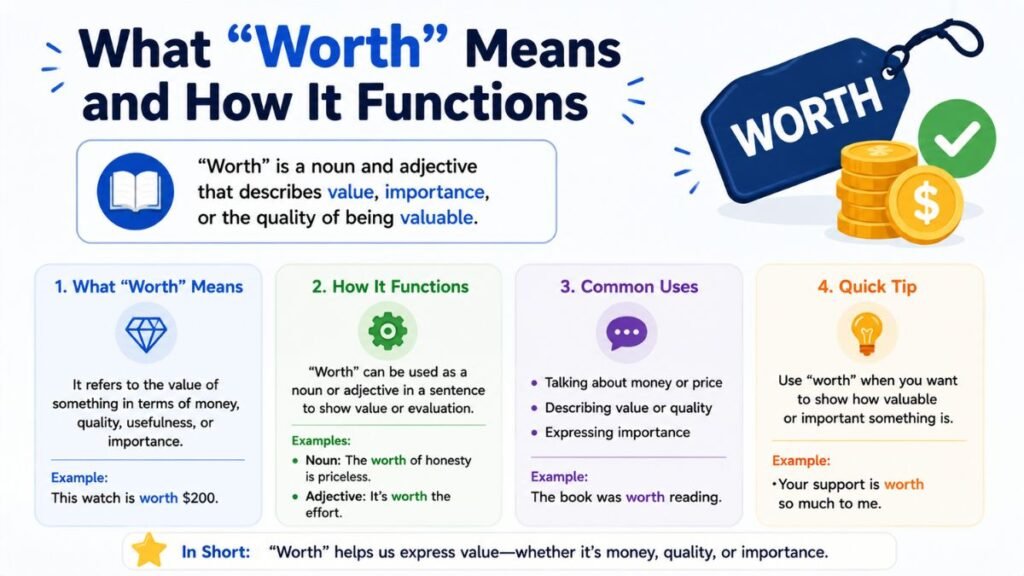
Worth describes value. It tells you whether something deserves the time, money, effort, or attention you’re putting into it. When you say something is it,” you’re making a judgment call: the cost matches, or exceeds, the reward.
Grammatically, worth behaves like an adjective, though it doesn’t act quite like typical adjectives such as “happy” or “tall.” You can’t say “very worth” the way you’d say “very happy” (more on that later). Instead, worth almost always needs a companion — a noun, a pronoun, or a gerund — right after it.
Think of worth as a word that can’t stand alone. It always needs to point at something. “This book is worth it” points at “it” (the money or time spent). “This job is worth the stress” points at “the stress.” Worth is constantly in relationship with something else in the sentence.
Worth as a Preposition-Like Adjective
Here’s where things get interesting for grammar nerds: worth acts a bit like a preposition even though it’s technically an adjective. Prepositions like “near,” “about,” or “despite” are followed directly by a noun or pronoun, no linking word needed between them and their object. Worth follows that same pattern after the linking verb:
- “It is worth the trip.” (worth + noun)
- “It is worth it.” (worth + pronoun)
- “It is worth trying.” (worth + gerund)
Notice the linking verb “is” comes before “worth,” and then “worth” jumps straight to its object without anything in between. That’s the pattern you need to memorize.
Why “It Worth It” Feels Right to Non-Native Speakers
If English isn’t your first language, and you’ve caught yourself saying “it worth it,” don’t beat yourself up over it. There are real, logical reasons this mistake happens so often.
Influence From Other Languages
Many languages don’t require a linking verb the way English does. In Russian, for example, present-tense sentences frequently skip the verb “to be” entirely — “Ona krasivaya” translates literally to “She beautiful,” not “She is beautiful.” Arabic and Hindi have similar patterns in certain tenses. If your native language allows you to connect a subject and an adjective without a verb, it’s completely natural to carry that habit into English. Your brain isn’t wrong; it’s just applying a rule from a different language system.
Fast Internet English
Casual texting, tweets, and comment sections have quietly reshaped how people write informally. “Worth it.” shows up constantly as a standalone reply — no subject, no verb, just the adjective phrase doing all the work. This is fine in texting shorthand. The problem is when learners absorb this compressed pattern and start treating it as the full grammatical rule, rather than recognizing it as a dropped-subject shortcut.
Misunderstanding the Word “Worth”
Some learners mistake worth for a verb because of how it’s used in similar-sounding constructions. Words like “cost” function as true verbs: “It cost me ten dollars.” Since “cost” doesn’t need “is” before it, learners sometimes assume “worth” works the same way. It doesn’t. “Cost” is a verb. “Worth” is an adjective. That single distinction explains most of the confusion.
The Correct Structure of “Worth It”
Here’s the formula, plain and simple:
Subject + to be (is/was/are/were) + worth + it / noun / gerund
Let’s break down each variation with real examples.
Worth + Noun
- “This car is worth the price.”
- “Her advice was worth the wait.”
- “The course is worth your time.”
Worth + Gerund
- “This movie is worth watching.”
- “That book is worth reading twice.”
- “The risk is worth taking.”
Note the gerund form here — “watching,” “reading,” “taking” — not the infinitive. You’ll never correctly say “worth to watch.” We’ll come back to that mistake shortly because it’s one of the most common ones out there.
Worth + Pronoun
- “She’s worth it.”
- “I promise, this is worth it.”
- “Was the trip worth it?”
Worth + Amount or Time
- “The painting is worth $2 million.”
- “It’s worth a shot.”
- “Honestly, it’s worth a few minutes of your day.”
This last category matters a lot in financial and everyday contexts — describing tangible value, like a car’s resale price, or intangible value, like the emotional payoff of a hard conversation.
Common Mistakes With “Worth”
Let’s go through the most frequent errors learners (and sometimes native speakers) make, one by one.
Leaving out “is”
- ❌ “It worth it.”
- ✅ “It is worth it.”
This is the headline mistake of this whole article, and it always comes down to the missing linking verb.
Using “Does it worth it?”
- ❌ “Does it worth it?”
- ✅ “Is it worth it?”
This error treats worth like a full verb, which triggers the auxiliary “does” the way real verbs do (“Does it cost a lot?”). But since worth isn’t a verb, it needs “is,” not “does.”
Saying “worthed”
- ❌ “It worthed the effort.”
- ✅ “It was worth the effort.”
There’s no such word as “worthed.” Adjectives don’t take -ed endings to show past tense; only verbs do. Since worth is an adjective, the past tense comes from changing “is” to “was,” not from modifying “worth” itself.
Saying “very worth it”
- ❌ “It’s very worth it.”
- ✅ “It’s totally worth it.” / “It’s definitely worth it.” / “It’s so worth it.”
This one surprises a lot of learners. Most adjectives happily pair with “very” — very tall, very expensive, very interesting. resists it. Native speakers rarely say “very out loud; it just sounds off. Instead, reach for totally it, definitely. completely it, absolutely or the casual so worth it. These intensifiers carry the same emphasis without the awkwardness.
Saying “worth to do”
- ❌ “It’s to visit that museum.”
- ✅ “It’s visiting that museum.”
Worth is followed by a gerund (the -ing form), never an infinitive (to + verb). This mistake is extremely common among speakers of languages where the infinitive is the default verb form after adjectives.
“Worth It To” — Is It Ever Correct?
Here’s a nuance most grammar guides skip entirely. “Worth it to” is sometimes correct, and sometimes wrong, depending on what comes right after it.
Correct usage: “worth it to” + a person
- “Is it worth it to you?”
- “The extra cost was it to the company.”
Here, “to you” or “to the company” identifies who finds the value, so this pattern is completely natural.
Incorrect usage: “worth it to” + a verb
- ❌ “It’s it to try.”
- ✅ “It’s trying.”
When a verb follows, drop “it to” entirely and switch to the gerund. it to try” is technically understandable, and you’ll hear it in casual speech, but trying” is the cleaner, more natural, and grammatically preferred structure in both spoken and written English.
Why Gerunds Sound More Natural
Native English speakers gravitate toward gerunds after because it mirrors how functions as a preposition-adjective hybrid, the same way you’d say “good at swimming” rather than “good at to swim.” Gerunds act like nouns, and a noun-like object. That’s the deep grammatical reason gerunds just sound right here.
“Worth” vs. “Worthy”
These two words look like siblings, but they don’t do the same job, and mixing them up is one of the more advanced mistakes English learners make.
Meaning of “Worth”
Worth measures the value of a thing — money, time, effort, attachment.
- “This ring is $500.”
- “Her friendship is more than gold.”
Meaning of “Worthy”
Worthy means deserving of something, usually respect, recognition, praise, or trust. It typically pairs with “of.”
- “He’s a worthy opponent.”
- “She’s worthy of respect.”
- “This achievement is worthy of praise.”
Comparison Table: Worth vs. Worthy
| Word | Function | Follows With | Example |
|---|---|---|---|
| Worth | Measures value | it / noun / gerund | “The house is worth $300,000.” |
| Worthy | Shows deservingness | of + noun | “The house is worthy of admiration.” |
Why “Worth” and “Worthy” Cannot Replace Each Other
You can’t say “the ring is worthy $500” — that’s nonsensical, because worthy doesn’t measure monetary or practical value. And you can’t say “he’s worth of respect” either — worth doesn’t pair with “of” in this deserving sense. Keep them in their separate lanes: = value, worthy = deservingness.
Understanding “Worthwhile”
Worthwhile is its own adjective, and it means something is valuable enough to justify the time or effort spent on it. It’s a single word, no space, and it doesn’t need an object after it the way” does.
- “The trip was worthwhile.”
- “It’s a worthwhile investment.”
- “Learning a new language is worthwhile.”
“Worth It” vs. “Worthwhile”
Here’s the practical difference: needs context (something specific it’s referring back to), while worthwhile stands on its own.
“The class was expensive, but it was worth it.” (worth it refers back to the cost of the class) “The class was worthwhile.” (no reference needed — worthwhile carries its own complete meaning)
They’re close cousins in meaning but different in grammar. “Worth it” leans conversational; “worthwhile” leans slightly more formal and shows up more often in academic writing, reports, and professional emails.
Common Collocations With “Worth”
English is full of set phrases — collocations — that pair naturally with. Learning these will boost your fluency far more than memorizing grammar rules alone.
- buying
- reading
- watching
- learning
- visiting
- trying
- discussing
- the effort
- the money
- the price
- the investment
Notice the pattern: worth pairs either with a gerund (buying, reading, watching) or with a noun phrase describing a resource (the money, the price, your time). Once you internalize this pattern, forming new sentences with worth becomes almost automatic.
Examples in Real Conversation
Seeing worth in action across different everyday situations makes the grammar stick better than rules alone.
Travel
- “Was the flight delay it once you saw the northern lights?”
- “That hike is absolutely worth the early wake-up call.”
Education
- “Honestly, this course was every penny.”
- “Is a master’s degree still the investment in this economy?”
Relationships
- “Every hard conversation with her turned out to be worth it.”
- “A good friend is worth more than a hundred acquaintances.”
Career
- “Was switching jobs worth the pay cut?”
- “The extra hours were worth it once the promotion came through.”
Why Native Speakers Sometimes Just Say “Worth It”
You’ll often hear native speakers drop the subject and verb entirely in casual speech: “Worth it.” as a full response to a question. This isn’t a grammar violation — it’s an ellipsis, a natural feature of spoken English where context fills in the missing words. If someone asks, “How was the concert, expensive tickets and all?” and you reply “Worth it,” everyone understands you mean “It was worth it.” This shortcut works because the full sentence is implied by the conversation. It’s casual, and it’s completely different from writing “it worth it” as if it were a complete standalone sentence.
Formal vs. Informal Usage of “Worth It”
Informal English allows more flexibility — dropped subjects, contractions, and quick replies like “So worth it” or “Not worth it, trust me.”
Formal English, on the other hand, always keeps the full structure intact: subject, linking verb, worth, and object. In academic writing, business emails, and reports, you’d write:
“The additional expenditure was worth the long-term return on investment.”
not
“Worth it, honestly.”
Knowing when to switch between these registers is a hallmark of real English fluency, not just grammar knowledge.
Using “Worth” in Questions
Questions with worth still require the linking verb — it just moves to the front.
Correct Examples
- “Is it worth it?”
- “Was the movie worth the hype?”
- “Are these shoes worth the price?”
- “Is a college degree still worth it these days?”
Never use “does” or “do” with worth in a question. “Does it worth it?” is a common error that treats worth as an action verb, which it simply isn’t.
Using “Worth” in Negative Sentences
Negating worth follows the same rule: negate the linking verb, not “worth” itself.
Examples
- “It’s not worth it.”
- “This isn’t worth the stress.”
- “The risk wasn’t worth taking.”
- “Honestly, it’s hardly worth mentioning.”
That last one — “hardly worth” — is a great natural intensifier for softening a negative judgment without being blunt.
Advanced “Worth” Structures
Once you’ve got the basics locked in, these advanced patterns will round out your understanding.
Worth + Amount
Used constantly in finance, real estate, and everyday value discussions:
- “The company is worth $4 billion.”
- “That antique clock is worth more than we thought.”
Worth + Pronoun
Shows up in emotional and personal contexts as much as practical ones:
- “You are worth so much more than you think.”
- “This friendship is worth protecting.”
Worth + Time Expressions
Common when weighing effort against outcome:
- “It’s worth a few extra minutes.”
- “The delay was worth an hour of waiting.”
- “Worth every second, honestly.”
The Psychology Behind “Worth It”
There’s something worth noting beyond grammar: the phrase “worth it” captures a mental cost-benefit calculation humans make constantly. Behavioral economists describe this as weighing reward vs. cost — deciding whether the payoff (financial, emotional, or practical) outweighs what you gave up to get it. That’s why “worth it” shows up so often in reflective, after-the-fact statements. We rarely say something is “worth it” in the moment; we usually say it looking back, once we can measure the tangible value or emotional value against what it actually took to get there.
Real-Life Examples of “Worth It”
Fitness
“Waking up at 5 a.m. for months straight? It was worth it when I finished my first marathon.”
Business
As one startup founder put it in a recent interview: “The eighteen-hour days felt brutal at the time, but looking back, every one of them was worth it.”
Learning English
“Grammar drills felt tedious at first, but once I could speak confidently, it was completely worth it.”
These examples show doing what it does best: summarizing a judgment about effort versus reward, in language that’s simple, direct, and universally understood.
Quick Reference Cheat Sheet
| Correct | Incorrect |
|---|---|
| It is worth it. | It worth it. |
| Is it worth it? | Does it worth it? |
| It was worth it. | It worthed. |
| It’s worth trying. | It’s worth to try. |
| It’s totally worth it. | It’s very worth it. |
| It’s not worth it. | It no worth it. |
Memory trick: Worth always needs a buddy. Pair it with is, was, or are before it, and a noun, pronoun, or gerund after it. never travels alone.
FAQs
Is “it worth it” grammatically correct?
No. “It worth it” is missing the linking verb “is.” The correct phrase is “it is worth it,” or in casual spoken shorthand, simply “worth it” as an ellipsis when the subject and verb are understood from context.
Why do people still say “it worth it” in conversation?
Usually because of influence from a native language that doesn’t require a linking verb, or from adopting internet shorthand (“worth it” as a text reply) as if it were a full grammatical rule rather than a contextual shortcut.
Is “I am worth it” correct?
Yes, completely correct. It follows the exact structure: subject (I) + linking verb (am) + worth + object (it).
What’s the difference between “worth” and “worthwhile”?
Worth needs an object after it (worth it, worth the money, worth trying), while worthwhile is a complete adjective that doesn’t need anything following it (“The trip was worthwhile”).
Can you say “worth to”?
Not directly before a verb — try” is incorrect; use trying” instead. But “worth it to [a person]” is correct, as in “It was to me.”
Conclusion
The rule really comes down to one small but essential detail: worth is an adjective, and adjectives need a linking verb to connect them to a subject. Say “it is” not it .” Beyond that core rule, the details — gerunds instead of infinitives, “totally it” instead of “very it,” and the distinction between worthy, and worthwhile — are what separate someone who knows the grammar rule from someone who actually sounds fluent. Keep the memory trick in mind: never travels alone. Give it a linking verb on one side and an object on the other, and you’ll get it right every time.
And read
HYS Mean in Text: What Does It Mean? Flirty or Friendly? (2026)
What Does OHP Mean in Text? Full Slang Guide (2026)
What Does OHRD Mean in Text? The Real Story Behind This Confusing Acronym (2026)

David Miller is the lead content writer at Meaning Loops, where he creates accurate and easy-to-understand content on word meanings, synonyms, antonyms, idioms, phrases, acronyms, abbreviations, and vocabulary. His goal is to help readers improve their English with reliable, well-researched, and SEO-friendly language resources.