You’ve typed it a hundred times without thinking twice. Then, out of nowhere, your cursor freezes over the keyboard. Is it “I don’t know weather I should go” or “I don’t know whether I should go”? And what in the world is a Wether’ or ‘Weather’ or ‘Whether,” anyway?
You’re not alone. Wether’ or ‘Weather’ or ‘Whether mix-ups rank among the most common spelling mistakes in English, and wether throws a third, rarely-seen word into the mix that trips up even careful writers. This guide breaks down wether vs weather vs whether in plain language, with real examples, memory tricks, and a cheat sheet you can bookmark for later.
By the end, you’ll know exactly which word to reach for, every single time.
The Quick Answer (For Skimmers)
Short on time? Here’s the deal in three sentences.
- Weather refers to atmospheric conditions — rain, sun, wind, snow, the stuff you check before leaving the house.
- Whether expresses choice or uncertainty between two or more options, like “if” but often more formal.
- Wether is a castrated male sheep, a term almost exclusively used in farming and livestock circles.
Here’s a trick that works almost every time: swap the word for “if.” If the sentence still makes sense, you need Wether’ or ‘Weather’ or ‘Whether. “I wonder if it’ll rain” and “I wonder whether it’ll rain” mean the same thing. Try that swap with “weather” or “wether,” and the sentence falls apart instantly. That one test solves the majority of mix-ups before you even open a dictionary.
What Does “Weather” Mean?
Let’s start with the word you already use daily, probably without a second thought.
Weather as a Noun
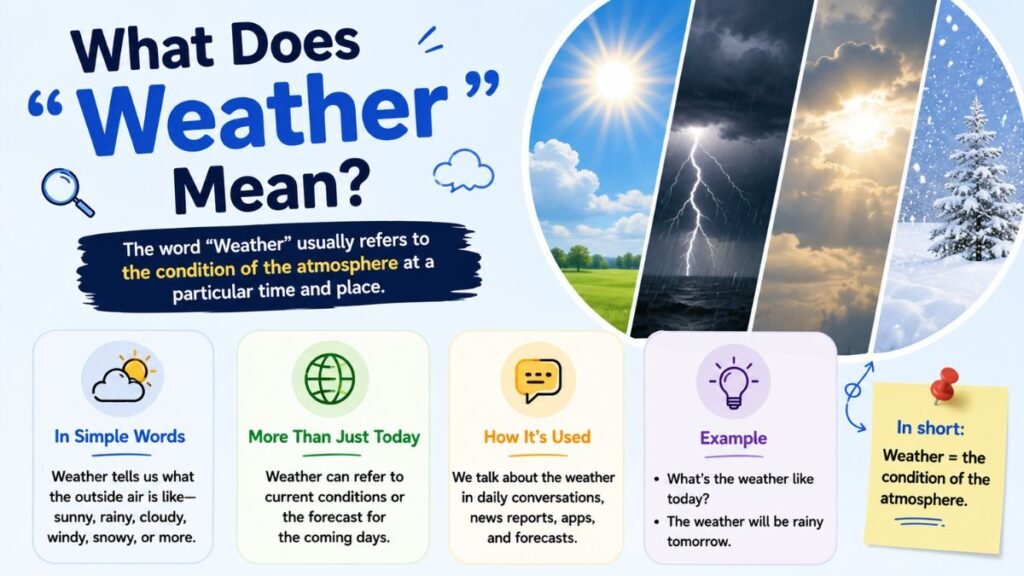
The weather definition, at its core, covers the day-to-day state of the atmosphere in a given place. Temperature, humidity, wind speed, cloud cover, precipitation — all of it falls under this single word. When your local news anchor talks about tomorrow’s weather forecast, they’re describing short-term atmospheric conditions, not long-term patterns (that’s climate, a related but separate concept).
Here’s a distinction worth remembering: weather changes hour to hour, while climate describes averages over decades. Arizona has a hot, dry climate. But even Arizona gets the occasional rainy, cold weather day. Confusing the two isn’t a grammar issue exactly, but it does trip people up in business writing and journalism.
Common Types of Weather
Weather comes in more flavors than most people bother naming. A quick rundown:
| Type of Weather | Typical Conditions |
|---|---|
| Sunny weather | Clear skies, minimal cloud cover, high visibility |
| Rainy weather | Precipitation, often paired with lower temperatures |
| Windy weather | High wind speeds, sometimes gusty or sustained |
| Snowy weather | Freezing temps, snowfall accumulation |
| Stormy weather | Thunder, lightning, heavy rain, or severe wind |
| Humid weather | High moisture content in the air, often sticky-feeling |
Each of these describes weather conditions at a specific moment, which is exactly why the word pairs so naturally with forecasts, warnings, and small talk at the bus stop.
Weather as a Verb
Here’s something a lot of people miss: weather doesn’t just sit around as a noun. It works as a verb too, meaning “to endure” or “to get through something difficult.” Think “the company managed to weather the recession” or “she weathered years of criticism without losing confidence.”
This verb form has nothing to do with rain or sunshine directly. Instead, it borrows the imagery of surviving harsh conditions and applies it to hardship in general. Ships “weather” storms. Businesses “weather” downturns. People “weather” tough seasons of life. It’s a small but useful shift in meaning, and native speakers use it constantly without even registering the metaphor buried inside it.
Common Phrases Using “Weather”
English loves to build idioms around weather, probably because everyone, everywhere, deals with it. A few worth knowing:
Under the weather — This one means feeling sick or unwell, not literally standing beneath a rain cloud. Nobody’s entirely sure where the phrase originated, though one popular theory ties it to sailors who’d go below deck when feeling ill during a storm, literally putting themselves “under” the bad weather.
Weather forecast — The prediction of upcoming atmospheric conditions, usually delivered by a meteorologist, an app, or your grandmother’s aching knee.
Fair-weather friend — Someone who sticks around only when things are easy, then disappears the moment trouble shows up. The phrase leans on the idea that fair (pleasant) weather brings people out, while foul weather sends them running.
What Does “Whether” Mean?
Now for the word that causes the most confusion in this whole trio.
Whether Expresses Choice or Uncertainty
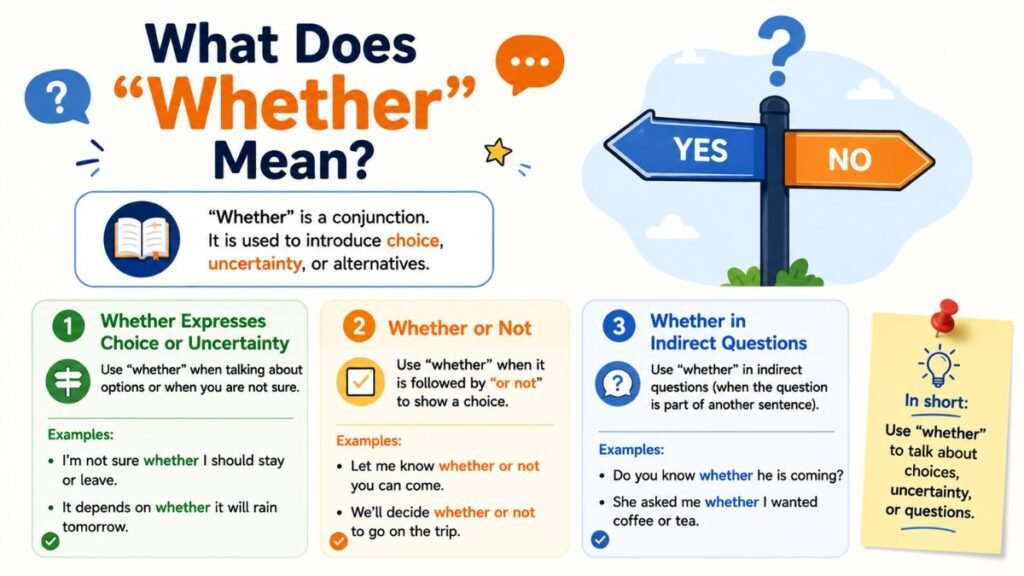
The whether meaning centers on decision-making and doubt. It introduces a question involving two or more possibilities, and it often shows up in situations where the outcome isn’t yet known. “I haven’t decided whether to accept the job offer” doesn’t just describe a decision — it captures the uncertainty behind it.
This is the heart of the weather and whether confusion, honestly. They sound identical when spoken aloud, yet one describes rain and sun, and the other describes a mental fork in the road. Nothing about pronunciation gives you a clue, which is exactly why context matters so much here.
Whether or Not
You’ve probably seen “whether or not” stapled together so often it feels like one word. Sometimes that “or not” earns its place, and sometimes it’s just dead weight.
- Necessary: “I’ll go for a run whether or not it rains.” (Here, “or not” emphasizes that the decision holds regardless of outcome.)
- Unnecessary: “I don’t know whether or not she’s coming.” (“Whether she’s coming” already implies the alternative — “or not she’s coming” — so the extra words add nothing.)
Trimming unnecessary “or nots” tightens your everyday writing without changing the meaning one bit.
Whether in Indirect Questions
Whether frequently introduces indirect questions, meaning questions embedded inside a larger sentence rather than asked directly. “She asked whether the meeting had been rescheduled” reports a question without quoting it word for word. This structure shows up constantly in business writing, emails, and reported speech, so getting comfortable with it pays off fast.
Whether vs. If — Are They Interchangeable?
This is where things get genuinely tricky, even for confident writers.
When “If” Works Fine
In casual conversation and most informal writing, if and whether swap freely. “Let me know if you’re coming” and “let me know whether you’re coming” both land fine in everyday speech. Native speakers use “if” constantly in this role, and nobody bats an eye.
When Only “Whether” Is Correct
Formal writing draws a sharper line, though, and a few specific structures demand whether, full stop.
Before an infinitive. “She couldn’t decide whether to leave” works. “She couldn’t decide if to leave” sounds broken because “if” can’t sit directly before an infinitive verb form like “to leave.”
With paired alternatives. “Whether X or Y” is a fixed structure. “I don’t care whether we eat pizza or tacos” reads naturally. Swap in “if,” and the sentence loses its rhythm and clarity.
After a preposition. Prepositions like “of,” “about,” or “on” require whether, never “if.” “The question of whether we should relocate” is correct. “The question of if we should relocate” isn’t standard English grammar.
Comparison Table
| Situation | Use “Whether” | Use “If” |
|---|---|---|
| Before an infinitive | ✅ “Decide whether to stay” | ❌ Not standard |
| With “or” alternatives | ✅ “Whether rain or shine” | ❌ Sounds off |
| After a preposition | ✅ “The issue of whether” | ❌ Not correct |
| Casual conditional statements | ✅ Works fine | ✅ Works fine |
| Formal writing, general uncertainty | ✅ Preferred | ⚠️ Acceptable but less polished |
As one longtime copyeditor put it during an industry panel on grammar rules: “If is the casual cousin. Whether is the one you invite to the formal dinner.” That distinction alone will steer you right nine times out of ten.
What Does “Wether” Mean? (The One Nobody Knows)
Here’s the word most people don’t even realize exists until autocorrect stops flagging it.
A Castrated Male Sheep
The wether definition is refreshingly specific: it’s a castrated male sheep, distinct from a ram (an intact male) and a ewe (a female). This isn’t some obscure dictionary relic either — it’s active sheep terminology used daily by ranchers and shepherds around the world.
The word traces back to Old English “weðer,” which itself connects to older Germanic roots referring to a yearling ram. Unlike weather and whether, which evolved alongside broader shifts in the English language, wether stayed narrowly tied to one specific meaning for centuries. It never expanded into idioms, verbs, or metaphors. It just quietly kept doing its one job.
Why It Survives in Farming and Livestock Terminology
In livestock management, distinguishing between rams, ewes, and wethers matters for practical reasons. Wethers don’t breed, so they’re often raised specifically for wool or meat production without the complications that come with intact males, like aggression or unwanted breeding. Agriculture communities rely on this precise vocabulary the same way medical professionals rely on precise anatomical terms — the specificity isn’t fussy, it’s functional.
Why It Almost Never Applies Outside That Context
Unless you’re reading a farming manual, drafting a livestock contract, or writing historical fiction set on a sheep farm, you’ll probably never need this word. That rarity is exactly why it confuses people. Spellcheck sometimes flags it as a typo simply because it’s used so infrequently that some dictionaries and software don’t prioritize it. If you’re not in farming or agriculture, chances are extremely high that “weather” or “whether” is what you actually meant.
Why People Mix These Up
There’s a reason this particular trio causes so much trouble, and it’s not because English speakers are careless.
They’re Homophones
Weather and whether are true homophones — words that sound completely identical despite different spellings and meanings. Wether pronounces almost the same way too, depending on regional accent. Since pronunciation offers zero clues, your brain has to rely entirely on context and memorized spelling rules to pick the right word. That’s a much harder task than it sounds, especially when you’re typing quickly.
Autocorrect Makes It Worse, Not Better
Here’s an uncomfortable truth: autocorrect won’t save you here. Because “weather,” “whether,” and “wether” are all real, correctly spelled words, spellcheck software has no way of knowing which one you meant based on spelling alone. It checks whether the word exists, not whether it fits the sentence. That means a weather vs whether typo can slip straight through a spellchecker, into a final email, and out into the world before anyone notices.
Muscle Memory From Typing “Weather” More Often
Because people talk about weather forecasts far more often than they discuss decisions or livestock, “weather” becomes the default word your fingers reach for, even when your brain means “whether.” This kind of muscle memory error happens to fast typists and careful writers alike. It’s not a knowledge gap; it’s a speed problem.
Side-by-Side Examples
Seeing all three words in action, side by side, makes the differences click faster than any rule ever could.
- ✅ “The weather today is sunny with a light breeze.” (atmospheric conditions)
- ✅ “I’m not sure whether I locked the front door.” (uncertainty)
- ✅ “The farmer separated the wether from the rest of the flock.” (castrated male sheep)
- ❌ “I don’t know weather I should call her.” → ✅ “I don’t know whether I should call her.”
- ❌ “Check the whether before you leave.” → ✅ “Check the weather before you leave.”
- ❌ “That old ram is actually a weather now.” → ✅ “That old ram is actually a wether now.”
Notice how the wrong word doesn’t just look off — it changes the entire meaning of the sentence, sometimes into something nonsensical.
Memory Tricks That Actually Work
If rules alone don’t stick, these visual and phonetic shortcuts might do the trick.
- Weather contains “EAT,” and eating happens outdoors, in nature, under whatever conditions the sky throws at you. Nature equals weather.
- Whether contains “ETHER,” and ether famously has no fixed form — kind of like a decision that hasn’t been made yet. Uncertainty equals whether.
- Wether is the odd one out, short and rare, reserved almost entirely for livestock. If you’re not talking about sheep, it’s probably not this word.
The Three-Second Test
Before you hit send, pause and ask: Am I talking about rain and sun? Use weather. Am I talking about a choice or a doubt? Use whether. Am I talking about a sheep? Use wether. Three seconds, three questions, zero embarrassing typos.
Common Mistakes (Real Examples)
Even experienced writers slip up here. A few patterns show up again and again.
- “Weather or not” instead of “whether or not” — this is one of the most common English mistakes in casual writing, especially in text messages and quick emails where nobody proofreads.
- Assuming “wether” is always a typo and deleting it, even in contexts (like farming content) where it’s the correct word.
- Overusing “or not” after whether, padding sentences unnecessarily when the alternative is already implied.
A quick self-check habit fixes most of these: read your sentence back and ask what you actually meant before you hit publish or send.
Quick Cheat Sheet
Bookmark this table. It’s built for fast scanning when you’re mid-sentence and second-guessing yourself.
| Word | Meaning | Part of Speech | Example |
|---|---|---|---|
| Weather | Atmospheric conditions (rain, sun, wind) | Noun / Verb | “The weather turned cold overnight.” |
| Whether | Choice or uncertainty between options | Conjunction | “I’m unsure whether to stay or go.” |
| Wether | A castrated male sheep | Noun | “The wether grazed near the barn.” |
FAQs
Is “wether” a real word?
Yes. It’s a legitimate dictionary word meaning a castrated male sheep, commonly used in farming and livestock management. It’s rare in everyday conversation, but it’s not a typo or a made-up term.
Can “whether” and “if” always be swapped?
Not always. Casual sentences usually allow either word. Formal structures — especially before infinitives, with paired alternatives, or after prepositions — require whether, not “if.” When precision matters, default to whether.
Why does spellcheck miss these errors?
Autocorrect and spellcheck tools check whether a word is spelled correctly, not whether it’s the right word for the sentence. Since “weather,” “whether,” and “wether” are all correctly spelled, none of them get flagged, even when you’ve picked the wrong one entirely.
What’s the fastest way to check which one I need?
Try swapping in “if.” If the sentence still makes sense, you need whether. If you’re describing rain, sun, or temperature, you need weather. If you’re talking about sheep, you need wether. This quick test resolves the vast majority of confusion in seconds.
Final Thoughts
Three words, one sound, wildly different meanings. That’s the whole story behind wether vs weather vs whether, and once the distinction clicks, it tends to stay clicked. Weather belongs to the sky. Whether belongs to decisions and doubt. Wether belongs to the farm, and honestly, it’ll rarely show up in your writing at all.
Next time your fingers hesitate over the keyboard, run the three-second test: rain or shine, choice or doubt, or sheep? Pick the right lane, and you’ll never send another sentence that quietly says something you didn’t mean.
And Read
What Does YWT Mean in Text? Simple Meaning Explained (2026)
HYS Mean in Text: What Does It Mean? Flirty or Friendly? (2026)
What Does OHP Mean in Text? Full Slang Guide (2026)

David Miller is the lead content writer at Meaning Loops, where he creates accurate and easy-to-understand content on word meanings, synonyms, antonyms, idioms, phrases, acronyms, abbreviations, and vocabulary. His goal is to help readers improve their English with reliable, well-researched, and SEO-friendly language resources.

1 thought on “‘Wether’ or ‘Weather’ or ‘Whether’: What’s the Difference?”