Ever typed “Sleeve vs. Sleave: Which One Should You Actually Use?” and had that nagging feeling something was off? You’re not imagining things. These two words sound identical, yet only one of them belongs in your everyday writing. The other is a linguistic fossil hiding in old poetry.
This guide clears up the confusion once and for all. You’ll learn exactly what each word means, where they came from, and why your spellchecker sometimes lets “sleave” slide through when it shouldn’t. By the end, you won’t need to second-guess yourself again.
The Short Answer
Here’s the deal in one breath: use “sleeve” for almost everything you write. It’s the part of a shirt that covers your arm, the protective case around your vinyl record, and the word behind idioms like “up your sleeve.”
“Sleave,” on the other hand, is a real but archaic word that once referred to untwisted silk thread. You’ll find it in Shakespeare. You won’t find it in a text message, a resume, or a product description—unless you’re quoting Macbeth, that word has no business showing up in modern writing.
If you remember nothing else from this article, remember that. Everything below fills in the details.
What “Sleeve” Means
Definition and Pronunciation
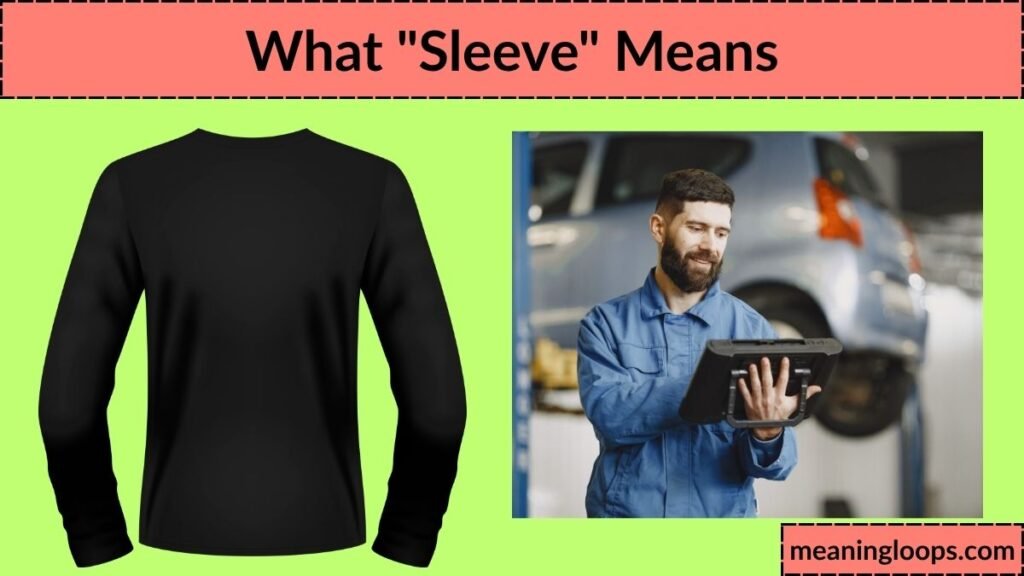
A sleeve is the part of a garment that covers all or part of the arm. Pronounced /sliːv/ (it rhymes with “believe”), the word functions as a noun in nearly every context you’ll encounter it.
But clothing isn’t the whole story. In broader usage, a sleeve is any tube-shaped covering that wraps around and protects something else. Think of a mechanical sleeve fitted around a shaft, or a cardboard sleeve wrapped around a hot coffee cup. The core idea stays consistent: something cylindrical that covers or shields.
Where the Word Comes From
The word traces back to Old English slēfe, which itself likely descended from a Proto-Germanic root, slēwō. Over centuries, spelling shifted through Middle English before settling into the “sleeve” we use today. Unlike many English words that got scrambled by French or Latin influence, “sleeve” has stayed remarkably close to its Germanic roots.
Here’s a fun wrinkle: while “sleeve” vs “sleave” look like they might share a common ancestor, they don’t. They evolved from completely separate root words that just happened to converge on the same pronunciation over time. That coincidence is the entire reason this article exists.
The Different Ways We Use “Sleeve” Today
“Sleeve” shows up in more places than you’d think. Here’s a breakdown:
| Category | Example |
|---|---|
| Clothing | “The jacket has long sleeves.” |
| Tech and objects | “Slide the laptop into its sleeve.” |
| Music/media | “The vinyl record sleeve was torn.” |
| Mechanical parts | “A sleeve fits around the pipe joint.” |
| Idiomatic | “She had a plan up her sleeve.” |
| Tattoos | “He’s getting a full sleeve tattoo.” |
That range matters. A word that only meant “shirt arm” wouldn’t need this much explanation, but “sleeve” pulls double and triple duty across clothing, mechanics, music packaging, and figurative speech. That’s part of why it stayed common while “sleave” faded out—useful words survive.
Common idioms worth knowing:
- “Up your sleeve” — a secret plan or hidden trick, like a card player concealing an ace
- “Wear your heart on your sleeve“ — showing your emotions openly, without holding back
- “Roll up your Sleeve vs Sleave” — getting ready to work hard
- “Something up one’s sleeve” — having a surprise or resource in reserve
These phrases have drifted so far from literal clothing that most people use them without picturing an actual sleeve at all. That’s the mark of a truly embedded idiom.
Real Examples of “Sleeve” in a Sentence
Seeing a word in context does more for memory than any definition. Here are several:
- “She rolled up her sleeves before starting the dishes.”
- “The mechanic replaced the worn sleeve around the piston.”
- “He kept a backup plan up his sleeve just in case.“
- “The record’s cardboard sleeve had a small tear in the corner.”
- “Long sleeves work better for cold-weather hikes.”
- “The barista wrapped a paper sleeve around my coffee cup.”
Notice how none of these repeat the exact same structure. Varying sentence length and subject keeps the examples from reading like a robotic drill—and honestly, that’s good advice for your own writing too.
So What Is “Sleave,” Then?
The Actual Definition
Buckle up, because this is where things get interesting. “Sleeve vs Sleave is a noun that refers to untwisted silk fibers or a tangled skein of thread. As a verb, “to sleave” meant to separate or untwist those tangled threads—basically, the process of untangling raw silk before it could be spun into usable material.
Merriam-Webster lists two entries: the noun form, meaning a skein of thread, and an obsolete verb form meaning to separate silk thread into filaments. Both carry the “archaic” or “obsolete” label, which tells you everything about how often you’ll need this word in daily life.
Where “Sleave” Came From
The etymology takes a different road than “sleeve.” Most sources trace it to Old English -slǣfan, meaning “to cut.” Collins Dictionary points to a similar root, Old English slǣfan, meaning to divide, related to Middle Low German slēf and Norwegian sleiv, an old word for a big spoon. Strange bedfellows, but that’s etymology for you—words drift and connect in ways that rarely make intuitive sense centuries later.
The word entered wider use during the height of the European silk trade in the Middle Ages, when working with raw silk fiber was a specialized and valuable skill. Weavers needed a specific term for tangled or unworked silk, and “sleave” filled that niche.
The Shakespeare Connection
Here’s the reason “sleave” survived into modern dictionaries at all, rather than disappearing entirely like thousands of other obsolete English words: William Shakespeare.
In Macbeth, Act 2, Scene 2, Shakespeare writes about sleep as something that “knits up the ravell’d sleave of care.” The image is gorgeous once you understand the reference—sleep untangles the knotted, frayed threads of a person’s worries, the same way a weaver would untangle raw silk before spinning it. Sleep, in other words, is the weaver of a troubled mind.
“Sleep that knits up the ravell’d sleave of care” — William Shakespeare, Macbeth
That single line has done more to keep “sleave” alive in the modern era than any other factor. English teachers still explain it to students every year, which means the word gets a small resurgence every time a new class studies the play. Without Shakespeare, “sleave” might have vanished from dictionaries decades ago.
Real Examples of “Sleave” in a Sentence
Because this word is so rare, examples are harder to come by naturally. Here are a few that show correct usage:
- “The weaver spent hours sleaving the tangled silk into usable thread.”
- “Scholars still quote Shakespeare’s line about the ravell’d sleave of care.”
- “The old textile manual described Sleeve vs Sleave as raw silk before processing.”
Notice something important: you’ll almost never write these sentences yourself unless you’re working in textile history, quoting classic literature, or writing a piece exactly like this one. That’s not a knock against the word—it’s just an honest description of how rare it’s become.
Why Do People Mix These Up?
This isn’t really a spelling problem. It’s a pronunciation problem wearing a spelling costume.
Sleeve and sleave are homophones—they sound completely identical, both pronounced /sliːv/. English has plenty of these traps: “there,” “their,” and “they’re” cause the same kind of trouble, as do “your” and “you’re.” When two words sound the same but mean completely different things, your brain has to rely purely on context and memorized spelling to pick correctly.
A few other factors pile on top of that core issue:
- Autocorrect and spellcheck won’t always catch it. Since “sleave” is a legitimate dictionary word, most spellcheckers won’t flag it as an error, even when you meant Sleeve vs Sleave.” The software has no way of knowing your intent—it only checks whether the word exists.
- Rarity breeds unfamiliarity. Because “sleave” shows up so infrequently, most people have literally never seen it in print. When they do encounter it, their brain assumes it’s a typo rather than a real, if obscure, word.
- Visual similarity adds to the confusion. The two words differ by a single letter, swapping an “e” for an “a” in the middle. That’s a tiny visual gap for your eyes to catch, especially when skimming.
Here’s a useful way to think about it: “sleave” isn’t competing with “sleeve” for popularity. It lost that fight centuries ago. The confusion exists purely because spellcheck tools are permissive and human memory defaults to the version we’ve seen ten thousand times over the version we’ve maybe seen once.
Sleeve or Sleave — A Fast Way to Decide

When you’re staring at a sentence and can’t remember which spelling belongs, run through this quick table:
| If you’re writing about… | Use this word |
|---|---|
| Shirts, jackets, or any clothing | sleeve |
| Tech accessories, laptop cases, protective covers | sleeve |
| Common idioms (“up your sleeve,” “heart on your sleeve”) | sleeve |
| Mechanical parts (pipe joints, shaft coverings) | sleeve |
| Quoting Shakespeare or historical poetry | sleave |
| Discussing untwisted silk in a textile history context | sleave |
A simple mnemonic: think “sleeve” rhymes with “believe,” and both are common, everyday words you actually use. “Sleave,” by contrast, pairs naturally with “weave”—both textile terms, both a little old-fashioned, both words you’d find in a history book before you’d find them in a group chat.
If you’re ever genuinely unsure which word fits, here’s the safest bet: default to “sleeve.” Statistically, that’s correct roughly 99% of the time. The exceptions are narrow enough that you’ll know when they apply—you’ll be quoting a play, translating archaic text, or writing specifically about historical silk production.
Is “Sleave” Even Still a Word?
Yes, and this deserves a direct answer because plenty of people assume it’s just a typo. It isn’t.
Sleeve vs Sleave” appears in Merriam-Webster, Collins English Dictionary, the American Heritage Dictionary, and The Free Dictionary, all of which confirm it as a legitimate, if archaic, English word. It’s also valid in tournament Scrabble dictionaries, which accept plenty of obsolete and rarely-used words as long as they’ve historically appeared in standard references.
So what separates a “real but rare” word from a genuine misspelling? Context and intent. If you write “sleave” meaning to describe a shirt’s arm covering, that’s a mistake—you wanted “sleeve” and typed the wrong one. But if you write “sleave” while discussing raw silk thread or quoting Shakespeare, you’re using the word exactly as intended. Same spelling, completely different judgment call depending on what you meant to say.
This distinction matters for writers, editors, and students alike. Flagging “Sleeve vs Sleave as always wrong would be inaccurate. Flagging it as always right would be equally unhelpful. The correct answer depends entirely on context, which is exactly why this guide exists.
Frequently Asked Questions
Is “sleave” a real word or just a typo for “sleeve”?
It’s a real word, though extremely rare in modern English. Dictionaries list it as archaic, referring to untwisted silk thread. In the overwhelming majority of cases, though, if you typed “sleave” and meant a shirt’s arm covering, you made a spelling mistake and want “sleeve” instead.
What does “sleave” mean in Macbeth?
In Shakespeare’s line about sleep knitting up “the ravell’d sleave of care,” Sleeve vs Sleave refers to tangled silk thread. The metaphor compares a troubled mind to knotted, unworked silk, with sleep acting as the force that untangles and smooths it out.
Why do sleeve and sleave sound the same?
They’re homophones with completely different etymological roots that happened to converge on the same pronunciation, /sliːv/, over centuries of language evolution. It’s coincidence, not shared origin.
Will spellcheck catch it if I use the wrong one?
Not reliably. Since “sleave” is a genuine dictionary word, most spellcheckers won’t flag it, even in a sentence where you clearly meant “sleeve.” This is exactly why homophone pairs like this one slip through so often in professional and academic writing.
Is “sleave” used anywhere in modern English?
Rarely, and almost exclusively in literary discussion, historical texts about textile production, or direct quotations from older works like Macbeth. Outside of those specific contexts, you won’t encounter it in everyday modern writing.
Bottom Line
The rule here is refreshingly simple, even if the etymology behind it isn’t: write “sleeve” for clothing, objects, idioms, and virtually everything else, and reserve “sleave” for Shakespeare quotes or textile history. These words aren’t actually competing—one is a thriving, everyday part of modern English, and the other is a quiet relic that survives mostly because a playwright wrote one unforgettable line about sleep and tangled silk four centuries ago.
Next time your fingers type “sleave” out of habit, pause for a second and ask yourself what you’re actually describing. Nine times out of ten—closer to ninety-nine—you’ll want “sleeve.” And now you’ll know exactly why.
Read
‘Wether’ or ‘Weather’ or ‘Whether’: What’s the Difference?
What Is FRL in Texting? Meaning, Examples & Usage (2026)
Frescade Meaning: What It Means and How to Use It (2026 Guide)

David Miller is the lead content writer at Meaning Loops, where he creates accurate and easy-to-understand content on word meanings, synonyms, antonyms, idioms, phrases, acronyms, abbreviations, and vocabulary. His goal is to help readers improve their English with reliable, well-researched, and SEO-friendly language resources.