Ever heard someone say “I’m your Huckleberry Meaning” and wondered what on earth that means? You’re not alone. This odd little word carries a double life: it’s a real fruit that grows wild across North America, and it’s also one of the most colorful idioms in American English. Let’s dig into both.
What Is a Huckleberry, Actually?
Start with the basics. A huckleberry meaning is a small, round berry, usually dark blue or deep purple, that grows wild on shrubs across North America. It looks a lot like a blueberry, and honestly, most people can’t tell the two apart at a glance. But they’re different fruits entirely.
Here’s where it gets interesting botanically. “Huckleberry” isn’t one single species. It’s actually an umbrella term covering several different plants, mainly from the genera Vaccinium and Gaylussacia. So when someone in Montana talks about huckleberries and someone in Maine does too, they might be describing slightly different fruits.
A few quick facts worth knowing:
- Where they grow: Huckleberry Meaning bushes thrive in the Pacific Northwest, the Rocky Mountains, and parts of Appalachia
- Season: Most varieties ripen in mid-to-late summer, typically July through September
- Farming: You basically can’t commercially farm huckleberries. They resist domestication and grow best wild, in acidic, well-drained soil
- Taste: Sweet-tart, with a deeper, more intense flavor than a blueberry
That last point matters more than you’d think. Because huckleberries can’t easily be mass-farmed, they’re prized. Foragers hike into the mountains every summer to pick them by hand, and in places like Montana, huckleberry season is practically a cultural event.
Huckleberry vs. Blueberry: A Quick Comparison
People mix these two up constantly, so here’s a side-by-side to settle it.
| Feature | Huckleberry | Blueberry |
|---|---|---|
| Color | Dark blue to deep purple, sometimes red or black | Blue to blue-gray |
| Taste | Tart and intense, slightly sweet | Mild, sweet |
| Seeds | Larger, slightly crunchy seeds | Small, soft seeds |
| Growing | Wild only, hard to cultivate | Widely farmed commercially |
| Availability | Limited, seasonal, regional | Year-round in most grocery stores |
If you’ve only ever had blueberries, a real wild Huckleberry Meaning will genuinely surprise you. The tartness hits first, then a rich sweetness follows. It’s the kind of flavor that explains why people build entire festivals around it.
How “Huckleberry” Became American Slang
Now here’s where the word starts doing more than describing a fruit. To understand the phrase “I’m your huckleberry,” you have to trace how the word itself evolved over a couple hundred years.
Linguists trace the word back to the English term “hurtleberry,” a dialect name for a small, dark, sweet fruit that reminded early European settlers of berries back home. Nobody knows exactly where “hurtleberry” came from, though some think it relates to “hurt,” possibly from the bruised color of the berries; a related British dialect term is “whortleberry.” By around 1670, that word had shifted into something closer to the “huckleberry” we use today.
Once the word took root in American English, it started picking up figurative meanings that had nothing to do with fruit. Because huckleberries are small, dark, and rather unremarkable, by the early 1800s the word had become slang for something humble, minor, or a tiny amount. You’ll actually spot this usage in early American literature. James Kirke Paulding’s 1832 novel Westward Ho! uses the phrase “within a huckleberry of” to mean coming very close to something, in that case, coming close to death.
By the 1860s, the word had shifted again, this time toward something warmer. People started using “huckleberry” to refer to one’s sweetheart or friend, a term of endearment for someone close to you. That shift, from “something small and insignificant” to “someone dear and dependable,” is the bridge you need to understand the phrase everyone actually searches for.
“I’m Your Huckleberry” — Where the Phrase Actually Comes From
Let’s clear up a myth first, because it’s everywhere online and it’s just not true.
The pallbearer myth: You’ll find plenty of sites claiming “huckleberry” is a corruption of “hucklebearer,” supposedly an old English term for pallbearers, and that Doc Holliday was really threatening to be Johnny Ringo’s funeral carrier. It’s a fun story. It also has zero historical backing. Linguists and etymologists who’ve actually traced the written record have found no documented use of “hucklebearer” as a real term before the myth started circulating, likely inspired by people simply mishearing the line in the movie.
The real story is more interesting anyway. “I’m your Huckleberry Meaning” is 19th-century American slang, meaning “I’m the right person for the job” or “I’m exactly who you’re looking for.” It’s a phrase from the late 19th century meaning someone is the right person for the job or up to the challenge, similar in spirit to saying “I’m your man.”
The documented history goes back further than most people realize. The phrase shows up in the 1862 papers of Val C. Giles, a Confederate soldier, describing two gamblers cheating with loaded dice. That’s a full three decades before anyone had heard of Doc Holliday. The phrase also turns up in ordinary commercial life. An 1873 flour and cornmeal seller in Nebraska ended a newspaper ad with “we are your huckleberry,” essentially promising they were exactly what the customer needed. This wasn’t rare frontier slang confined to gunfighters. It was common, everyday American vernacular.Why did “huckleberry” specifically come to mean “the right person”? Nobody has pinned down a perfectly tidy explanation. But it likely built on that earlier sense of the word as a term of affection for a close companion. If your huckleberry is your trusted friend, then saying “I’m your huckleberry” naturally slides into meaning “I’m the one you can count on.”
Doc Holliday, Tombstone, and Pop Culture
So if the movie didn’t invent the phrase, why does everyone associate it with Val Kilmer? Simple: he made it iconic.
In Tombstone (1993), when Johnny Ringo is
shown up to duel him in a graveyard, Holliday responds with the now-famous line. Kilmer’s delivery, calm, a little amused, thoroughly unbothered, turned an obscure piece of 19th-century slang into one of the most quoted lines in Western film history.
The real historical account is almost as good as the movie version. According to one account of the actual Earp-Ringo standoff, Ringo told Holliday “here’s my handkerchief, take hold” as a challenge, and Holliday replied, “I’m your huckleberry, Ringo. That’s just my game.” Whether that exact exchange happened word-for-word is debated by historians, but the phrase itself was already circulating in exactly that context: a confident, almost cheerful acceptance of a challenge.
The line’s had a long afterlife since 1993. It shows up in country songs, TV shows, video games, and social media captions, almost always carrying that same swagger: I’ve got this. I’m the one you want.
Mark Twain’s Huckleberry Finn — A Different Kind of Huckleberry
Here’s where a lot of articles skip over something worth actually explaining. Mark Twain didn’t pick the name “Huckleberry Finn” randomly.
Remember that earlier slang sense, small, humble, unremarkable? That’s exactly the character Twain built. Huck Finn is a poor, uneducated, socially marginal boy, about as far from a respectable, “important” person as you could get in 1880s Missouri. Naming him after a small, wild, unfarmed berry wasn’t an accident. It signaled from the title page that this was a story about someone society considered minor and disposable.
That’s part of what makes Adventures of Huckleberry Meaning Finn so quietly radical. Twain took a character defined by smallness and insignificance and made him the moral center of the novel, more honest, more perceptive, and ultimately more courageous than most of the “respectable” adults around him. The name carries the theme before you’ve read a single chapter: rural innocence, simplicity, and a kind of quiet dependability that outshines polish and status.
So when you see “huckleberry” pop up in both a gunfighter’s boast and a barefoot boy’s name, you’re actually looking at the same underlying idea, just aimed in two different directions. One says “I’m small, but I’m exactly enough.” The other says “I’m small, but don’t underestimate me.”
How People Use “Huckleberry” Today
The word hasn’t stayed frozen in the 1800s. It shows up in a few distinct ways depending on context.
Literal, everyday use. People in Huckleberry Meaning-growing regions talk about the fruit constantly, foraging trips, jam recipes, pie fillings. Montana even named the huckleberry its official state fruit, and you’ll see it on everything from candy to beer labels there.
Idiomatic use. “I’m your Huckleberry Meaning” still gets used, usually with a wink, when someone wants to volunteer for a task with confidence. It’s playful rather than boastful. Someone says, “We need someone to handle this,” and you respond, “I’m your huckleberry,” it signals readiness without sounding pushy or arrogant.
Regional identity marker. In parts of the Pacific Northwest and Montana, “huckleberry” functions almost like a badge of local pride, similar to how Georgians talk about peaches. It’s shorthand for home.
Here’s how the phrase tends to break down by context:
| Context | Meaning | Example |
|---|---|---|
| Literal | Describing the fruit | “We picked huckleberries all afternoon.” |
| Idiomatic (confidence) | “I’m the right person” | “Need someone to fix this? I’m your huckleberry.” |
| Idiomatic (challenge) | “I accept” / “Bring it on” | Used in confrontational or competitive contexts |
| Historical/archaic | Small amount or degree | “Within a huckleberry of” (close to something) |
| Term of endearment | Close friend or sweetheart | 19th-century usage among companions |
Other Huckleberry Idioms Worth Knowing
The phrase “I’m your huckleberry” gets all the attention, but it’s not the only huckleberry expression that’s floated around American English.
- “A huckleberry over my persimmon“ — meant something was a bit beyond one’s abilities, essentially “that’s out of my league.” The persimmon, being a larger fruit, stood in for something bigger and harder to reach.
- “Huckleberry friend” — huckleberries carried an affectionate connotation tied to smallness, echoed in the lyrics of “Moon River,” where “my huckleberry friend” describes someone dear and familiar, not grand, just close.
- “Not worth a huckleberry” — an older way of dismissing something as worthless or trivial, drawing on the fruit’s reputation as small and humble.
None of these are common in everyday speech anymore, but they show how flexible the word became once Americans started using it figuratively.
Huckleberries as Food — Taste, Nutrition, and How to Use Them
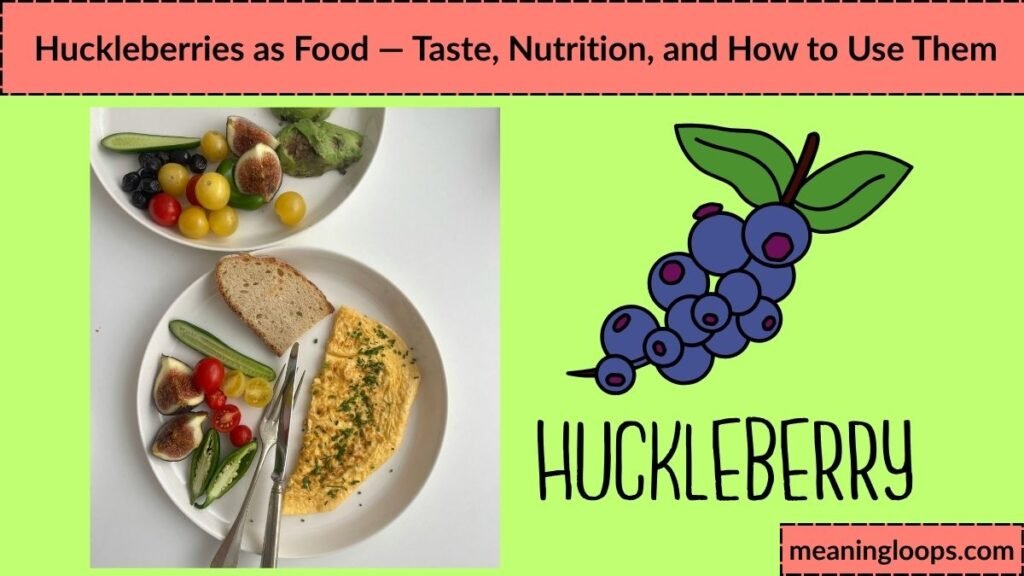
Let’s get back to the actual fruit, because it deserves attention on its own merits.
Fresh huckleberries have a flavor that’s hard to replicate. Tart up front, sweet underneath, with a slightly firmer bite than a blueberry thanks to those larger seeds. Chefs and home bakers who get their hands on wild huckleberries tend to use them sparingly and let the flavor lead.
Common uses include:
- Jams and preserves (the tartness holds up beautifully against sugar)
- Pie fillings, often paired with a simple lattice crust
- Syrups for pancakes or cocktails
- Baked into muffins and scones
- Candies and chocolates, especially popular as regional souvenirs in Montana and Idaho
Nutritionally, huckleberries hold their own against any “superfood” berry you’d find in a grocery store. They’re rich in antioxidants, particularly anthocyanins, the same compounds responsible for their deep color. They also offer a solid dose of vitamin C, dietary fiber, and manganese. Some traditional folk medicine practices used huckleberry leaves and fruit to support digestive health and reduce inflammation, though modern research on huckleberries specifically is still fairly limited compared to blueberries.
If you’re foraging, a word of caution: always positively identify huckleberry bushes before eating anything you pick. Some lookalike berries in the wild aren’t safe to eat, and huckleberry leaves and unripe berries can cause stomach upset.
FAQs
What does “huckleberry” mean in slang?
In 19th-century American slang, “huckleberry” meant someone perfectly suited for a task, or affectionately, a close friend. The phrase “I’m your huckleberry” specifically means “I’m the right person for the job.”
Did Doc Holliday really say “I’m your huckleberry,” or is it a movie invention?
The phrase predates the film Tombstone (1993) by decades. Documented uses appear as early as 1862. The movie popularized the line but didn’t invent it, and historical accounts suggest Holliday did use a version of the phrase during his real-life standoff with Johnny Ringo.
Is a huckleberry the same as a blueberry?
No. They look similar and belong to related plant families, but huckleberries have larger seeds, a more intense sweet-tart flavor, and can’t be commercially farmed the way blueberries can.
Are huckleberries safe and healthy to eat?
Yes, ripe huckleberries are safe and nutritious, packed with antioxidants, vitamin C, and fiber. Just make sure you correctly identify the plant before foraging, since some wild lookalikes aren’t edible.
What does “I’ll be your huckleberry” mean today?
It’s a lighthearted, confident way to volunteer for something, essentially “I’ve got this” or “I’m up for the challenge.” You’ll still hear it used playfully in casual conversation, especially in the South and West.
conclusion
“Huckleberry” leads a double life, and that’s exactly what makes it such a rich piece of American English. As a fruit, it’s a small, wild, sweet-tart berry that resists domestication and rewards anyone willing to forage for it. As an idiom, it traveled from meaning “something small and unremarkable” to “a dear friend” to, eventually, “exactly the right person for the job,” a journey that took it from Civil War-era slang all the way to Val Kilmer’s graveyard showdown in Tombstone. Mark Twain leaned on that same humble connotation when he named his most famous character, turning a small, overlooked fruit into a symbol of quiet integrity. Fruit or phrase, the word has held onto one consistent thread for nearly two centuries: something small that turns out to matter a great deal.
And Read
What Does HY Mean in Text? Meaning, Uses & Examples (2026)
Hooplehead: The Full Story Behind One of American Slang’s Strangest Insults
Orientated vs Oriented: Understanding the Difference (And Which One to Actually Use)

David Miller is the lead content writer at Meaning Loops, where he creates accurate and easy-to-understand content on word meanings, synonyms, antonyms, idioms, phrases, acronyms, abbreviations, and vocabulary. His goal is to help readers improve their English with reliable, well-researched, and SEO-friendly language resources.


1 thought on “What Does “Huckleberry” Meaning? Definition, Origin, and How People Use It Today”