You just got a text that says “imy” and now you’re staring at your phone trying to decode it. You’re not alone — this four-letter combo shows up everywhere from Snapchat streaks to late-night group chats, and if you didn’t grow up texting in shorthand, it can look like a typo more than a message.
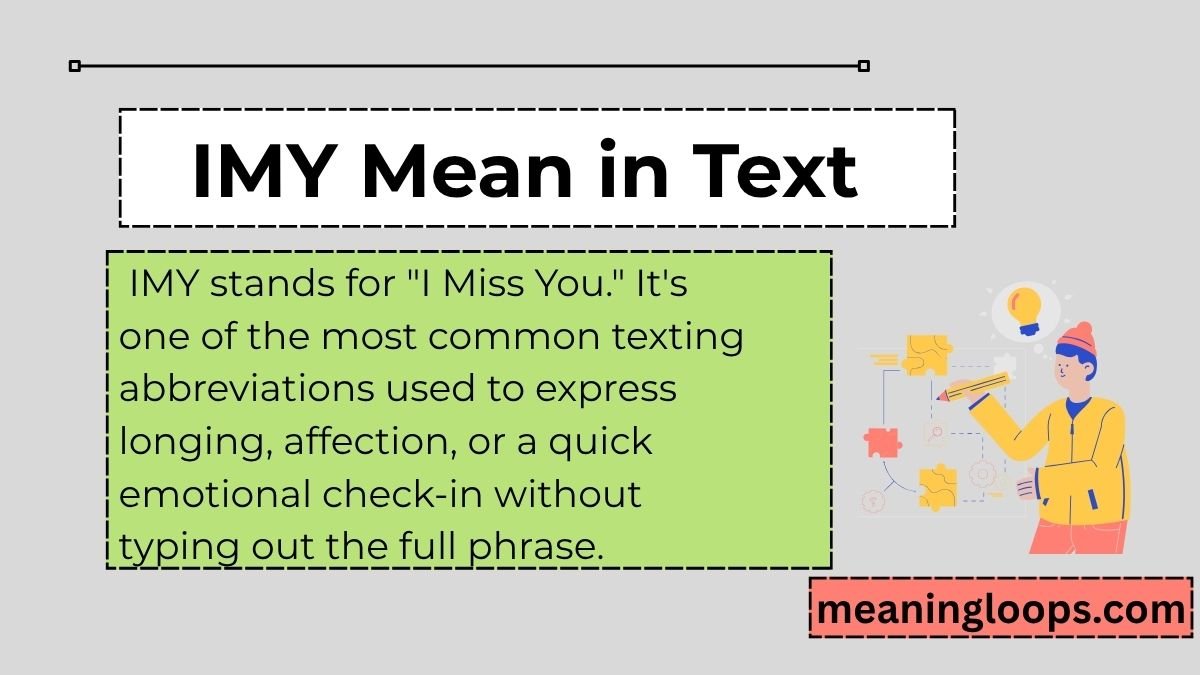
Here’s the short version: IMY stands for “I Miss You.” It’s one of the most common texting abbreviations used to express longing, affection, or a quick emotional check-in without typing out the full phrase. But the real question isn’t just what the letters stand for — it’s when to use it, who sends it, and what it actually signals depending on who’s texting who.
By the end of this guide, you’ll know exactly what IMY means in text, how it’s used across different platforms and relationships, how it compares to similar slang like ILY and MYA, and how to respond when someone sends it to you. Let’s get into it.
IMY Meaning
It’s a texting abbreviation used to tell someone you’re thinking about them and wish they were around. It’s most common in casual digital communication — texting, DMs, Snapchat, and group chats — where speed and brevity matter more than full sentences.
Unlike ILY (“I Love You”), IMY doesn’t necessarily carry romantic weight. It can be sent between friends, family members, or partners, and its tone shifts heavily depending on that relationship context, which we’ll break down section by section.
How Did IMY Become Popular?

IMY belongs to a broader family of internet slang and chat abbreviations that exploded in the early 2000s alongside SMS texting, AIM (AOL Instant Messenger), and early social platforms. Back when text messages were capped at 160 characters and mobile keypads required multiple taps per letter, shorthand wasn’t just trendy — it was practical.
Abbreviations like BRB (Be Right Back), TTYL (Talk to You Later), and HBU (How About You) emerged from the same era, all solving the same problem: say more with fewer keystrokes. I Miss You compresses naturally into IMY because it’s a phrase people type constantly, especially in long-distance relationships, family group chats, and friendships where people don’t see each other daily.
What’s kept IMY alive well into 2026, even with full keyboards and voice-to-text everywhere, is habit and tone. Typing “imy” feels lighter and more casual than typing out “I miss you” — the abbreviation itself has become a specific emotional register, not just a shortcut.
How to Use IMY Correctly
Capitalization Rules
You’ll see IMY written as IMY, imy, or occasionally Imy. There’s no strict grammatical rule here — capitalization is stylistic, not functional.
- Lowercase (“imy”) — Most common in casual, everyday texting. Feels relaxed and low-effort, which in texting culture often reads as more genuine.
- Uppercase (“IMY”) — Slightly more emphatic. Often used when someone wants the message to stand out, or when typing in all caps for excitement or emotional emphasis.
- Mixed case (“Imy”) — Uncommon, usually just autocorrect capitalizing the first letter of a sentence.
Bottom line: don’t overthink the capitalization. It rarely changes the meaning, though ALL CAPS (“IMY!!”) does tend to signal stronger emotion.
Punctuation and Tone Variants
The punctuation and add-ons around IMY change its emotional intensity significantly:
| Variant | Tone | Typical Use |
| imy | Neutral, casual | Everyday check-in |
| IMY! | Enthusiastic | Excited or affectionate |
| imy 🙁 | Sad, longing | Missing someone during time apart |
| imy ❤️ | Romantic/affectionate | Partners, close relationships |
| IMYSM | Intensified (“I Miss You So Much”) | Strong emotional emphasis |
| imy… | Wistful, trailing off | Reflective, quiet longing |
A plain “imy” with no punctuation is the most neutral version — it’s a quick, low-pressure way to say you’re thinking of someone.
IMY in Different Relationships
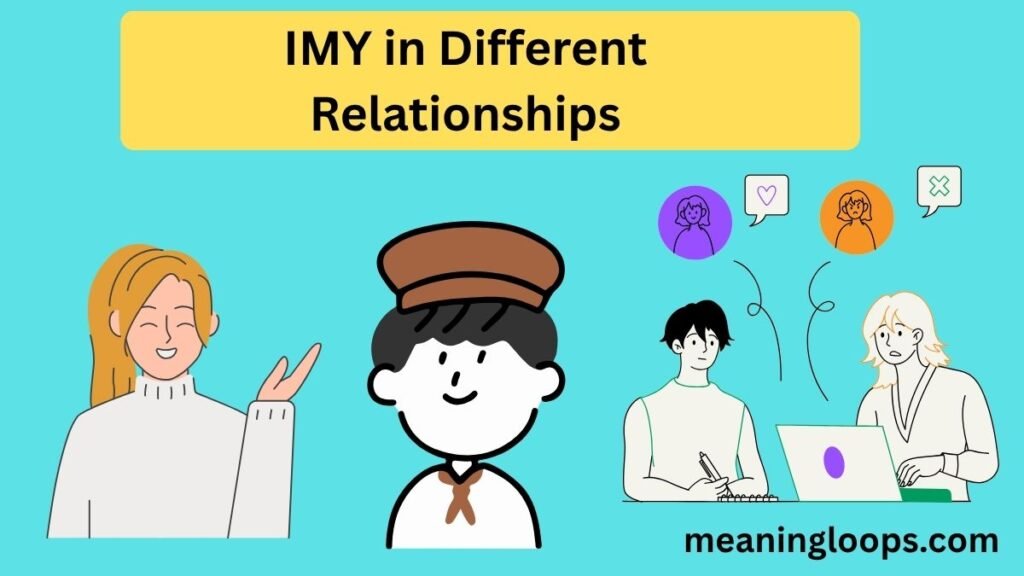
Context is everything with IMY. The same three letters carry completely different weight depending on who’s sending them.
Between Friends
Among friends, IMY is common and rarely loaded with romantic meaning. It’s a friendly, platonic way to say “hey, thinking of you” — especially if you haven’t hung out in a while, someone moved away, or you just miss the dynamic of your friend group.
Example:
“omg it’s been so long since we hung out, imy 😭”
This kind of message is casual and expected in close friendships, particularly among people who grew up texting regularly.
Between Family Members
Family use of IMY tends to be warm and unguarded — parents to kids, siblings, cousins, grandparents who’ve picked up texting slang. It often follows a visit, a move, or simply a quiet moment of thinking about someone.
Example:
“Just got home from your place, already imy 🥺”
There’s no ambiguity to decode here. It’s straightforward affection.
Between Partners or Romantic Interests
This is where IMY carries the most emotional charge. In romantic texting, IMY often reflects longing, especially in long-distance relationships where physical distance makes small emotional check-ins matter more.
Example:
“Can’t sleep, just keep thinking about you. imy so much 💕”
Between partners, IMY can also function as a softer, lower-stakes alternative to ILY — especially early in a relationship, or in situations where someone wants to express care without escalating to “I love you.”
In Professional or Casual Acquaintance Contexts
This is the one place IMY typically doesn’t belong. Sending IMY to a coworker, an acquaintance, or someone you’re not emotionally close to can feel confusing or overly familiar. Texting etiquette generally reserves IMY for people you have an established personal bond with — it’s not neutral small talk.
Where Is IMY Commonly Used?
IMY shows up across nearly every major messaging platform, but tone shifts slightly depending on where it’s sent:
- SMS/Texting — The most traditional use case; direct and personal.
- Snapchat — Often paired with streak-related messages or quick check-ins; casual and frequent.
- Instagram DMs — Common in both friendships and romantic contexts, sometimes accompanied by a photo or reel.
- Discord — Used in gaming and community chats, typically among close friend groups within a server.
- Twitter/X — Less personal, sometimes used publicly or semi-publicly as a lighthearted callout to a friend or follower.
Key takeaway: the more private the platform (texting, DMs), the more emotionally genuine IMY tends to be. On more public platforms, it can lean casual or even performative.
Real Examples of IMY in Conversation
Seeing IMY in context makes its meaning much clearer than any definition alone.
A: “It’s been way too long, we need to hang out” B: “fr, imy!! let’s plan something this weekend”
Long-distance partner:
A: “Just landed, missing home already” B: “imy already and you just left 🥺”
Family group chat:
Mom: “Sunday dinner isn’t the same without you all here, imy 💛”
Reconnecting after time apart:
A: “Sorry I’ve been so busy lately” B: “no worries, just imy, let’s catch up soon“
Notice how none of these messages need extra explanation — the abbreviation carries the full emotional weight of “I miss you” without slowing down the conversation.
How to Respond to IMY
Getting an IMY text doesn’t require an essay back, but a flat “ok” can come across as dismissive. Here’s how to respond depending on the situation:
- If you feel the same way: “imy too 💕” or “miss you so much, let’s talk soon”
- If you’re busy but care: “aww imy too, been slammed but thinking of you”
- If it’s platonic and casual: “same!! we need to hang out fr”
- If you’re unsure how to feel: A simple “aww that’s sweet” keeps things warm without overcommitting emotionally.
What if someone doesn’t reply to your IMY? Don’t automatically assume something’s wrong. People get busy, and a delayed response to a low-pressure message like IMY is common. If it becomes a pattern, that’s more about the relationship dynamic than the abbreviation itself.
When to Use IMY (and When to Skip It)
Good Times to Send IMY
- After spending quality time with someone and then being apart
- During long-distance stretches in a relationship
- When reconnecting with a friend or family member after a gap
- As a quick, genuine way to let someone know you’re thinking of them
Situations Where It Can Backfire
- Sending it to someone you’re not emotionally close with — it can feel confusing or too forward
- Using it too frequently, which can dilute its sincerity
- Sending it in professional or formal contexts
- Using it as a substitute for real communication in a relationship that needs deeper conversation
IMY vs. Other Options — Comparison Table
| Abbreviation | Full Meaning | Emotional Intensity | Best Use Case |
| IMY | I Miss You | Moderate | Friends, family, partners — casual to warm affection |
| ILY | I Love You | High | Romantic partners, close family — deep emotional commitment |
| MYA | Miss You Already | Moderate | Right after saying goodbye to someone |
| TMB | Text Me Back | Low (functional, not emotional) | Prompting a response, no emotional weight |
| LYSM | Love You So Much | High | Close friends or partners, intensified affection |
This table makes one thing clear: IMY sits in a middle ground — more emotionally expressive than a functional abbreviation like TMB, but less intense and less romantically loaded than ILY.
Common Mistakes People Make With IMY
Overusing it. Sending IMY multiple times a day, every day, can wear down its emotional impact. Like any expression of affection, scarcity keeps it meaningful.
Sending it too early. In a new romantic relationship, an early or unprompted IMY can feel like it’s moving faster than the relationship actually is. Reading the room matters.
Misreading its weight. Some people assume IMY always means something romantic. As covered above, context — not the abbreviation itself — determines that.
IMY vs. Similar Slang Terms
IMY vs. ILY
This is the most searched comparison, and for good reason — the two are easy to confuse but mean fundamentally different things.
- IMY (“I Miss You”) expresses longing or the absence of someone. It doesn’t require an existing declaration of love.
- ILY (“I Love You”) is a direct statement of romantic or deep platonic love, carrying significantly more emotional commitment.
In short: IMY is about missing someone’s presence; ILY is about the depth of feeling toward them. You can say IMY to a friend you haven’t seen in a month. Saying ILY to that same friend implies a much deeper bond or is reserved for very close relationships.
IMY vs. MYA
MYA (“Miss You Already”) is more situational — it’s typically sent immediately after parting ways, almost as a follow-up to a goodbye. IMY is more flexible and can be sent anytime, not just right after separation.
IMY vs. TMB
TMB (“Text Me Back”) carries zero emotional content — it’s purely functional, a nudge for a response. IMY, by contrast, is inherently emotional and expressive.
IMY vs. Miss U
“Miss U” is essentially the non-abbreviated cousin of IMY, dropping only the “I” and spelling out “miss” and “u” instead of compressing into initials. The meaning is identical; the choice between them is purely stylistic.
FAQs
What does IMY mean in text messages?
IMY stands for “I Miss You.” It is commonly used in texts, social media, and online chats to express that you miss someone.
How is IMY used in a conversation?
People often send IMY to friends, family members, or partners. For example: “Haven’t seen you in weeks, IMY!”
Is IMY considered romantic?
It can be, but not always. IMY is used in both romantic relationships and friendships to show affection and care.
What is the difference between IMY and ILY?
IMY means “I Miss You,” while ILY means “I Love You.” Missing someone and loving someone are related but different feelings.
Is IMY still popular in texting in 2026?
Yes, IMY remains a widely used texting abbreviation in 2026 because it is short, simple, and easy to understand.
Can IMY be used on social media?
Absolutely. IMY frequently appears in comments, captions, direct messages, and posts when people want to express that they miss someone.
What are some variations of IMY?
Popular variations include IMYSM (“I Miss You So Much”) and IMYM (“I Miss You More”), which add extra emotion to the message.
Should I use IMY in professional communication?
Generally, no. IMY is informal slang and is best used in personal conversations rather than workplace or business settings.
Why do people use IMY instead of writing the full phrase?
Using IMY saves time while conveying the same message. It is especially useful in fast-paced texting and online conversations.
What are some examples of IMY in a sentence?
Examples include: “IMY, we should catch up soon!” and “It’s been a long time—IMY!” Both express feelings of missing someone in a casual way.
Final Thoughts
IMY is a small abbreviation that carries real emotional weight when used with the right context and intent. Whether you’re texting a close friend after too long apart, checking in with family, or expressing longing to a partner during a long-distance stretch, those three letters do a lot of communicative work in very little space.
The key is reading the relationship correctly: use it freely with people you’re already close to, be mindful of timing in newer romantic connections, and skip it entirely in formal or professional settings. Used thoughtfully, IMY remains one of the simplest and most genuine ways to tell someone they’re on your mind.
Read more:
What Does HW Mean in Text? Meaning, Uses, and Examples
What Does DNI Mean in Text? Meaning, Uses, and Examples
What Does MH Mean in a Text? Complete Guide 🚀💬 (2026)

Hi, I’m Andrew Wilson, the founder of Meaning Loops. I created this website to help people understand English words in a simple and easy way. Here, I share word meanings, synonyms, antonyms, idioms, phrases, grammar tips, and vocabulary guides. My goal is to provide clear, accurate, and useful content that helps students, writers, and English learners improve their language skills. Thank you for visiting Meaning Loops and being part of this journey.






1 thought on “What Does IMY Mean in Text? Full Meaning, Uses & Examples (2026 Guide)”