You got a text that just says “HY” and now you’re stuck staring at your phone wondering what it means. Is it a greeting? Is it a question? Did your friend mean to type more and their thumb slipped?
Here’s the short version: HY meaning in text almost always comes down to one of two things — a casual way of typing “Hey” or “Hi”, or shorthand for “Hell Yeah”. Less often, it can stand for something else entirely, depending on the platform and the conversation around it.
This guide breaks down exactly what does HY mean in every context you’re likely to run into it, how to tell which meaning someone intended, how to reply, and when you should skip the abbreviation altogether. By the end, you won’t just know the HY definition — you’ll know how to use it (or avoid it) like someone who actually understands modern texting culture.
What Does HY Mean in Text?
In most texting slang contexts, HY stands for “Hey” or “Hi” — a fast, informal greeting used to open or continue a casual conversation. The second most common HY meaning in text is “Hell Yeah”, used to express strong agreement or excitement.
There is no single official HY full form. Unlike acronyms with one fixed meaning, HY is what linguists call a context-dependent abbreviation — its meaning shifts based on where it appears in a conversation, not just what letters it contains.
The Two Main Meanings at a Glance
| Meaning | What It Signals | Typical Trigger |
|---|---|---|
| HY = Hey / Hi | Opening a conversation, casual check-in | Sent as the first message, or a simple greeting mid-chat |
| HY = Hell Yeah | Enthusiastic agreement, excitement | Sent as a reply to a question, invite, or exciting news |
That single distinction — is HY the first message, or a reply — solves the confusion in the vast majority of real conversations. Keep reading, because there’s a full method for figuring it out below.
How to Tell Which Meaning Someone Means

Texting slang like HY relies almost entirely on context, not the letters themselves. Here’s a practical framework for reading it correctly.
Check What Came Before It
This is the single most reliable signal. If HY shows up as someone’s opening line — the very first text in a conversation or after a long gap — it’s almost certainly a casual greeting. If it shows up as a reply to a question, plan, or invitation, it’s far more likely to mean “Hell Yeah.”
- “Wanna grab food later? — HY” → Hell Yeah
- “HY, haven’t heard from you in a while!” → Hey
Look at Punctuation and Capitals
Small formatting choices carry real tone in digital communication:
- “hy” (lowercase, no punctuation) tends to read as low-key or neutral
- “HY!!” or “Hyyy” reads as excited or playful
- “Hy?” with a question mark often signals uncertainty or a check-in
Consider the Platform
Different apps have different texting shortcut cultures, and HY tends to lean one way or the other depending on where it’s used.
- Instagram DMs and TikTok comments: HY frequently opens a conversation with a stranger or new follower — leans toward “Hey.”
- WhatsApp chats and iMessage: HY often shows up mid-conversation as a quick reply — leans toward “Hell Yeah” when responding to something exciting.
- Snapchat messages: Both meanings are common; check whether it’s a snap-opener or a reply to a streak/plan.
- Discord chats and gaming chats: HY as a greeting is common when someone joins a voice or text channel; HY as agreement shows up when confirming a match, raid, or plan.
Consider Who’s Sending It
A friend replying to weekend plans almost certainly means “Hell Yeah.” A stranger opening your DMs almost certainly means “Hey.” Relationship and history with the sender narrows the guesswork fast.
Key takeaway: position in the conversation beats everything else. Opener = greeting. Reply to something exciting = agreement.
HY as “Hey” or “Hi” — Greeting Use
The most common HY meaning across casual online communication is a shortened, stylized version of “Hey” or “Hi.” It functions exactly like a wave or a quick tap on the shoulder — low effort, friendly, and meant to start or maintain a conversation without a lot of ceremony.
Where This Meaning Is Most Common
This use of HY shows up constantly in:
- Instagram DMs, especially from new followers or people opening a first conversation
- TikTok comments and inbox, often as a friendly icebreaker
- Snapchat messages, particularly as a snap caption or opener
- Group chats, when someone rejoins after being quiet for a while
It’s especially common among younger texters — teens through people in their mid-20s — who treat two-letter greetings as the norm rather than the exception. That doesn’t mean older users never use it, but the casual greeting version of HY skews toward faster-paced, informal digital spaces.
Real Examples in Conversation
Maya: hy!! long time no talk Jordan: omg hyyy I know, how’ve you been?
New follower: hy, love your art btw Creator: hey thank you so much!! 🙏
Group chat, after silence: hy guys, anyone free this weekend?
In each case, HY functions as an informal greeting — the texting equivalent of poking your head into the room and saying “hello.”
HY as “Hell Yeah” — Agreement/Enthusiasm Use
The second major HY meaning in text is “Hell Yeah” — a quick, energetic way to say yes with enthusiasm. This use almost always appears as a reply, not an opener, which is the fastest way to distinguish it from the greeting version.
Where This Meaning Is Most Common
This meaning of HY shows up heavily in:
- WhatsApp chats when confirming plans
- Instagram and TikTok comments, reacting positively to a post, video, or announcement
- Gaming chats and Discord, confirming a match, team-up, or event
- Group chats, agreeing to an idea someone floated
Real Examples in Conversation
Sam: you down for the trip next month? Alex: HY!! been waiting for someone to ask
Comment on a video: HY this song goes so hard
Discord: anyone want to queue up? — hy let’s go
Notice the pattern: in every one of these, HY answers a question or reacts to something rather than starting the conversation cold. That reply-position pattern is what separates the “Hell Yeah” meaning from the “Hey” meaning almost every time.
Other Meanings of HY (Less Common but Real)
Beyond the two dominant meanings, HY occasionally stands for a few other things depending on the conversation and, outside of texting, the industry.
“Have You…?” (Question Shorthand)
In fast typing, some texters use HY as shorthand for the start of a question, like “HY seen this?” meaning “Have you seen this?” This use is far less common and usually only makes sense with the rest of the sentence attached — standalone “HY” rarely means this.
“Hungry Yet?” (Used in Food/Plans Conversations)
Occasionally, especially in conversations already about food or meals, HY gets used as a quick nudge meaning “Hungry yet?” Context is essential here — this meaning only really works when food is already the topic.
HY in Finance — “High Yield”
Outside of texting slang entirely, HY is a standard abbreviation in finance and investing, where it stands for High Yield — commonly seen in terms like “HY bonds” (high-yield bonds, also known as junk bonds). If you see “HY” in a financial article, report, or investing chat, this is almost certainly the intended meaning, not the texting slang version.
HY as a Name or Username
In gaming communities, fandoms, and online usernames, HY can simply be a shortened nickname, tag, or brand reference (for example, shorthand tied to the game Hytale in some gaming spaces). This use is context-specific to that community and won’t show up in general texting.
HY vs Similar Greetings and Slang
Understanding how HY compares to other casual greetings and texting shortcuts helps clarify exactly why people reach for it instead of alternatives.
| Term | Meaning | Typical Tone | Common Platforms |
|---|---|---|---|
| HY | Hey/Hi, or Hell Yeah | Casual, fast, ambiguous without context | Instagram, WhatsApp, Snapchat, Discord |
| HI | Standard greeting | Neutral, universally understood | All platforms |
| HEY | Standard casual greeting | Friendly, slightly warmer than “Hi” | All platforms |
| HYY / HEYY | Emphasized greeting | Playful, enthusiastic | Instagram, Snapchat, TikTok |
| YO | Casual greeting | Laid-back, often used between close friends | Discord, gaming chats, group chats |
| SUP | “What’s up?” | Casual, sometimes flirty or checking in | Texting, DMs |
| HRU | “How are you?” | Follow-up to a greeting | Texting, DMs |
The key difference: HI and HEY are unambiguous. HY is faster to type but carries genuine ambiguity, which is exactly why the context-reading method earlier in this guide matters so much.
Why Do People Use HY Instead of Hey?
A few practical and cultural reasons explain why HY texting slang caught on instead of just typing the full word.
- Faster typing. Dropping the “e” saves a keystroke, which adds up across dozens of daily messages.
- Modern chat style. Shortened spellings signal fluency in current texting slang — using the full word can read as slightly more formal or dated in fast-paced group chats.
- Casual tone. Deliberately misspelling or shortening a greeting softens it, making it feel more relaxed than a “properly” spelled one.
- Social media culture. Platforms like Instagram, TikTok, and Snapchat reward quick, low-effort, high-frequency interaction — short greetings like HY fit that pace naturally.
None of these reasons make HY “better” than “Hey” — they just explain the appeal in high-volume, casual digital messaging environments.
Is HY Rude, Dry, or Just Casual?
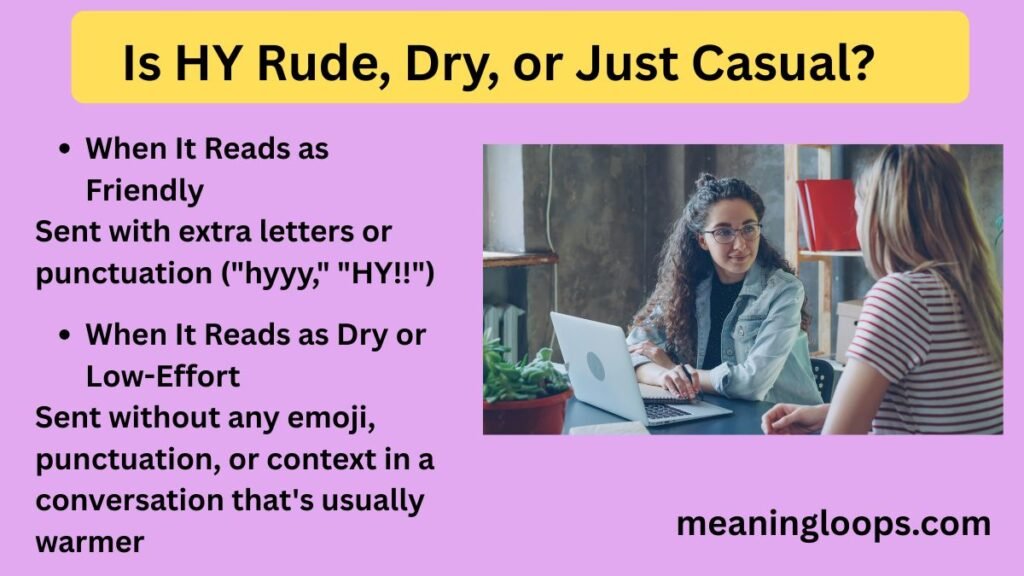
Generally speaking, HY is not rude. It’s casual and low-effort by design, but low-effort isn’t the same as disrespectful. That said, tone can shift depending on how and when it’s used.
When It Reads as Friendly
- Sent with extra letters or punctuation (“hyyy,” “HY!!”)
- Sent between people who already text casually
- Used to reopen a conversation warmly after time apart
When It Reads as Dry or Low-Effort
- Sent as a one-word response with no follow-up, especially after a longer message from the other person
- Sent without any emoji, punctuation, or context in a conversation that’s usually warmer
- Used repeatedly as someone’s only contribution to a conversation
Why Context (Not the Word Itself) Decides Tone
The word “HY” carries no inherent rudeness — the surrounding behavior does. A friend replying “hy” to your detailed message about your day might just be busy, not uninterested. The safest read: treat a single dry “HY” as ambiguous rather than assuming the worst, especially with people who already text you casually elsewhere.
How to Reply When Someone Texts You “HY”
Knowing how to respond keeps the conversation moving naturally instead of leaving you stuck decoding two letters.
If It’s Clearly a Greeting
Reply the way you’d respond to any casual hello — a simple “hey!” or “hii, what’s up?” keeps the same energy.
If It’s Ambiguous
When you genuinely can’t tell whether someone means “Hey” or “Hell Yeah,” a short clarifying reply works fine: “hey! or are you saying yes to something 😅” This isn’t awkward — it’s normal in fast-paced texting where ambiguity is common.
If You Think It Means “Hell Yeah”
Match the enthusiasm. A flat reply to an excited “HY” can feel like a letdown, so responding with similar energy — “let’s gooo” or “amazing, I’m so down” — keeps the tone consistent.
When to Use HY (and When to Avoid It)
Good Times to Use It
- Texting close friends or people you already chat with casually
- Replying to an exciting invite or plan
- Opening a DM in a casual social space like Instagram or TikTok
- Group chats where shorthand is already the norm
Situations Where You Should Spell It Out
Some contexts call for the full word instead of the abbreviation:
- Professional messages — emails, work Slack, LinkedIn messages
- First impressions — texting someone new who doesn’t know your texting style yet
- Messaging older recipients who may not recognize the abbreviation and could read it as a typo
- Formal or sensitive conversations, where a fully spelled-out greeting reads as more respectful
Expert tip: when in doubt, default to “Hey” or “Hi” instead of “HY.” You lose almost nothing in typing speed, and you remove all ambiguity — a fair trade in any context where a wrong read could cause confusion.
Who Uses HY? (Generational and Platform Patterns)
Usage of HY skews heavily toward younger, high-frequency texters — largely teens and people in their 20s who are active across Instagram, TikTok, Snapchat, and Discord. It’s less common in workplace messaging tools or with older recipients, who are more likely to read it as an unfinished word or a typo rather than intentional shorthand.
This isn’t a hard rule — plenty of people outside that age range use it too — but if you’re texting someone unfamiliar with fast-paced text message slang, spelling out “Hey” avoids any risk of confusion.
Common Mistakes People Make With HY
- Assuming it always means the same thing. Treating every “HY” as a greeting (or always as “Hell Yeah”) leads to real misreads — always check position and context first.
- Using it in professional messages. It reads as unpolished in work or formal settings, even if that’s not the intent.
- Overreacting to a dry “HY.” A short reply usually reflects timing or effort, not necessarily disinterest.
- Sending it as a cold opener to strangers in serious contexts. It can come across as low-effort if the situation calls for more.
Frequently Asked Questions
What does HY mean in a text message?
HY most commonly means “Hey” or “Hi” — a casual greeting. It can also mean “Hell Yeah” when used as a reply expressing enthusiastic agreement.
Does HY mean Hi or Hell Yeah?
Both are valid — the difference comes down to context. If HY opens a conversation, it usually means “Hi” or “Hey.” If it replies to a question or invite, it usually means “Hell Yeah.”
Is HY rude?
No, HY is not inherently rude. It’s a casual, informal shorthand. It can occasionally read as dry or low-effort depending on tone and context, but the abbreviation itself isn’t disrespectful.
Is it okay to use HY in a work message?
Generally, no. HY texting slang is too casual for professional communication — stick to “Hi” or “Hello” in work emails, Slack messages, or formal texts.
What does HY mean from a guy or girl specifically?
The meaning doesn’t change based on gender — it still depends on context, not who’s sending it. A flirty tone (extra letters, emojis, quick replies) can make either version feel warmer, but the underlying HY meaning stays the same: greeting or agreement.
What’s the difference between HY and HRU?
HY is a greeting or expression of agreement, while HRU specifically means “How are you?” — they often appear together, as in “hy! hru?”
Does HY have a meaning outside of texting (finance, etc.)?
Yes. Outside of texting slang, HY commonly stands for “High Yield” in finance and investing contexts, such as high-yield bonds. This meaning has nothing to do with the texting version.
Bottom Line
HY meaning in text isn’t complicated once you know what to look for. In casual online communication, it almost always means one of two things: a quick “Hey” or “Hi” when it opens a conversation, or an enthusiastic “Hell Yeah” when it replies to something exciting. Position in the conversation — opener versus reply — solves the ambiguity in nearly every real-world case.
Outside of texting, remember that HY carries a completely different, unrelated meaning in finance (“High Yield”), so context always matters, whether you’re reading a group chat or a market report. Use it freely with friends who already text casually, but default to spelling out “Hey” or “Hi” in professional or unfamiliar conversations — it costs you nothing and removes all the guesswork.
Read more:
What Does WDYM Mean in Text? Meaning, Uses, and Examples
Sans Meaning Explained: Definition and Real-Life Examples of “Sans” in English
Minoot or Minute? The Real Story Behind English’s Trickiest Small Word

Hi, I’m Andrew Wilson, the founder of Meaning Loops. I created this website to help people understand English words in a simple and easy way. Here, I share word meanings, synonyms, antonyms, idioms, phrases, grammar tips, and vocabulary guides. My goal is to provide clear, accurate, and useful content that helps students, writers, and English learners improve their language skills. Thank you for visiting Meaning Loops and being part of this journey.








1 thought on “What Does HY Mean in Text? Meaning, Uses & Examples (2026)”