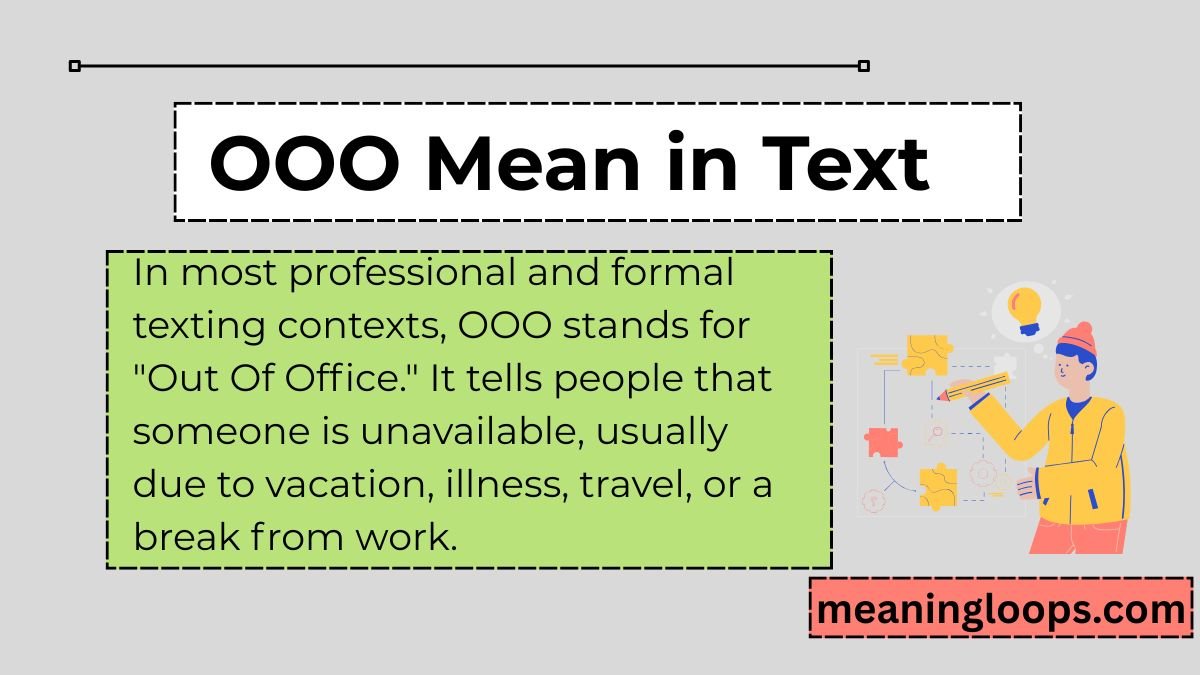
Texting is full of short codes that save time but confuse readers. “OOO” is one of them.
Depending on where you see it, OOO can mean something totally different. In a work email, it usually means “Out Of Office.” In a text from a friend, “Ooo” is often just an excited sound, like “oh wow.”
This guide breaks down every common meaning of OOO and Ooo, with real examples from work chats, group texts, and flirty conversations.
Ooo mean in text from girl
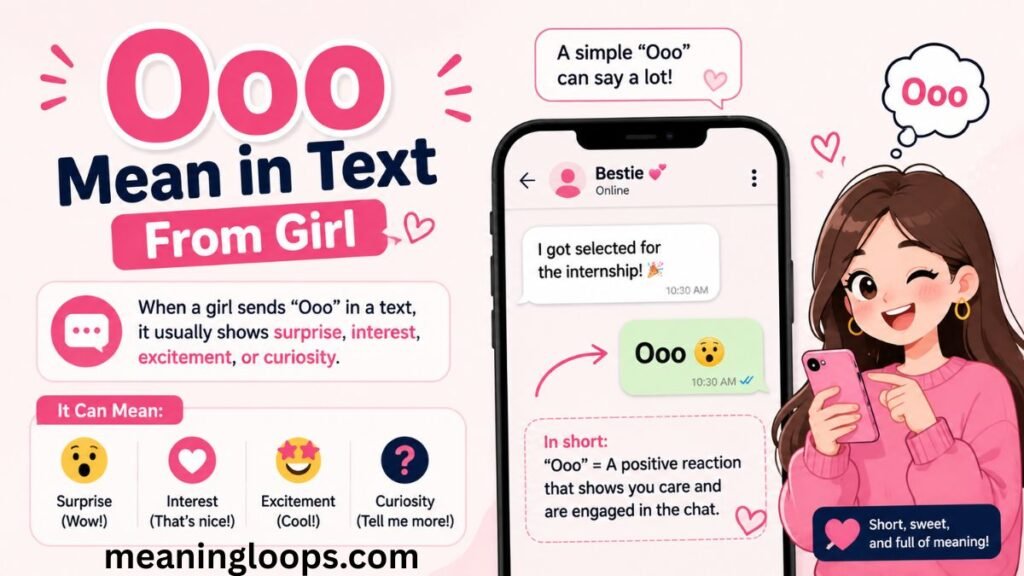
When a girl texts “Ooo,” she is usually reacting to something interesting, surprising, or exciting. It works like a shorter version of “oh” or “whoa.”
For example, if you tell her you got tickets to a concert, she might reply “Ooo nice!” This is a positive, engaged reaction, not a random filler word.
Context matters a lot here. “Ooo” paired with emojis (😏, 👀, 😍) usually signals playful or flirty interest. Without emojis, it is often just casual excitement or curiosity.
Ooo’ meaning from a girl
The apostrophe version, “Ooo’,” is not a different word. It is usually a typo or a stylistic choice while typing fast on a phone keyboard.
It carries the same meaning as “Ooo” — surprise, interest, or a reaction to news. Some people add the apostrophe out of habit from autocorrect suggestions.
Don’t overanalyze the punctuation. Focus on the words around it and the emojis used to understand the actual tone.
Ooo meaning from a guy
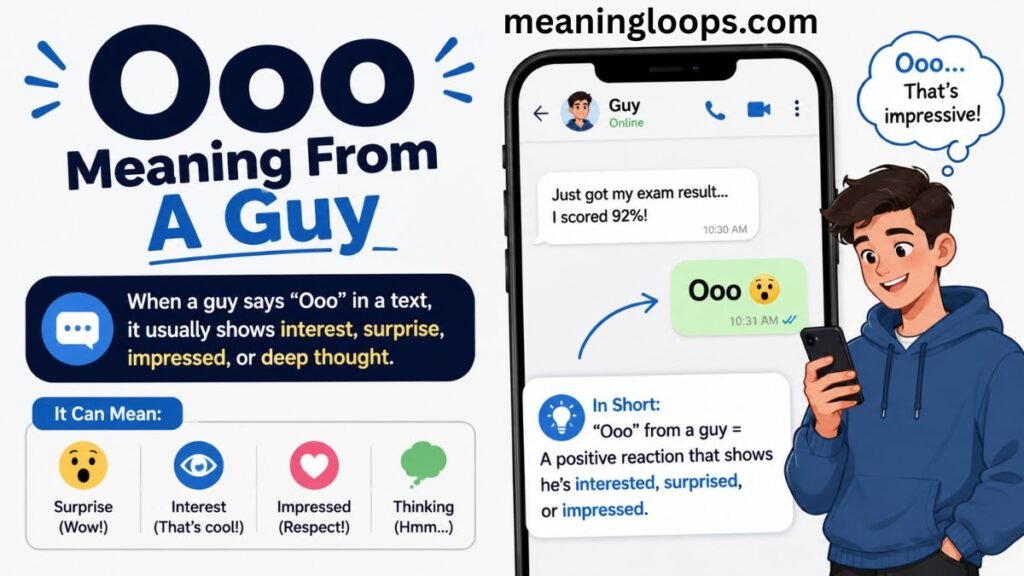
When a guy sends “Ooo,” it usually means he is impressed, intrigued, or reacting to a bold statement. It can also signal mild teasing.
For example, if you send a confident or slightly cheeky message, a guy might reply “Ooo, look at you.” This is often playful, not literal.
In competitive or gaming contexts, guys also use “Ooo” to react to a good move, a win, or something impressive happening in real time.
Ooo mean in text from a guy
This phrase overlaps with the point above but often comes up when someone is trying to figure out if a guy is flirting. The short answer: it depends on the full message, not just the word.
A single “Ooo” with no follow-up is usually low-effort interest or a reaction. A longer reply like “Ooo really? Tell me more” signals genuine engagement.
Quick way to read it:
- “Ooo” alone → casual reaction
- “Ooo 😏” → playful or flirty
- “Ooo nice, when?” → genuine interest in the topic
Ooo mean in text from a boy
Younger texters (teens) tend to use “Ooo” in a lighter, more dramatic way. It often shows up in group chats to react to gossip, drama, or funny moments.
For example: “Ooo she really said that?” This is common in reaction to news, screenshots, or callouts shared in a group chat.
It rarely carries deep meaning at this stage. It is mostly a quick, expressive reaction similar to “wow” or “no way.”
Ooo meaning funny
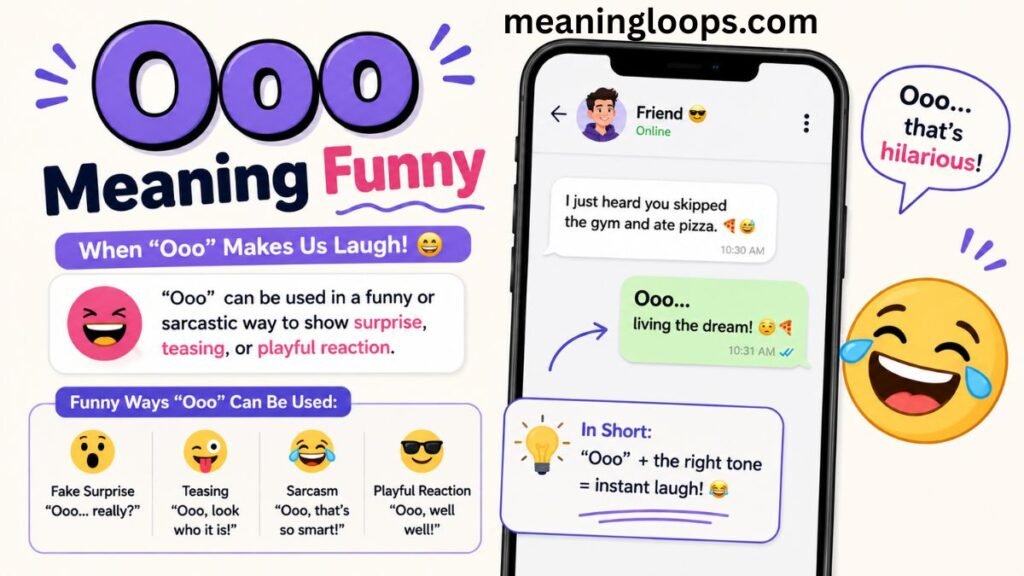
And “Ooo” is also used to react to something funny, awkward, or dramatic, almost like a sound effect in a comic strip. Think of it as the text version of an audience going “ooh” during a game show.
Common funny uses:
- Reacting to an embarrassing moment: “Ooo that’s rough 😂”
- Reacting to savage comebacks: “Oooo he went off!”
- Reacting to plot twists in a show or story someone is telling
The repeated O’s (“Ooooo”) usually increase the drama or comedic effect. More O’s generally means a bigger reaction.
Ooo mean in text funny
This is essentially the same use case as above, just phrased differently by searchers. People want to know why “Ooo” shows up as a joke reaction rather than a serious one.
The short version: extra letters signal exaggeration for comic effect, not literal meaning. “Ooo” mimics the sound people make out loud when something is dramatic or funny.
Ooo meaning in love
In flirty or romantic conversations, “Ooo” often shows interest, attraction, or playful teasing. It is a low-pressure way to react without saying too much.
Examples in a romantic context:
- “I made dinner reservations for us.” → “Ooo fancy 😏”
- “You looked really good today.” → “Ooo thank you 🥰”
It signals that the person is flattered, intrigued, or enjoying the flirty tone, without committing to anything too serious in the reply.
🧠 What Does OOO Meaning in Text?
In most professional and formal texting contexts, OOO stands for “Out Of Office.” It tells people that someone is unavailable, usually due to vacation, illness, travel, or a break from work.
It is commonly used in emails, Slack messages, and auto-replies. The goal is to set expectations about response time.
Example in Professional Context:
“Hey team, I’ll be OOO from August 10–14. Please reach out to Sarah for anything urgent.”
This tells coworkers exactly when someone is unreachable and who to contact instead. It is polite, clear, and efficient.
Other Meanings in Casual Texting
Outside of work, OOO (or more commonly written as “Ooo”) usually loses its office meaning entirely. It becomes an expressive sound word.
- Ooo = excitement, surprise, or interest
- OOO (all caps, work context) = Out Of Office
- Ooo (repeated letters) = dramatic or emotional reaction
Reading the context — work chat vs. personal text — is the fastest way to know which meaning applies.
📱 Where Is OOO Commonly Used?
📍 Professional/Work Context
OOO is standard in corporate communication. It appears in:
- Email auto-replies
- Slack or Microsoft Teams status updates
- Calendar event titles
- Team announcements before holidays or leave
📍 Casual/Personal Context
In texting and social media, “Ooo” shows up in:
- Group chats reacting to news or gossip
- Comments on Instagram or TikTok
- Flirty or playful DMs
- Reactions to memes, plans, or surprises
🧩 Tone & Style
| Context | Meaning | Tone |
| Work email | Out of Office | Formal, informative |
| Group chat | Reaction/interest | Casual, expressive |
| Flirty DM | Playful interest | Light, teasing |
| Comment section | Surprise/hype | Excited, social |
💬 Examples of OOO in Conversation
Professional/Work Examples:
- “I’ll be OOO next week for a family event. Back on Monday.”
- “Setting my status to OOO until Thursday — limited email access.”
- “Quick heads up, I’m OOO tomorrow for a doctor’s appointment.“
Casual Examples:
- “You got the job?? Ooo congrats!!”
- “Ooo who told you that 👀”
- “Ooo I actually love that idea.”
- “Oooo that’s messy 😅”
🕓 When to Use and When Not to Use OOO
✅ When to Use OOO
- Setting an email auto-reply before time off
- Updating a team chat status
- Letting coworkers know you’re unreachable
- Reacting casually to exciting or surprising news (as “Ooo”)
❌ When Not to Use OOO
- In formal documents or reports (spell it out instead)
- When exact return dates matter — always add specific dates, not just “OOO”
- In serious or sensitive conversations, since “Ooo” can come across as dismissive
- With clients unfamiliar with internal shorthand — clarify what it means
🔄 Other Meanings of OOO
While “Out Of Office” is the most common meaning, OOO can occasionally stand for other things depending on context:
- Out Of Order — used for broken machines or systems
- Out Of Options — informal use in decision-making chats
- Object-Oriented (Programming) — used loosely in tech circles, though usually written as OOP
These meanings are far less common than “Out Of Office” but can appear in specific industries.
🔄 Similar Slang Words or Alternatives
If you want alternatives to “OOO” or “Ooo,” depending on context, try these:
Work alternatives:
- BRB (Be Right Back)
- AFK (Away From Keyboard)
- WFH (Working From Home)
- PTO (Paid Time Off)
Casual/reaction alternatives:
- “Whoa”
- “Omg”
- “Wow really?”
- “No way”
🧾 Why People Use OOO
⚡ 1. Saves Time
Typing “OOO” is much faster than writing “I am currently out of the office and unable to respond.” It communicates the same idea in three letters.
📱 2. Fits Professional Culture
Most workplaces already use shorthand like ASAP, EOD, and FYI. OOO fits naturally into that same communication style.
😎 3. Works in Casual Chats
As “Ooo,” it fits the fast, expressive style of texting and social media, where short reactions keep conversations flowing.
🔥 4. Matches Online Messaging Trends
Short reaction words like “Ooo,” “Omg,” and “Lol” have become a normal part of how people communicate online, especially among younger texters.
🧠 Tone Considerations
Professional Tone
Use OOO in all caps, paired with clear dates and a backup contact. Keep it short but informative.
Example: “OOO Aug 5–7, back Monday. Contact Alex for urgent matters.”
Casual/Fun Tone
Use lowercase “Ooo,” often with emojis, to react to exciting, funny, or flirty messages.
Example: “Ooo that sounds fun, count me in 😍”
Neutral Tone
Sometimes “Ooo” is used simply to acknowledge something without adding much emotion, similar to “oh, okay.”
Example: “Ooo got it, thanks for letting me know.”
❓ FAQs:
❓ What does OOO stand for?
OOO most commonly stands for “Out Of Office,” used to show someone is unavailable, usually for work-related communication.
❓ Is OOO only professional?
No. In casual texting, “Ooo” is often just an expressive reaction to surprising, exciting, or funny news, with no connection to work at all.
❓ Can I use OOO in casual texts?
Yes, but it usually means something different there. In casual chats, “Ooo” expresses interest or surprise rather than being away from work.
❓ Is it rude to write OOO?
Not at all. In work settings, it is a normal, accepted shorthand. In casual texting, it can occasionally seem dismissive if used alone without any follow-up, so adding a sentence after it helps.
❓ Are there alternatives to OOO?
Yes. For work, you can use PTO, WFH, or spell out “Out of Office.” For casual reactions, alternatives include “Whoa,” “Omg,” or “Wow.”
🧾 Final Thoughts
“OOO” is one of those short texting terms that changes meaning completely based on where you see it. In a work email, it almost always means “Out Of Office.” In a text from a friend or crush, “Ooo” is usually just an excited or curious reaction.
The best way to avoid confusion is to look at the context — who sent it, where you saw it, and what came before or after it. Once you know the setting, decoding OOO becomes second nature.
Whether you’re setting your email status before a vacation or reacting to your friend’s dramatic story, “OOO” and “Ooo” are simple tools that keep modern texting fast, clear, and expressive.

Hi, I’m Andrew Wilson, the founder of Meaning Loops. I created this website to help people understand English words in a simple and easy way. Here, I share word meanings, synonyms, antonyms, idioms, phrases, grammar tips, and vocabulary guides. My goal is to provide clear, accurate, and useful content that helps students, writers, and English learners improve their language skills. Thank you for visiting Meaning Loops and being part of this journey.