You’ve written a sentence, paused, and thought: should I say “the latter two” or “the last two”? If that’s you right now, you’re in good company. This mix-up shows up in emails, research papers, contracts, and casual conversation alike, and it trips up even experienced writers.
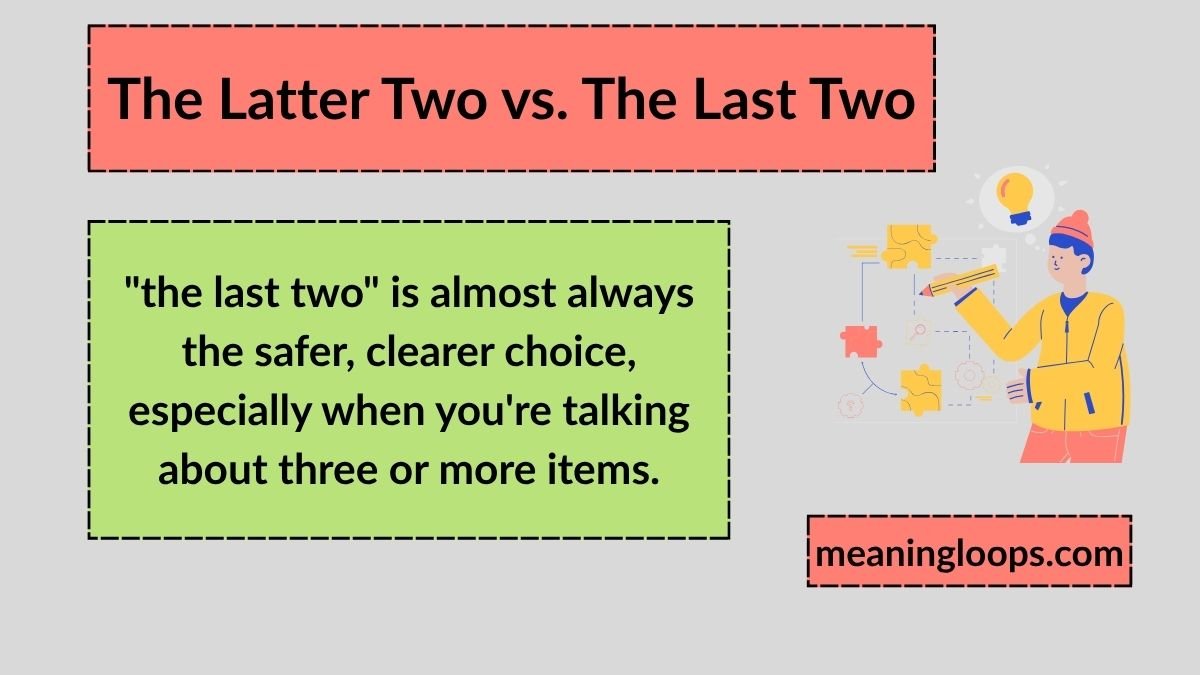
Here’s the short version before we dig in: “the last two” is almost always the safer, clearer choice, especially when you’re talking about three or more items. “The latter two” carries a stricter grammatical history, and using it incorrectly can quietly confuse your reader. Let’s unpack why, where each term comes from, and how to pick the right one every time.
Why This Phrase Trips Up Even Careful Writers

Grammar rules don’t always keep pace with how people actually talk. “Latter” is a perfect example. It has a precise, traditional meaning, but everyday usage has stretched that meaning well past its original boundaries.
Picture a business report listing five product lines. The writer wants to point out the two weakest performers, so they write “the latter two underperformed this quarter.” Sounds fine, right? Except, technically, “latter” was never built to handle groups of five. It was built for exactly two.
That’s the tension at the heart of this whole topic: tradition says “latter” only works for pairs, but real-world usage has expanded it to lists of any size. Understanding both sides lets you write with confidence instead of guessing.
Where “Former” and “Latter” Actually Come From
To understand the rule, it helps to know where these words came from in the first place.
“Former” traces back to Old English forma, meaning “first” or “foremost.” “Latter” comes from lætra, a comparative form related to “late.” Think of it this way: just as “later” describes something that comes after something else in time, “latter” describes something that comes after something else in a sequence of two.
That comparative structure matters. Words like “later,” “elder,” and “latter” only make sense when you’re comparing exactly two things. You wouldn’t say “the elder of the five siblings” without raising an eyebrow, because “elder” implies a straightforward two-way comparison. “Latter” works the same way.
The traditional pairing rule breaks down like this:
| Term | Refers to | Example |
|---|---|---|
| Former | The first of two items | “Of tea and coffee, I prefer the former.” |
| Latter | The second of two items | “Of tea and coffee, I prefer the latter.” |
Simple, symmetrical, and airtight, as long as you’re only ever talking about two things.
The Strict Rule: Why “Latter” Was Never Meant for Groups of Three or More
Here’s where things get interesting. Because “latter” is a comparative word, it doesn’t have a natural counterpart for “third,” “fourth,” or “fifth” position in a list. There’s no equivalent of “the latterest” or “the third latter.” The word simply doesn’t scale.
So when someone writes “the latter two” while referring to, say, three items out of five, they’re technically asking “latter” to do a job it was never designed for. Grammatically speaking, “latter” describes a single item’s position relative to one other item, not a subgroup’s position within a longer list.
This is the piece most style discussions skip over, and it’s worth sitting with for a second. “The latter” answers the question “which one of these two?” It doesn’t answer “which two of these five?” Those are different questions, and conflating them is where the confusion starts.
So Why Do People Say “The Latter Two” Anyway?

If the strict rule is this clear, why does “the latter two” show up so often in professional writing, news articles, and academic papers?
Language evolves through analogy. Once” became strongly associated with “the second, more recent one,” writers naturally extended it to mean “the more recent ones,” plural. It’s the same instinct that turns nouns into verbs or singular terms into collective ones over time. Usage drifts, and enough drift eventually reshapes what “correct” even means.
Major usage authorities acknowledge this shift, even while flagging it as non-traditional:
- Merriam-Webster’s Dictionary of English Usage notes that has long been used informally to refer to more than the second of two, even though the strict sense applies only to pairs.
- Garner’s Modern English Usage, one of the most widely cited style references, treats “the latter two” as a usage that careful writers should generally avoid in favor of clearer alternatives, precisely because it invites ambiguity in lists of three or more.
- The Chicago Manual of Style doesn’t explicitly rule on “the latter two,” but its broader guidance consistently favors precision over convention when a clearer phrasing exists.
So here’s the distinction that matters: “the latter two” is commonly used, but it isn’t universally accepted as correct, especially in formal writing. Descriptive linguists will tell you it’s a natural evolution of the language. Prescriptive editors will tell you to avoid it because it’s imprecise. Both are right, depending on your context.
“The Last Two”: The Safer, Unambiguous Choice
This is where “the last two” earns its keep. Unlike “latter,” which comes loaded with grammatical baggage about pairs and comparisons, “last” is a straightforward ordinal reference. It simply means the final items in a sequence, no matter how long that sequence is.
Say you’re listing seven finalists in a competition. “The last two” instantly and unambiguously tells your reader which two you mean: positions six and seven. No historical baggage, no comparative logic to untangle, no risk of a reader pausing to do mental math.
Why “the last two” works better in most situations:
- It’s numerically precise and scales to any list length.
- It requires zero grammatical background knowledge from your reader.
- It fits naturally into a symmetrical system: “the first two,” “the middle two,” “the last two.”
- It reads clearly in both spoken English and written English, without sounding overly formal or oddly casual.
That symmetry is genuinely useful. Once you start using “first,” “middle,” and “last” together, your writing gains a built-in consistency that “former” and “latter” simply can’t offer once you’re past two items.
When “The Latter Two” Is Actually Correct
Now, let’s give “the latter two” its due, because there’s one specific situation where it’s completely defensible.
Imagine a list of exactly four items, conceptually split into two pairs. For example: “We reviewed four proposals: two from internal teams and two from external vendors. The former two came in under budget, while the latter two exceeded projections.”
Here, “latter two” doesn’t mean “the last two out of four” in a generic sense. It means “the second pair of two,” which lines up with a genuine two-part comparison. This usage respects the original comparative logic of “latter” because you’re really comparing two groups of two, not picking an arbitrary subset from a longer list.
Quick test to check if your usage is defensible:
- Can the full list be split cleanly into exactly two conceptual pairs?
- Are you comparing those two pairs directly against each other?
- Would “the second pair” work as a natural substitute?
If you answered “yes” to all three, “the latter two” holds up. If not, reach for “the last two” instead.
“The Latter of the Two” vs. “The Latter Two”: Don’t Confuse These
Here’s a common source of confusion that even the earlier sections of this guide can blur if you’re skimming: “the latter of the two” and “the latter two” are not the same construction.
“The latter of the two” always refers to exactly two items. It’s grammatically clean and always correct, no exceptions. “The latter two,” by contrast, implies you’re selecting two items out of a larger group, which is the exact construction that raises eyebrows among careful editors.
| Phrase | Number of items referenced | Grammatically standard? |
|---|---|---|
| “The latter of the two” | Exactly 2 | Yes, always |
| “The latter two” (from 2 items) | Redundant, but harmless | Technically fine, just wordy |
| “The latter two” (from 3+ items) | 2 out of a longer list | Debated; avoid in formal writing |
| “The last two” (from any list) | Final 2 in the sequence | Yes, always |
Keep this table handy. When you’re unsure which phrase fits, ask yourself how many total items you’re working with, and let that number guide your word choice.
What Style Guides Actually Say
Different guides land in slightly different places on this, and it helps to know the landscape rather than treat any single source as gospel.
- Garner’s Modern English Usage (lawprose.org) generally advises against “the latter two” in formal contexts, recommending “the last two” or spelling out the specific items instead.
- Merriam-Webster’s Dictionary of English Usage (merriam-webster.com) documents the extended usage as common but non-traditional.
- AP Style, widely used in journalism, doesn’t have a dedicated entry on “latter two,” but its broader emphasis on clarity and brevity favors “last two” for lists longer than a pair.
- The Chicago Manual of Style (chicagomanualofstyle.org) similarly prioritizes unambiguous phrasing, which tilts toward “last two” in most professional and academic writing.
None of these guides call “the latter two” flatly wrong. They call it risky, because it depends on the reader correctly inferring your list size and grouping logic. In formal writing, academic papers, and business reports, that’s a risk worth avoiding.
A Simple Decision Framework for Writers
Rather than memorizing every rule above, use this quick framework the next time you’re stuck:
- Exactly 2 items? Use “the latter” (no need to add “two” at all).
- 3 or more items, and you want maximum clarity? Use “the last two,” “the last three,” and so on.
- 4 items split into two clear conceptual pairs? “The latter two” is defensible.
- Writing something formal, legal, or academic? Default to “the last two,” or better yet, name the specific items directly.
That last option, naming the items directly, is worth remembering. When precision truly matters, nothing beats writing out exactly what you mean: “the two lowest-performing regions” beats “the latter two” every single time, because it leaves zero room for misreading.
Real Examples From Legal, Academic, and Business Writing
Ambiguity costs more in some fields than others. Here’s how this distinction plays out across a few high-stakes contexts.
Legal writing: Contracts often list multiple parties or clauses in sequence. A phrase like “the latter two obligations shall survive termination” is dangerous if the contract lists more than two obligations, because a court or opposing counsel could dispute exactly which obligations that phrase covers. Legal drafters overwhelmingly prefer naming clauses explicitly or using “the last two” for this exact reason.
Academic writing: Research papers frequently compare multiple variables or study groups. A sentence like “the latter two variables showed significant correlation” in a paper analyzing five variables invites exactly the kind of ambiguity peer reviewers flag. Swapping in “the last two variables” or naming them directly removes the guesswork.
Business writing: Quarterly reports, project updates, and internal memos often summarize performance across several categories. “The last two initiatives missed their targets” reads instantly clearly to any reader skimming a dense report, while “the latter two initiatives” forces a brief mental pause to confirm which ones you mean.
Across all three fields, the pattern holds: the higher the stakes, the more writers lean toward explicit, unambiguous phrasing. That’s not a coincidence. It’s a direct response to how costly misreadings can get.
Common Mistakes Writers Make With “Latter” and “Former”
Even once you understand the rule, a few related mistakes tend to creep back in. Watch for these:
- Using “latter” for three or more unrelated items, without any pairing logic to justify it.
- Mismatching “former” and “latter” when the list has shifted, such as adding a third item mid-paragraph and forgetting the words no longer apply cleanly.
- Dangling references, where it’s genuinely unclear what “the latter” is even pointing back to, especially in long paragraphs with multiple nouns between the reference and its antecedent.
- Overusing “latter” and “former” in spoken English, where listeners can’t reread a sentence to double-check who’s who. These terms work far better in written English than in conversation.
A quick self-check: if you had to explain your sentence out loud to a colleague without them being able to see the original list, would they know exactly which items you mean? If not, swap in “last two,” “first two,” or the specific item names.
How to Remember the Difference Without Overthinking It
Here’s a mental shortcut that sticks: “latter” and “later” share a root, and “later” only ever compares two points in time. You wouldn’t say “the later of the five appointments” without adding more detail, so don’t ask “latter” to do that job either.
For everything beyond a simple pair, lean on the “first, middle, last” system. It’s clean, it scales, and it never requires your reader to do extra mental work.
Frequently Asked Questions
Is “the latter two” grammatically correct? It depends on context. For exactly four items split into two pairs, it’s defensible. For picking two items out of a longer, ungrouped list, most style guides consider it imprecise and recommend “the last two” instead.
What’s the difference between “the latter two” and “the last two”? “The latter two” implies a comparison between two pairs and traditionally applies to four-item sets split in half. “The last two” simply means the final two items in any sequence, regardless of the total list length.
Can “latter” ever refer to more than two things? Strictly speaking, no. “Latter” is a comparative word built for two-item comparisons. Extended usage for larger groups exists in modern English, but it’s considered informal and best avoided in formal writing.
Is “the latter of the two” the same as “the latter two”? No, and this is a key distinction. “The latter of the two” always refers to exactly two items and is always grammatically correct. “The latter two” often implies selecting two items from a larger group, which is the usage that draws criticism.
What do style guides recommend for lists of three or more? Most major guides, including Garner’s Modern English Usage and general Chicago Manual of Style principles, recommend “the last two,” “the last three,” or naming the specific items directly, rather than stretching “latter” beyond its traditional two-item scope.
The Bottom Line: Precision Beats Convention
When you’re stuck choosing between these two phrases, let this be your rule of thumb: “the last two” is never wrong, no matter how long your list is. “The latter two” only holds up in the narrow case of two conceptual pairs, and even then, plenty of readers will pause to double-check your meaning.
Good writing isn’t about following the fanciest-sounding rule. It’s about making sure your reader never has to guess what you mean. So next time you’re tempted to write “the latter two” out of habit, ask yourself how many items you’re really talking about, and let precision win.
Read
Wasn’t vs. Weren’t: The Complete Grammar Guide (With Examples)
Spiel or Schpiel? The Real Meaning, Spelling, Origin & Examples
Height vs. Hight: Which One Should You Actually Use?

David Miller is the lead content writer at Meaning Loops, where he creates accurate and easy-to-understand content on word meanings, synonyms, antonyms, idioms, phrases, acronyms, abbreviations, and vocabulary. His goal is to help readers improve their English with reliable, well-researched, and SEO-friendly language resources.



1 thought on “The Latter Two vs. The Last Two: Mastering Precision in English”