You’re scrolling through a group chat, and someone drops a reply: “lmc, brb.” No context, no explanation, just three letters that leave you staring at your screen wondering what you missed. If you’ve landed here searching what does LMC mean in text, you’re not alone — this little acronym trips up more people than you’d expect, mostly because it doesn’t have just one meaning.
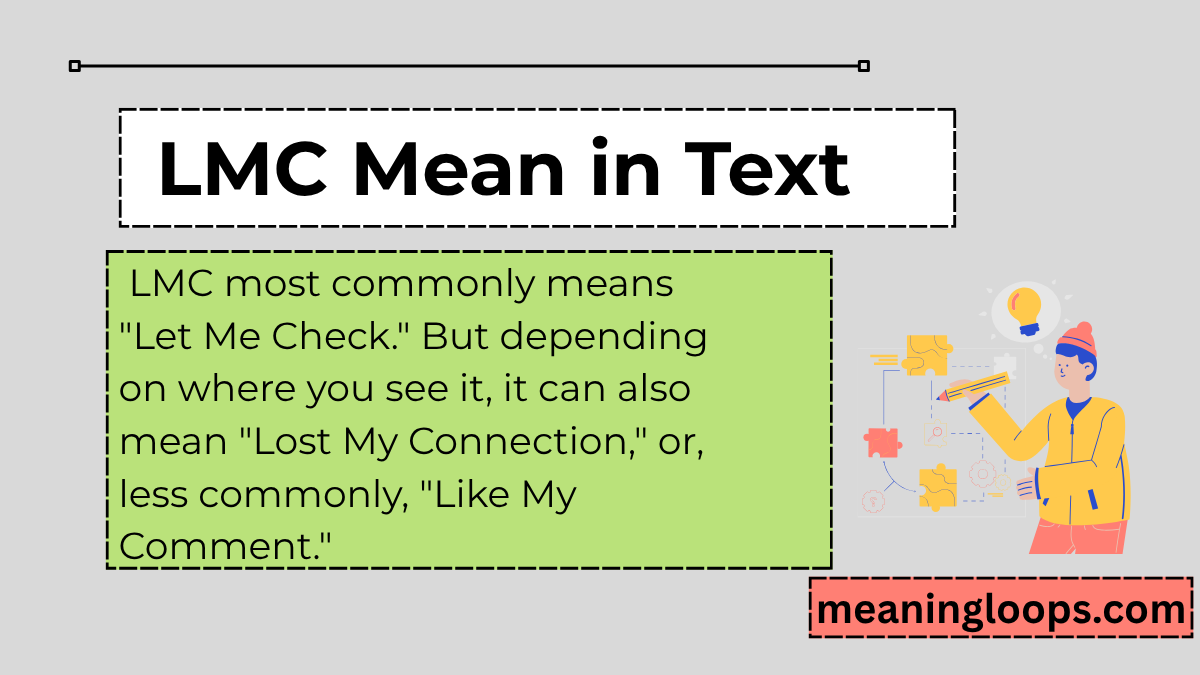
Here’s the short version: LMC most commonly means “Let Me Check.” But depending on where you see it, it can also mean “Lost My Connection,” or, less commonly, “Like My Comment.” This guide breaks down every meaning, shows you exactly how to tell which one applies, and gives you real examples so you’ll never have to guess again.
LMC Meaning
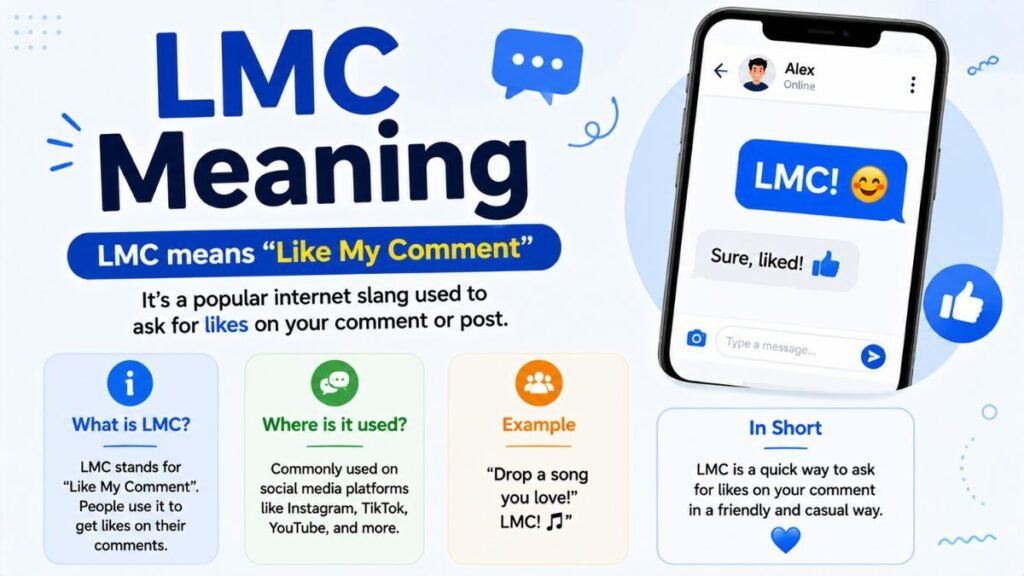
And LMC stands for “Let Me Check” in the vast majority of everyday texting and chat contexts. It’s a quick, casual way of telling someone you need a moment to look something up, ask around, or confirm a detail before responding properly.
That said, LMC is not a fixed abbreviation — unlike acronyms such as FYI or ASAP, it hasn’t been standardized by major dictionaries or style guides. Its meaning shifts based on platform, conversation flow, and sometimes even the person’s age group or online community. Two other meanings show up regularly enough to matter:
| Meaning | Typical Context | Frequency |
|---|---|---|
| Let Me Check | Texting, WhatsApp, casual chats, work-adjacent messaging | Most common |
| Lost My Connection | Gaming chats, Discord, video calls, spotty wifi situations | Common |
| Like My Comment | Instagram, TikTok, YouTube comment sections | Less common, platform-specific |
Keep that table in mind — it’s the fastest way to decode LMC once you know where the message came from. We’ll unpack each one below.
Where Does LMC Come From?
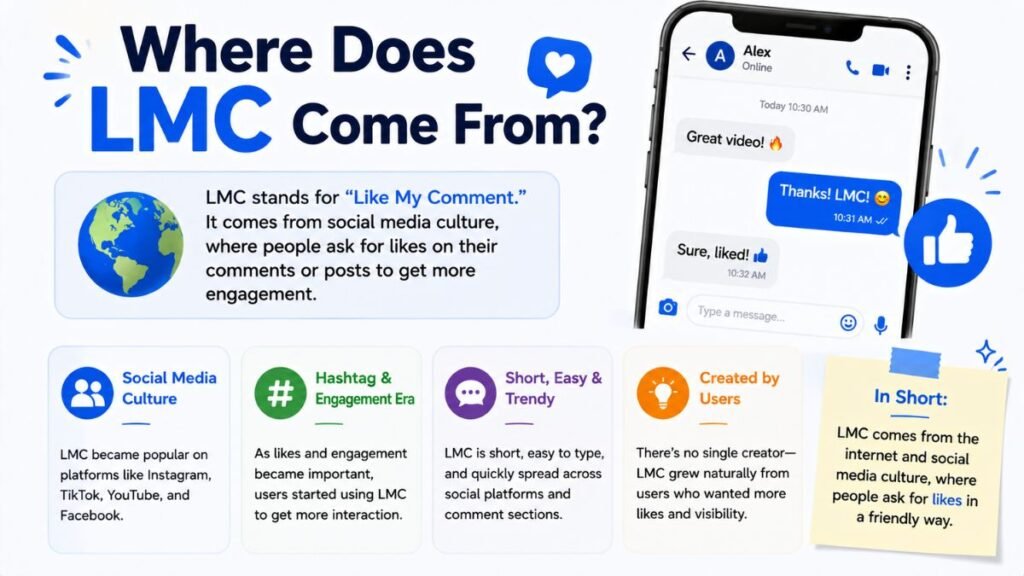
Texting abbreviations like LMC didn’t appear out of nowhere. They’re a byproduct of decades of digital communication history, starting with SMS character limits and evolving through instant messaging, social media, and gaming culture.
Back when SMS text messages were capped at 160 characters, and some carriers charged per message, people had a real incentive to shorten everything. Phrases like “let me check” naturally got trimmed down to fit more meaning into fewer characters. That habit stuck around even after character limits stopped mattering, because shorthand had become part of how digital communication feels — quick, informal, and low-effort.
LMC hasn’t been formalized by major dictionaries the way terms like “LOL” or “BRB” eventually were, largely because its meaning isn’t fixed. Dictionaries tend to standardize slang once a single definition becomes dominant across contexts. LMC never fully got there — its meaning still depends heavily on where you encounter it, which is exactly why context-reading skills matter more here than with most other chat abbreviations.
The 3 Main Meanings of LMC
Let’s go through each meaning in detail, including how it sounds in a real conversation and what signals point to it.
Let Me Check (Most Common Meaning)
This is the meaning you’ll run into most often in personal conversations, casual chat, and even semi-professional messaging like a coworker Slack DM or a customer asking a quick question in a WhatsApp group.
When someone texts “LMC,” they’re telling you they don’t have an immediate answer and need a beat to verify something — check a schedule, ask someone else, look something up online, or confirm availability. It functions as a placeholder that keeps the conversation moving without leaving you hanging entirely.
Example exchange:
Sam: hey are you free saturday for the game night? Jordan: lmc, i think i have plans but let me look at my calendar
Priya: does the store still have that jacket in stock? Alex: lmc, i’ll ask the sales rep
In both cases, LMC signals “hold on, I’m verifying information” — it’s polite, low-pressure, and doesn’t require a full sentence to get the point across.
Lost My Connection
The second major meaning shows up almost exclusively in situations involving unstable internet, dropped calls, or gaming disruptions. If you see LMC pop up mid-conversation and the topic has nothing to do with checking something, this is likely what’s meant.
This usage is especially common in online gaming chats, Discord servers, and video call follow-ups, where connection issues are a near-daily occurrence. A player might type “lmc” right after reconnecting to explain a sudden silence or a missed play.
Example exchange:
Player1: why’d you go quiet mid-round? Player2: sry lmc for like 2 mins, back now
Maya: you dropped off the call earlier Ben: yeah lmc, wifi’s been garbage all day
Notice the tone difference — this version of LMC is almost always paired with an apology or explanation, since it’s describing a technical hiccup rather than a deliberate pause.
Like My Comment (Less Common, Social-Media-Specific)
This third meaning is worth mentioning honestly rather than glossing over: “Like My Comment” as an LMC meaning is real but far less established than the other two. It shows up occasionally on Instagram, TikTok, and YouTube comment sections, usually from users trying to boost engagement on their own comment by asking others to like it.
Unlike “Let Me Check” and “Lost My Connection,” which are backed by long-standing usage across texting and chat platforms, “Like My Comment” is a newer, narrower usage that hasn’t achieved the same widespread recognition. You’re more likely to encounter it in comment threads than in direct messages or texting apps.
Example:
Comment: “This song hits different at 2am 🎧 lmc if you agree”
If you see LMC directly under a social media post or comment, asking for engagement, this is probably the intended meaning — but it’s genuinely the rarest of the three, so don’t default to it unless the context clearly points that way.
How to Tell Which Meaning Someone Means
Since LMC doesn’t come with a built-in decoder, reading context clues is the real skill here. Use this quick checklist:
- Where did it appear? Comment section → likely “Like My Comment.” Group chat or DM → likely “Let Me Check.” Gaming voice/text chat → likely “Lost My Connection.”
- What came before it? A question that needs an answer → “Let Me Check.” A sudden gap in conversation or a missed moment → “Lost My Connection.”
- Is there an apology attached? “sry lmc” almost always means “Lost My Connection.” A plain “lmc” answering a question almost always means “Let Me Check.”
- Is it asking for interaction? If it’s followed by “if you agree” or attached to someone’s own comment, it’s “Like My Comment.”
Quick decision guide:
- Comes right after a question → Let Me Check
- Comes right after a dropped call, missed message, or gaming disconnect → Lost My Connection
- Appears on a comment thread asking for engagement → Like My Comment
This kind of context-based interpretation isn’t unique to LMC — it’s a general skill for reading online abbreviations and chat slang, since so many acronyms in casual texting carry more than one possible meaning.
LMC vs. Similar Texting Acronyms
Part of the confusion around LMC comes from how similar it looks to other common texting abbreviations. Here’s a side-by-side comparison to keep things straight:
| Acronym | Full Meaning | Typical Use |
|---|---|---|
| LMC | Let Me Check / Lost My Connection / Like My Comment | Verifying info, connection issues, or comment engagement |
| LMK | Let Me Know | Asking someone to inform you of a decision or update |
| LMS | Let Me See | Similar to LMC’s primary meaning, sometimes used interchangeably |
| OMW | On My Way | Announcing you’re headed somewhere |
LMK (“Let Me Know”) is probably the acronym most frequently confused with LMC, since both start with “L” and both relate to information exchange. The difference is direction: LMC means the sender needs to check something, while LMK means the sender wants the other person to report back. If you mix these up in a real conversation, you’ll end up either waiting on information you were supposed to provide, or vice versa — so it’s worth locking in the distinction.
LMS (“Let Me See”) is close enough to LMC’s primary meaning that some people use them interchangeably, though LMS leans slightly more toward “let me look at something visually” (a photo, a document) rather than “let me check a fact or schedule.”
Where You’ll See LMC Used
LMC shows up differently depending on the platform, so here’s a breakdown by digital space.
Texting & Group Chats
This is LMC’s home turf. In SMS texting and apps like WhatsApp, LMC almost always means “Let Me Check,” used casually between friends, family, or acquaintances coordinating plans, confirming details, or answering questions on the fly.
Social Media Comments
On Instagram, TikTok, Facebook, and YouTube comments, LMC’s meaning becomes more variable. You might see the “Let Me Check” usage in reply threads, but you’re also more likely to encounter the “Like My Comment” usage here than anywhere else, since comment sections are where engagement-seeking behavior concentrates.
Gaming Voice/Text Chat
In online gaming environments — think competitive multiplayer titles, voice chat during matches, or Discord servers built around a game community — “Lost My Connection” becomes the dominant meaning. Players use it constantly to explain lag, disconnects, and missed plays.
Customer Service & Casual Work Chats
In lightly informal business communication — a customer support rep chatting with a client over WhatsApp, or a quick internal Slack message — “Let Me Check” remains the standard meaning, though it’s used more sparingly than in purely personal chats, since even casual professional messaging tends to favor slightly more complete phrasing.
Real Conversation Examples
Seeing LMC in varied, realistic contexts helps cement how flexible — and how contextual — this acronym really is.
Personal texting (Let Me Check):
Mom: did you finish your homework? You: lmc, i think i still have math left
Customer chat (Let Me Check):
Customer: is this available in size medium? Support: lmc, one sec
Gaming (Lost My Connection):
Teammate: where’d you go?? You: lmc mid-fight, so annoying
Video call follow-up (Lost My Connection):
Coworker: you froze during the meeting You: ugh yeah lmc, missed the last part can you recap?
Instagram comment (Like My Comment):
Comment: “Underrated post fr, lmc if you’re watching this in 2026”
Group chat, ambiguous without context (Let Me Check, inferred from the question):
Friend: what time does the movie start? You: lmc
When to Use (and Avoid) LMC
Like most casual texting abbreviations, LMC has a time and place. Using it well means matching it to the right audience and setting.
When It Works
- Casual chat with friends, family, or peers
- Quick clarifications where a full sentence feels unnecessary
- Gaming chats to explain disconnects without breaking flow
- Light customer interactions over informal channels like DM or WhatsApp
When to Skip It
- Professional emails or formal business communication
- Academic writing or any formal writing context
- Customer support messages meant to sound polished and reassuring
- First-time conversations with someone you don’t know well, where the abbreviation might come across as unclear rather than casual
Expert tip: If you’re texting someone significantly older, someone outside your usual social circle, or writing to a professional contact, swap LMC for the full phrase. “Let me check and get back to you” costs you a few extra seconds of typing but removes any risk of confusion.
Why People Use Acronyms Like LMC Instead of Full Sentences
The appeal of texting abbreviations hasn’t gone away just because character limits mostly have. A few real reasons keep this kind of shorthand alive:
- Speed matters in fast-paced conversations. Typing “lmc” is faster than “let me check,” and in a rapid back-and-forth chat, every saved keystroke adds up.
- Platform culture reinforces it. Social media platforms and messaging apps have normalized abbreviation-heavy communication to the point where full sentences can feel oddly formal in casual settings.
- Gaming demands speed. In online gaming, typing while playing is already a distraction — shorter messages mean less time looking away from the action.
- It signals casual tone. Using acronyms like LMC subtly communicates “this is a relaxed, informal exchange,” which matters in how digital communication conveys tone without facial expressions or vocal cues.
None of these reasons are unique to LMC specifically — they explain the broader popularity of internet slang and chat abbreviations as a category, with LMC simply being one entry in a much larger shorthand vocabulary that includes terms like BRB (be right back), IDC (I don’t care), IMO (in my opinion), TTYL (talk to you later), and FYI (for your information).
Common Mistakes People Make With LMC
Even fluent texters trip up on LMC sometimes. Here are the most frequent missteps:
- Using it in professional communication. Sending “lmc” in a client email or formal business message reads as unpolished, even if the sender meant no disrespect.
- Assuming the wrong meaning. Reading “lmc” as “Lost My Connection” when someone actually meant “Let Me Check” (or vice versa) can lead to genuinely confusing replies.
- Overusing it in fast conversations. Relying on LMC repeatedly without following through — saying “lmc” multiple times without ever actually checking or responding — can come across as evasive rather than helpful.
- Confusing it with LMK. As covered above, mixing up “Let Me Check” with “Let Me Know” flips who’s responsible for the next step in the conversation.
Best Practices for Using LMC Correctly
- Match the abbreviation to the conversation type — personal and casual only.
- Follow up with an actual answer once you’ve “checked,” rather than letting the conversation trail off.
- If there’s any chance of ambiguity (new contact, mixed context), spell it out instead of assuming they’ll interpret LMC correctly.
- Pay attention to platform context — what’s normal on Discord isn’t necessarily normal on a work Slack channel.
Pros and Cons of Using LMC
| Pros | Cons |
|---|---|
| Saves time in quick, casual exchanges | Can be misread if context is unclear |
| Signals a relaxed, friendly tone | Inappropriate for formal or professional settings |
| Useful shorthand across texting, gaming, and social platforms | Not universally recognized — some readers won’t know it at all |
| Keeps conversation moving without long pauses | Multiple meanings can cause genuine miscommunication |
Similar Slang and Alternatives to LMC
If you’d rather avoid ambiguity altogether, or you’re chatting with someone unfamiliar with LMC, these alternatives get the same point across with more clarity:
- “Let me check” — full phrase, zero ambiguity, works everywhere
- “I’ll verify this” — slightly more formal, good for semi-professional chats
- “One sec, checking” — casual but still clear
- “I lost connection” — spells out the “Lost My Connection” meaning directly
- “Give me a moment to confirm” — best for formal or customer-facing communication
And for related shorthand worth knowing alongside LMC:
- LMK — Let me know
- BRB — Be right back
- IDC — I don’t care
- IMO — In my opinion
- TTYL — Talk to you later
- FYI — For your information
FAQs About LMC
What does LMC stand for in texting?
LMC most commonly stands for “Let Me Check” in texting and casual chat. It can also mean “Lost My Connection” (especially in gaming or call contexts) or, less commonly, “Like My Comment” on social media.
What’s the difference between LMC and LMK?
LMC (“Let Me Check”) means the sender needs to verify something before responding. LMK (“Let Me Know”) means the sender is asking the other person to provide information. The two are frequently confused because of their similar structure, but they point in opposite directions.
Is LMC appropriate for work or formal messages?
No. LMC is a casual texting abbreviation best suited for personal conversations, gaming chats, and informal social media use. In professional emails, academic writing, or customer support messages, it’s better to spell out the full phrase.
Does LMC mean something different in gaming vs. everyday texting?
Yes. In gaming chats and Discord servers, LMC almost always means “Lost My Connection.” In everyday texting and casual chat, it almost always means “Let Me Check.” The platform and surrounding conversation are the biggest clues.
Is “Like My Comment” a real meaning of LMC?
It’s a real usage, but a comparatively minor one, mostly seen in Instagram, TikTok, and YouTube comments where users are seeking engagement. It’s far less common than the other two meanings, so don’t assume this is the intended meaning unless the context is a comment section specifically.
What should I say instead of LMC in formal writing?
Use the full phrase: “Let me check and get back to you,” “I’ll verify this information,” or “Give me a moment to confirm.” These keep the same meaning without the casual abbreviation.
Final Thoughts
LMC is a small acronym that packs in three genuinely different meanings, and the only reliable way to decode it is by paying attention to where and how it’s used. In most everyday texting and casual chat, you can safely assume it means “Let Me Check.” If you’re in a gaming chat or someone just went quiet after a call dropped, it’s probably “Lost My Connection.” And if it shows up on a comment thread asking for engagement, it’s likely “Like My Comment.”
Once you’ve got that framework down, LMC stops being a confusing string of letters and starts being just another piece of everyday internet shorthand — one you can read correctly, and use appropriately, without a second thought.

Hi, I’m Andrew Wilson, the founder of Meaning Loops. I created this website to help people understand English words in a simple and easy way. Here, I share word meanings, synonyms, antonyms, idioms, phrases, grammar tips, and vocabulary guides. My goal is to provide clear, accurate, and useful content that helps students, writers, and English learners improve their language skills. Thank you for visiting Meaning Loops and being part of this journey.







2 thoughts on “What Does LMC Mean in Text? Meaning, Uses & Examples (2026)”