You’re texting a friend about your beach trip, and autocorrect swaps “coral reef” for “corral reef.” Or maybe you’re writing a ranch story and type “coral the horses” instead of “corral the horses.” If any of that sounds familiar, you’re not alone. Coral vs corral is one of the most common word mix-ups in English, and honestly, it makes sense. The two words look almost identical on paper. They sound close enough to trip up your ear too.
Here’s the thing, though: coral and corral don’t share a single meaning. One belongs in the ocean. The other belongs on a ranch. Mix them up in an email, a school paper, or a business report, and readers will notice, even if they can’t quite explain why the sentence feels off.
This guide breaks down the difference between coral and corral in plain terms. You’ll get the exact meaning of each word, how to pronounce them correctly, where they came from, and a few memory tricks that actually stick. By the end, you won’t second-guess yourself again.
Quick Answer
Coral refers to a marine organism that forms colorful underwater structures called reefs, and it also names a pinkish-orange color. Corral, on the other hand, refers to a fenced enclosure for livestock, or the act of gathering and rounding up animals (or people, or ideas). The words differ by a single letter, one “r” versus two, but their meanings couldn’t be further apart.
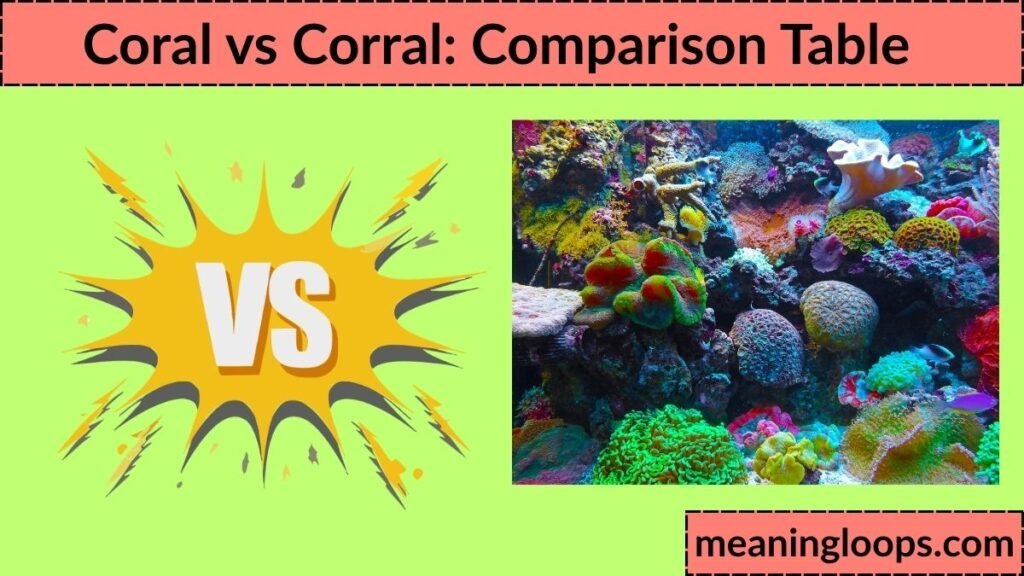
Coral vs Corral: Comparison Table
| Feature | Coral | Corral |
|---|---|---|
| Part of speech | Noun, adjective | Noun, verb |
| Meaning | Marine organism that builds reefs; also a pink-orange color | A fenced enclosure for livestock; to gather or round up |
| Pronunciation | KOR-uhl (stress on first syllable) | kuh-RAL (stress on second syllable) |
| Spelling | One “r” | Double “r” |
| Word origin | Latin corallium | Spanish corral |
| Common context | Oceans, beaches, marine biology, color palettes | Farms, ranches, livestock, organizing tasks |
| Example sentence | “The coral reef stretched for miles.” | “They corralled the cattle before the storm hit.” |
Keep this table handy. If you only remember one thing from this article, remember this: coral swims, corral fences.
What Does “Coral” Mean?
At its core, coral describes a living marine organism. Tiny animals called coral polyps live in colonies, and over time, they build hard, branching skeletons out of calcium carbonate. Stack enough of those skeletons together across decades, sometimes centuries, and you get a coral reef, one of the most biologically rich environments on the planet.
Marine biologists often describe coral as an animal, a plant, and a mineral all at once, which sounds strange until you understand the biology. The living tissue is animal. The algae living inside the tissue (called zooxanthellae) behaves like a plant, producing food through photosynthesis. And the skeleton left behind is essentially mineral, a limestone structure that other marine organisms can build on for generations.
Coral as a Marine Organism
Coral colonies form the backbone of many ocean ecosystems. The Great Barrier Reef off the coast of Australia, stretching roughly 1,400 miles, stands as the largest living structure on Earth, visible even from space. It shelters thousands of species: fish, sea turtles, mollusks, and countless smaller creatures that depend on the reef for food and shelter.
Here’s a fact that surprises a lot of people: healthy coral isn’t actually its vibrant color on its own. The color comes from the algae living symbiotically inside the coral tissue. When ocean temperatures rise and stress the coral, it expels that algae in a process called coral bleaching, leaving the skeleton stark white. According to NOAA, mass bleaching events have become more frequent as ocean temperatures climb, threatening marine ecosystems worldwide.
Coral as a Color
Coral also works as a color name, a warm, pinkish-orange shade that takes its name directly from the marine organism. You’ll see it everywhere in fashion, home decor, and design: coral lipstick, coral throw pillows, coral summer dresses. This is where coral functions as an adjective rather than a noun.
Grammar Note: Coral as Noun and Adjective
- Noun: “The diver photographed the coral up close.”
- Adjective: “She wore a coral dress to the wedding.”
One thing coral does not do: it never functions as a verb. That single grammatical fact alone can help you sort out which word you need in a sentence, more on that trick later.
Where Does the Word “Coral” Come From?
Coral traces back to the Latin word corallium, which itself came from the Greek korallion. Language historians believe the Greek root may connect even further back to Semitic languages describing small stones or gems, fitting, given how coral skeletons resemble stone. You can check the full etymology on Merriam-Webster.
What Does “Corral” Mean?
Now flip to dry land. Corral describes a fenced area used to contain livestock, horses, cattle, sheep, and other farm animals. Walk onto almost any working ranch, and you’ll spot a corral near the barn, a sturdy, fenced pen used to sort, treat, or load animals safely.
But corral does something coral never does: it works as a verb too. To corral something means to gather it, contain it, or round it up, whether you’re talking about actual animals or something more abstract, like a group of rowdy toddlers or a scattered set of ideas.
Corral as a Noun (The Enclosure)
As a noun, corral refers to a physical fenced area, typically built from wood, metal rails, or wire, designed to hold animals securely. Ranchers and farmers rely on corrals daily for tasks like:
- Sorting cattle by size, age, or health
- Branding or vaccinating livestock
- Loading animals onto trailers
- Keeping horses contained overnight
Livestock management experts note that a well-designed cattle corral reduces stress on animals and lowers injury risk for both the animals and the handlers working them. Poor corral design, tight corners, blind spots, slick footing, actually causes measurable problems on working ranches, which is why entire engineering guides exist just for corral layout.
Corral as a Verb (The Action)
As a verb, corral means to gather, contain, or round up. This works literally with animals and figuratively with just about anything else:
- Literal: “The ranch hands corralled the horses before the thunderstorm.”
- Figurative: “The teacher corralled the students into a single line.”
- Figurative: “I spent the morning trying to corral all my notes into one document.”
That figurative flexibility is part of why corral shows up so often outside of ranching contexts. Businesses “corral” resources. Writers “corral” ideas. Parents “corral” kids at the grocery store. It’s become genuinely useful shorthand for organizing chaos.
Where Does the Word “Corral” Come From?
Corral comes from Spanish, where it originally meant a yard or pen for animals. Language historians trace it further back through Portuguese curral, with roots possibly tied to Vulgar Latin words describing an enclosed space. The word entered English through Spanish-speaking ranching culture in the American West, which explains why it still carries such strong ranch and farms and ranches associations today. You can read more on Etymonline.
Coral vs Corral: Key Differences
Let’s cut straight to it. Here’s every meaningful difference between these two words, stripped down to essentials:
- Spelling: Coral has one “r.” Corral has two.
- Meaning: Coral relates to marine life or color; corral relates to livestock or gathering.
- Part of speech: Corral can function as a verb. Coral cannot.
- Pronunciation stress: Coral stresses the first syllable; corral stresses the second.
- Word origin: Coral descends from Latin; corral descends from Spanish.
- Typical context: Coral shows up in ocean and design writing; corral shows up in ranching, farming, or organizational writing.
Notice that grammar rule again, corral can act as a verb, coral cannot. That’s often the fastest way to catch a mistake while proofreading.
Pronunciation Comparison
Even when the spelling trips you up, your ear can usually save you, once you know what to listen for.
Coral is pronounced KOR-uhl, with the stress landing hard on the first syllable. It’s a soft, quick word, almost clipped.
Corral is pronounced kuh-RAL, with the stress shifting to the second syllable. It rhymes with words like “canal” or “banal.”
That shift in pronunciation stress is the real giveaway. Say both words out loud right now: “CORAL… corRAL.” Feel where your voice naturally punches? That single stress difference separates a sentence about the ocean from a sentence about a horse pen.
If you’re an English learner working on speaking skills and listening skills together, this pair makes excellent practice. Native speakers rarely confuse the two out loud, spelling confusion is almost entirely a written-language problem, not a spoken one.
Coral and Corral in Sentences
Sometimes the fastest way to lock in a definition is to just see the word doing its job.
Coral Examples
- “The coral reef near the shore attracted snorkelers from all over the island.”
- “Marine biologists study coral colonies to track the health of ocean habitats.”
- “Her nails were painted a soft coral color for the summer wedding.”
- “Rising water temperatures have damaged coral reefs across tropical oceans.”
Corral Examples
- “The rancher built a new horse corral behind the barn.”
- “Volunteers helped corral the loose sheep back toward the pasture.”
- “I need to corral my thoughts before this meeting starts.”
- “The cattle corral was full by sunrise, ready for the morning branding.”
Notice how corral slides comfortably between literal farm use and figurative everyday use, while coral stays anchored to its ocean and color meanings. That range is exactly what makes corral so easy to misuse in casual writing; it shows up in more places than people expect.
Common Mistakes
Here’s where things go sideways in real writing, not hypothetical errors, actual patterns people run into constantly.
Mistake 1: Writing “corral reef” instead of “coral reef.” This is shockingly common in search queries and casual writing. Spell-check won’t flag it because corral is a correctly spelled word, just the wrong one for the context.
Mistake 2: Using “coral” where a verb is needed. “Please coral the dogs before the guests arrive” should read “please corral the dogs.” Since coral can never act as a verb, this mistake is an easy one to catch once you know the rule.
Mistake 3: Mixing up the color and the pen. “She painted her fence corral” (probably meant coral, the color) versus “She painted her fence’s corral” (referring to an actual livestock pen). Context saves you here, but it’s worth a second read.
Quick gut check: If the sentence involves fencing, animals, or rounding something up, you need corral. If it involves the ocean, reefs, or a shade of pink-orange, you need coral.
Why do spell-checkers miss these so often? Because both coral and corral are legitimate, correctly spelled English words. Spell-check tools flag misspellings, not wrong-word choices. This exact category of error, real words used incorrectly, falls under what linguists call word confusion or a commonly confused words pair. Other well-known examples include “affect vs effect” and “desert vs dessert.”
Easy Trick to Remember the Difference
You don’t need to memorize a dictionary entry. You just need one trick that sticks.
- Trick 1: Corral has two R’s, just like “ranch” and “round-up,” two other livestock words. Double letters, double animals.
- Trick 2: Picture a coral reef as a single, delicate strand of color underwater (one “r”), and picture a corral fence as a double rail (two “r”s) built to hold weight.
- Trick 3: If the word could work as a verb in your sentence, it’s corral. Coral never acts as a verb, not once, not ever.
That third trick alone solves the majority of real-world mix-ups. Before you hit send on that text or email, ask yourself: is something being gathered, rounded up, or fenced in? If yes, you want corral.
FAQs
What is the difference between coral and corral?
Coral is a marine organism that builds underwater reef structures, and it also names a pink-orange color. Corral is a fenced enclosure for livestock, or the act of rounding up animals, people, or ideas. They differ by one letter and mean entirely different things.
Is it coral or corral?
It depends entirely on context. Talking about the ocean, a reef, or a color? Use coral. Talking about a livestock pen, a ranch, or gathering something together? Use corral.
Can corral be a verb?
Yes. Corral works as both a noun (the fenced pen itself) and a verb (the act of gathering or rounding up). Example: “The cowboys corralled the herd before nightfall.”
Is coral a noun?
Yes, and it also functions as an adjective describing the color. Example noun use: “The coral grew along the ocean floor.” Example adjective use: “She chose a coral-colored blouse.”
Why do people confuse coral and corral?
The two words share nearly identical spelling, separated by just one letter, and their pronunciations sound similar at a glance. Add in the fact that spell-checkers won’t catch the error (since both are real, correctly spelled words), and the mix-up becomes an easy trap for even careful writers.
Do coral and corral come from the same root word?
No. Coral descends from Latin corallium, tracing further back to Greek. Corral comes from Spanish, with roots tied to Portuguese and possibly Vulgar Latin words for an enclosed space. Despite the near-identical spelling today, the two words developed through entirely separate language paths.
What’s a sentence using both coral and corral?
Here’s one that puts them side by side: “The rancher wore a coral shirt while he corralled the horses before sunset.” Reading both words in the same sentence makes the contrast obvious, one describes a color, the other describes an action.
Quick Recap
Before you go, here’s the fastest possible refresher:
- Coral = ocean organism + reef-builder + pinkish-orange color. Never a verb.
- Corral = livestock pen + the act of gathering or rounding up. Works as both noun and verb.
- Pronunciation stress flips between the two: KOR-uhl vs. kuh-RAL.
- Spelling hinges on one letter: single “r” for coral, double “r” for corral.
- When in doubt, ask if the sentence involves fencing or gathering something. If yes, it’s corral.
Final Thoughts
Coral and corral sit in that small, stubborn category of English words that look close enough to swap by accident but mean nothing alike once you slow down and check. One belongs to marine life, sea life, and ocean biodiversity. The other belongs to ranching, animal enclosures, and the everyday act of gathering things together. Once that single-letter, single-syllable distinction clicks, you won’t need to pause over this pair again.
Next time your fingers type one of these words, run the quick gut check: ocean or ranch, color or fence, noun or verb. That’s really all it takes.

David Miller is the lead content writer at Meaning Loops, where he creates accurate and easy-to-understand content on word meanings, synonyms, antonyms, idioms, phrases, acronyms, abbreviations, and vocabulary. His goal is to help readers improve their English with reliable, well-researched, and SEO-friendly language resources.




3 thoughts on “Coral vs Corral: What’s the Difference? (Meaning, Pronunciation & Examples)”