If a friend just texted you “that’s tuff” and you’re not sure whether they’re hyping you up or feeling sorry for you, you’re not alone. The tuff meaning in text is one of the more genuinely confusing pieces of modern slang, because unlike most internet words, it doesn’t have just one meaning — it has three, and they can point in almost opposite directions.
In this guide, you’ll get the full breakdown of what does tuff mean in text, where the word comes from, how to figure out which meaning someone intends, and how to actually reply. No filler, no guessing — just a clear framework you can use the next time “tuff” shows up in your DMs.
What “Tuff” Means
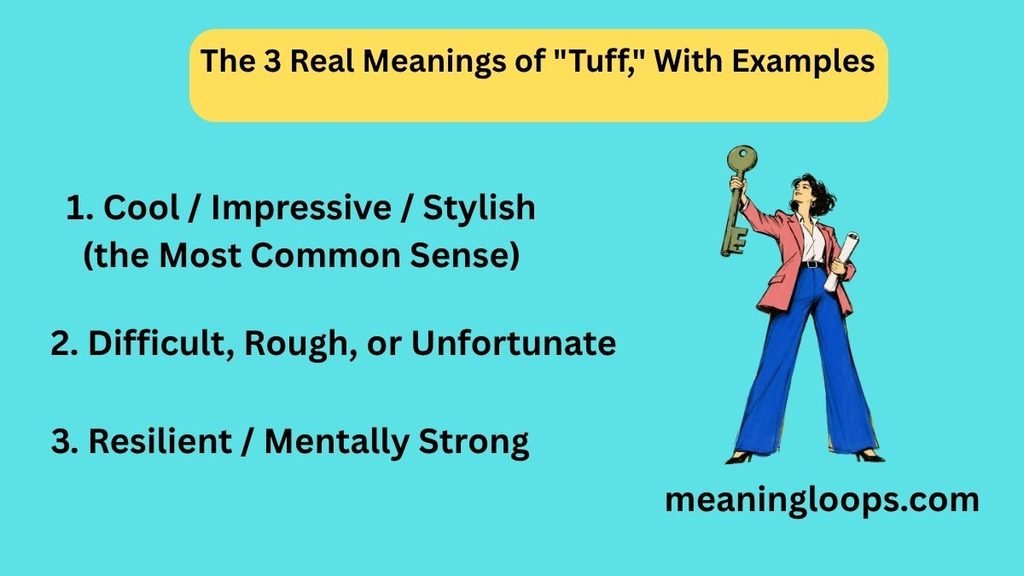
Here’s the short version before we go deep: “tuff” is an informal, phonetic respelling of the word “tough.” In tuff slang, it’s used in three main ways:
- Cool, impressive, or stylish — the most common usage today (“that fit is tuff”)
- Difficult, rough, or unfortunate — used as sympathy (“that’s tuff, man”)
- Resilient or mentally strong — praising how someone handled a hard moment (“you stayed tuff through that”)
The word itself hasn’t changed meaning from “tough” — what’s changed is that texting culture picked up the alternate spelling and started using it as a flexible reaction word, almost like “fire” or “rough” depending on context.
The 3 Meanings in One Sentence Each
| Meaning | One-Line Definition | Example |
|---|---|---|
| Cool/Impressive | Something looks great, skillful, or admirable | “Your new setup is tuff.” |
| Difficult/Rough | A situation is hard or unfortunate | “Lost my job today.” → “That’s tuff.” |
| Resilient/Strong | Someone handled adversity well | “She stayed tuff through the whole thing.” |
How to Tell Which Meaning Applies
Because tuff meaning in texting shifts with context, the fastest way to decode it is to look at what came right before the message. If the previous line was a compliment-worthy photo, outfit, achievement, or flex, “tuff” almost always means impressive. If the previous line was bad news, a complaint, or a vent, “tuff” is functioning as sympathy. And if the conversation is about someone pushing through a hard situation, it’s praising their resilience. The word rarely shows up with no context at all — read one message up, and the meaning is usually obvious.
Where “Tuff” Comes From
Understanding tuff word meaning starts with understanding that this isn’t a brand-new coinage — it’s a spelling variant of an old word.
A Phonetic Respelling of “Tough,” Not a New Word
“Tough” traces back to Old English tōh, meaning strong, resilient, or able to withstand strain. “Tuff” is simply the phonetic spelling of that same word — it’s pronounced identically to “tough,” just written the way it sounds. This kind of phonetic simplification (dropping the “-ough” ending in favor of a straightforward “-uff”) has been documented in informal American English slang dictionaries going back decades, well before texting existed. It wasn’t invented by any single platform or subculture — it’s an old spelling habit that texting culture revived and expanded.
Why the Spelling Caught On in Texting
Texting rewards speed and tone. “Tuff” does two jobs that “tough” doesn’t do as well:
- It’s visually casual. Alternate spellings (“thru,” “nite,” “tuff”) instantly signal informal, conversational tone the moment you see them, before you even read the meaning.
- It softens or stylizes the word. “Tough” can sound blunt or formal in writing; “tuff” reads as more playful, making it easier to use as a quick compliment or a light acknowledgment of a hard situation without sounding like a lecture.
Common Origin Myths, and What’s Actually Verifiable
You’ll see several competing origin stories across slang sites — some point to gaming forums, some to hip-hop and street culture, and some cite 1960s youth-culture fiction. Here’s the honest answer: there’s no single, verifiable origin event for “tuff” as slang. What’s verifiable is that phonetic respelling of “tough” as “tuff” predates the internet, and that hip-hop, streetwear, and social media culture all contributed to popularizing “tuff” as a standalone compliment over the past two decades. If you see a site claiming a precise founding moment or platform, treat that claim skeptically — it’s more likely a plausible-sounding guess than a documented fact.
Key takeaway: “Tuff” isn’t slang for a different concept than “tough” — it’s the same word, same core meaning, wearing more casual clothes.
The 3 Real Meanings of “Tuff,” With Examples
Let’s go deeper on each sense of tuff meaning slang, since this is where most confusion actually happens.
1. Cool / Impressive / Stylish (the Most Common Sense)
This is the dominant modern usage, especially in tuff on social media contexts like TikTok comments, Instagram captions, and gaming chats. Here, “tuff” functions as a compliment — interchangeable with “fire,” “clean,” or “impressive.”
Examples:
- “That edit is tuff 🔥”
- “Bro your pull-up form is tuff“
- “This beat is actually tuff“
2. Difficult, Rough, or Unfortunate
This is the closer-to-literal usage, where tuff means difficult or hard in a sympathetic, not celebratory, sense. It shows up as a reply to bad news.
Examples:
- “I bombed my interview.” → “That’s tuff, I’m sorry.”
- “My flight got cancelled.” → “Ugh, that’s tuff.”
- “This semester has been tuff.”
3. Resilient / Mentally Strong
The third sense borrows most directly from the original meaning of “tough” — tuff means resilient, and it’s used to praise someone’s composure or endurance under pressure.
Examples:
- “You stayed tuff through that whole breakup.”
- “She’s tuff, she didn’t even flinch.”
- “Built tuff, that’s why nothing gets to him.”
Side-by-Side Example: Same Word, Three Meanings
| Text Received | Likely Meaning | Why |
|---|---|---|
| “New kicks just dropped, they’re tuff“ | Cool/impressive | Follows a flex/show-off statement |
| “Failed my exam again” → “tuff“ | Difficult/sympathy | Follows bad news |
| “Didn’t cry once at the funeral, stayed tuff for my mom” | Resilient/strong | Describes handling adversity |
How to Know Which Meaning Someone Means
Since tuff meaning depending on context is the whole challenge here, it helps to have a repeatable method rather than guessing each time.
Reading the Sentence Before/After
The single best signal is the message that triggered the “tuff” reply. Compliment-worthy content → cool/impressive. Bad news or a complaint → sympathy. A story about overcoming something → resilience. This one rule resolves the ambiguity in the vast majority of real conversations.
Emoji and Punctuation as Signals
Emoji and punctuation carry a surprising amount of the tone in short texts:
- 🔥, 😍, 💯, or exclamation points after “tuff” → almost always the cool/impressive sense
- 😔, 😢, or a plain period with no emoji → usually the rough situation sense
- 💪 or “stay tuff” phrasing → the resilience sense
When It’s Genuinely Ambiguous — and It’s Fine to Ask
Sometimes a bare “tuff” with zero context really is unclear — for instance, if it’s the very first message in a conversation. In that case, it’s completely normal to just ask, “wait, good tuff or bad tuff?” This isn’t awkward; plenty of native slang users clarify this exact word regularly because the three-way ambiguity is a known quirk of the term.
“Tuff” vs. “Tough”: Is There a Difference?
A lot of readers search tuff vs tough expecting a meaning difference. There isn’t one in definition — the difference is entirely about register and spelling convention.
Same Meaning, Different Register
“Tuff” and “tough” mean the same thing semantically. “Tuff” is not a separate word with a separate dictionary definition — it’s an informal spelling variant used almost exclusively in texting, comments, and casual chat.
Why Texters Choose “Tuff” Over “Tough”
People default to “tuff” in digital spaces because it visually matches the tone of a casual conversation. Seeing “tough” in a text can read as slightly more serious or formal, while “tuff” immediately signals “this is casual and I’m not being that formal about it,” even though the underlying meaning hasn’t shifted.
When to Use Which Spelling
| Situation | Recommended Spelling |
|---|---|
| Texting friends, DMs, social captions | tuff |
| Formal writing, resumes, essays | tough |
| Work email or business chat | tough |
| Gaming chat, TikTok/Instagram comments | tuff |
| Talking to someone unfamiliar with slang | tough |
How to Use “Tuff” in a Text or Comment
Once you know the three meanings, using tuff in texting correctly is straightforward.
Complimenting Someone or Something
Use “tuff” the same way you’d use “impressive” or “cool,” but with more casual energy. It works well paired with a specific detail rather than standing alone — “that fit is tuff” lands better than a bare “tuff” with no reference point.
Responding to Bad News With “Tuff”
As sympathy, “tuff” works best as a short, warm acknowledgment — not a replacement for actual support if someone is genuinely struggling. “That’s tuff, I’m here if you want to talk” reads much better than a flat “tuff” with nothing else attached.
Common Mistakes
- Using it in professional messages. “Tuff” reads as noticeably informal — it doesn’t belong in a work Slack message to your manager or a client email.
- Sending it with no context. A bare “tuff” out of nowhere is genuinely confusing to the recipient — always keep it close to whatever it’s reacting to.
- Misreading the tone. Because the three meanings can look similar in text, it’s easy to accidentally reply “tuff 🔥” to someone venting about a bad day, which can land as dismissive instead of supportive. Match the emoji and phrasing to the actual situation.
How to Respond When Someone Calls You (or Something) “Tuff”
Knowing how to respond to tuff depends entirely on which of the three meanings was intended.
When It’s a Compliment
A simple, low-effort reply works fine here — this is casual praise, not a deep conversation starter.
- “Appreciate it 🙏”
- “Fr, thank you”
- “Lol thanks, I try”
When It’s Sympathy for Something Hard
Acknowledge it and keep the conversation open if you want support.
- “Yeah it really was, thanks for checking”
- “It’s been a lot honestly”
- “I’ll get through it, appreciate you asking”
A Few Natural Reply Examples for Each
| Original Message | Meaning | Natural Reply |
|---|---|---|
| “This playlist is tuff“ | Compliment | “Glad you like it 🔥” |
| “Rent went up again” → “tuff“ | Sympathy | “Tell me about it 😩” |
| “You handled that so tuff“ | Resilience praise | “Had no other choice honestly, thank you” |
Where You’ll See It Most
Tuff in social media and casual messaging apps is where this word lives. Its distribution isn’t even across platforms — some spaces use it constantly, others barely at all.
TikTok and Instagram Comments
This is the highest-frequency environment for tuff on TikTok and tuff on Instagram — usually as a quick reaction comment under an outfit photo, dance clip, or skill-showcase video. It functions almost like a one-word review.
Gaming and Discord Chats
In gaming communities, “tuff” often praises a skilled play, a good setup, or a strong performance — “that clip was tuff” is common after a highlight-reel moment. It also shows up as part of usernames or gamer tags, which is a completely separate use from the slang meaning (more on that below).
Group Texts vs. DMs — Does Context Change the Meaning?
Not fundamentally, but tone tends to be more playful and exaggerated in group texts (multiple people reacting, more emoji, more “that’s tuff 😂” energy), while one-on-one DMs lean more toward the sincere compliment or genuine sympathy usage.
Don’t Confuse “Tuff” With These
A few lookalikes cause real confusion, and no other guide on this topic addresses them clearly.
TUF (The Ultimate Fighter, MMA)
Written in all-caps, TUF is an acronym for The Ultimate Fighter, a UFC reality competition show. It has nothing to do with the slang word — the all-caps formatting and MMA context are the giveaway. If you see “TUF” in a sports or combat-sports conversation, it’s almost certainly referring to the show, not the slang term.
Usernames and Gamer Tags
Plenty of people use “Tuff” or “TuffGuy,” “TuffKid,” etc., as a standalone username or gamer tag. In that case, it’s just a name — not a statement being made about the conversation. Context (is this a name being called, or a reaction to something?) makes the distinction obvious almost every time.
Similar-Sounding Compliment Slang
“Tuff” sits in a small family of slang compliments that overlap in meaning but aren’t identical in tone:
- Fire — almost always positive, used for something exciting or impressive, no “difficult” sense
- Hard — similar dual-meaning pattern to “tuff” (can mean impressive or literally difficult), common in music and fashion contexts
- Goated — means “greatest of all time,” a stronger, more specific superlative than “tuff”
- Slaps — specifically used for music or content that hits well, narrower than “tuff”
“Tuff” is more flexible than any of these because it’s the only one that comfortably covers both compliment and sympathy without changing spelling.
Who Uses “Tuff” and Where It’s Common
Tuff Gen Z slang is a fair label, but it’s not exclusive to that group.
Age Groups Most Likely to Use It
Gen Z and younger millennials use “tuff” most frequently, particularly in social media comments and group texts. It’s less common among older millennials and largely absent from Gen X and older texting habits, where “tough” (standard spelling) or entirely different compliment words are more typical.
Platforms Where It’s Most Common vs. Rare
Common: TikTok comments, Instagram captions/comments, Discord and gaming chat, casual group texts.
Rare: LinkedIn, professional email, formal messaging apps used for work, customer service chats.
Is It Fading, Growing, or Stable?
Here’s an honest answer instead of a guess: there’s no independent, verifiable usage-frequency data (like Google Trends or a linguistic corpus study) that reliably tracks “tuff” specifically as slang separate from the standard word “tough,” so any claim about it “exploding” or “dying out” in a given year should be treated as unverified marketing language rather than fact. What can be said with confidence is that phonetic slang respellings like “tuff” tend to have long shelf lives precisely because they’re simple, easy to type, and not tied to a single meme or trend cycle — unlike slang tied to a specific viral moment, “tuff” doesn’t need cultural context to make sense.
When Not to Use “Tuff”
Even though it’s common online, tuff in professional writing is not appropriate, and there are a few clear boundaries worth knowing.
Professional Emails and Workplace Chat
Stick to “tough” (or better, more specific words like “challenging” or “difficult”) in emails, work Slack/Teams messages, and any communication with clients, managers, or coworkers you don’t have a casual relationship with. “Tuff” will read as noticeably unprofessional in these settings.
Messages to Older Relatives or People Unfamiliar With Slang
If you’re not sure the recipient knows the slang meaning, “tuff” risks just reading as a typo for “tough” rather than landing as intended. When in doubt, spell it out or use plain language.
Formal Writing, Resumes, and Cover Letters
Standard English spelling (“tough,” or a stronger alternative like “resilient” or “demanding”) belongs in any formal document. There’s no context in formal writing where the informal spelling adds value.
Frequently Asked Questions
Is “tuff” a real word?
Not in the sense of having its own dictionary entry separate from “tough.” “Tuff” is an informal, phonetic spelling of “tough” used mainly in texting and social media, not a standalone dictionary word.
Does “tuff” mean good or bad?
It depends on context — that’s the core of the confusion. It’s positive when used as a compliment (“that’s tuff” = impressive), and it’s used in a sympathetic way (acknowledging something negative) when reacting to bad news. It’s rarely used with genuinely negative or insulting intent.
What’s the actual difference between “tough” and “tuff”?
There’s no difference in meaning — only in spelling and register. “Tuff” is casual and used in texting/social media; “tough” is the standard spelling used in formal or neutral writing.
Can “tuff” be used sarcastically?
Occasionally, yes — usually in a joking or exaggerated tone among friends who already understand each other’s humor. It’s not the default usage, and sarcastic “tuff” typically relies heavily on prior context or an obviously joking emoji to land correctly.
Is “tuff” only used by Gen Z?
No, but it’s most common among Gen Z and younger millennials. Older generations are far less likely to use it and more likely to default to standard spelling.
Can I use “tuff” in a work message?
It’s not recommended. Save it for casual texting, social media comments, and messages to friends — use “tough” or a more specific word in professional communication.
The Bottom Line
The tuff meaning in text comes down to one word doing three jobs: complimenting something impressive, sympathizing with something difficult, and praising resilience. The spelling itself is just a casual, texting-friendly version of “tough” — nothing more mysterious than that. The real skill isn’t memorizing a definition; it’s reading the message right before “tuff” shows up, since that context almost always tells you exactly which of the three meanings is in play. Get comfortable with that one habit, and you’ll never be confused by a “tuff” text again.
Read more:
What Does BRK Mean in Text? Meaning, Uses & Examples (2026)
What Does GD Mean in Text? Meaning, Uses & Examples (2026)

Hi, I’m Andrew Wilson, the founder of Meaning Loops. I created this website to help people understand English words in a simple and easy way. Here, I share word meanings, synonyms, antonyms, idioms, phrases, grammar tips, and vocabulary guides. My goal is to provide clear, accurate, and useful content that helps students, writers, and English learners improve their language skills. Thank you for visiting Meaning Loops and being part of this journey.










1 thought on “What Does Tuff Mean in Text? Slang Meaning & Examples (2026)”