Someone calls you “Relentless Meaning” in a text, and you pause. Is that a compliment? A jab? Both?
That little moment of confusion is exactly why this word deserves a real breakdown. Relentless meaning has shifted a lot over the past few decades, and in 2026, it carries more emotional weight than most people realize. It shows up in gym captions, performance reviews, breakup texts, and motivational reels — and it doesn’t mean the same thing in any two of those places.
This guide breaks down where the word came from, what it actually signals about a person, and how to use it (or respond to it) without getting it wrong.
What Does Relentless Mean? (Quick Answer)
Relentless definition: showing no signs of slowing down, stopping, or becoming less intense; unyielding in effort, pressure, or pursuit.
It’s an adjective, pronounced rih-LENT-liss, and at its core it describes something — or someone — that just won’t quit. Not “won’t quit” in a stubborn, dig-your-heels-in way necessarily, but in a sustained, ongoing way. Think of a drumbeat that never lets up rather than a person refusing to move from one spot.
Here’s the word doing real work in a sentence:
- Her Relentless Meaning effort in training paid off when she broke the school record.
- The critic’s Relentless Meaning criticism started to feel personal after a while.
- He approached the deal with Relentless Meaning focus, refusing every distraction.
Notice something? Two of those sound admirable. One sounds exhausting. That’s the whole story of this word in one glance — same term, wildly different emotional temperature depending on what it’s attached to.
Where the Word Comes From
The origin of Relentless Meaning traces back to Latin. It combines re- (again, back) with lentus (slow, pliant, yielding), by way of the older verb relentire, meaning “to slacken.”
Here’s the twist most people miss: “relentless” literally means refusing to slacken. So from the very beginning, the word was built around resistance — resistance to slowing down, resistance to softening, resistance to stopping.
In its earliest English use, back in the late 1500s, “Relentless Meaning” leaned almost entirely negative. It described cruelty — a relentless enemy, a relentless storm, a relentless ruler who showed no mercy. For a long stretch of history, calling someone relentless was closer to calling them merciless.
That’s not really how most people use it today. Somewhere between the rise of sports culture, self-help language, and the entrepreneurship boom, the word picked up a second, more flattering meaning: someone who simply refuses to give up. The old sense never fully disappeared, though — and that’s exactly why the word still carries a double edge.
The Psychology Behind Calling Someone “Relentless”
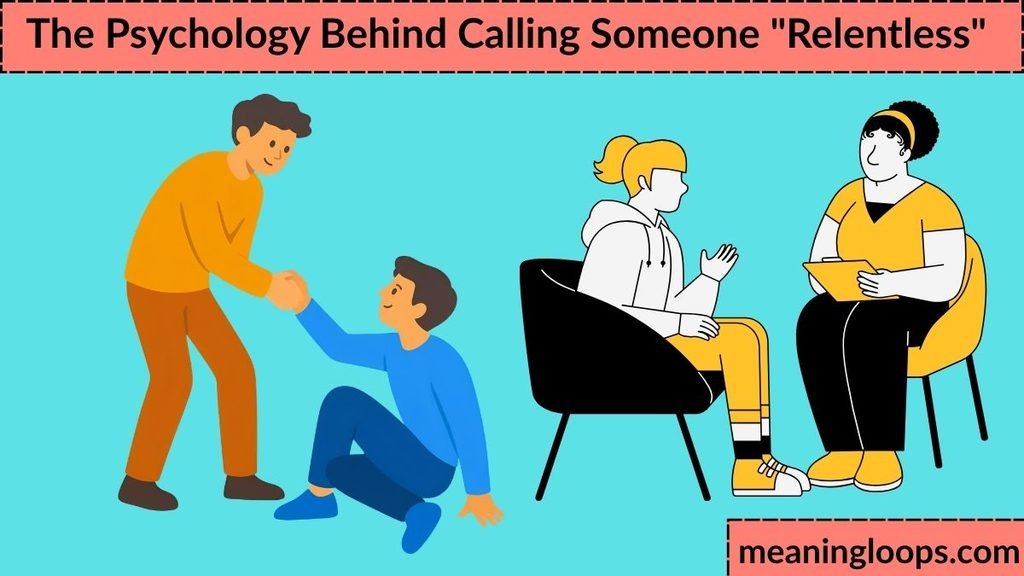
Words don’t just describe people. They reveal what the speaker is feeling about them. And “relentless” is a particularly loaded example.
When someone calls you relentless, they’re usually reacting to one of three things:
- Admiration — they’re impressed by your inner drive and can’t quite believe you keep going.
- Intimidation — your pace or intensity makes them uneasy, even if they respect it.
- Resentment — they feel worn down by you, and the word slips out as a complaint.
Psychologists studying grit and determination (Angela Duckworth’s research at the University of Pennsylvania is the most cited work here) point out that sustained effort toward a goal is one of the strongest predictors of long-term achievement, often stronger than raw talent. Relentlessness, in that framework, looks a lot like grit in action.
But there’s a catch. Grit research also draws a hard line between discipline vs obsession. Healthy persistence adapts. It rests, reroutes, and adjusts when something isn’t working. Obsessive persistence doesn’t — it just keeps pushing, even past the point where pushing makes sense. That’s the line between someone who’s relentlessly pursuing a goal and someone who’s just refusing to face reality.
This matters because burnout and fear of failure often hide underneath what looks like relentless drive from the outside. Someone praised for never stopping might actually be terrified of what happens if they stop. The emotional intensity behind the word isn’t always what it looks like on the surface.
“Persistence guided by feedback is grit. Persistence that ignores feedback is just stubbornness with better marketing.”
How People Actually Use “Relentless” Today
Forget which app someone’s texting on — that doesn’t change what the word means. What actually changes the meaning is tone. Here’s how relentless shows up in real conversations:
As a compliment:
- “You’re so relentless, I don’t know how you keep this pace.”
- “Coach said I’ve got a relentless mindset and that’s why I made varsity.”
As a warning or complaint:
- “He’s relentless. I said no three times and he still won’t drop it.”
- “The relentless pressure from her manager finally pushed her to quit.”
self-description:
- Dating bios: “Relentless in the gym, soft everywhere else.”
- Resumes and LinkedIn: “Relentless problem-solver with a track record of hitting targets.”
That last category deserves a second look, because it’s exploded in the last few years. Relentless ambition has become a badge of honor in online social media hustle culture, especially across fitness and business content. The word shows up constantly in captions, bios, and motivational hashtags — almost always positioned as praise, rarely with any nuance attached.
Relentless in Different Contexts
The same word, four completely different meanings depending on where it lands.
Relentless at Work
In professional settings, relentless in business usually signals someone who doesn’t back down from hard problems. A relentless negotiator doesn’t cave at the first pushback. A relentless competitor keeps refining their pitch after every rejection. HR reviews often use it as shorthand for high performance under pressure.
But there’s a downside worth naming: relentless in negotiations can also describe someone who wears people down rather than winning them over. Persistence without empathy tends to read as pressure, not skill.
Relentless in Relationships
This is where the word gets genuinely tricky, and it’s also one of the most searched angles around it.
Relentless pursuit in the early stages of dating can feel flattering — someone who won’t let a good connection slip away. But the same behavior after a “no,” or inside an existing relationship during conflict, flips fast. Relentless arguing, relentless texting after being asked for space, relentless attempts to “win” a disagreement — none of that is romantic. It’s a boundary problem wearing a romantic label.
The healthy version of relentless in love looks like consistency: showing up, again and again, in ways the other person actually welcomes. The unhealthy version looks like refusal to accept “no” as an answer.
Relentless in Sports and Fitness
This is the cleanest, most purely positive use of the word. Relentless energy on the field, relentless discipline in training, a relentless competitor who never eases up in the fourth quarter — coaches and athletes use the term constantly, and almost nobody reads it as a red flag here. Sports culture built an entire identity around this meaning, and gym culture motivation content online leans on it heavily.
Casual vs Serious Tone
| Setting | Tone | Typical Meaning |
|---|---|---|
| Gym captions, sports commentary | Casual, high-energy | Praise for drive and consistency |
| Performance reviews | Semi-formal | Strong work ethic, sometimes with a caveat |
| Relationship conversations | Serious | Can flip from flattering to concerning fast |
| Weather reports, disaster coverage | Formal, literal | Ongoing, unyielding intensity (storms, heat, rain) |
3 Common Misconceptions About “Relentless”
Misconception 1: Relentless always means positive. It doesn’t. Context decides everything. “Relentless support” and “relentless harassment” use the exact same adjective for opposite experiences.
Misconception 2: Relentless means aggressive. Not quite. Aggression is about force and hostility. Relentless is about duration and consistency. You can be relentlessly kind, relentlessly patient, or relentlessly calm — none of that is aggressive.
Misconception 3: Relentless equals toxic hustle. Toxic hustle culture gets a lot of criticism these days, and fairly so — but relentlessness on its own isn’t the problem. The problem is relentlessness with no room for rest, feedback, or reflection. Sustainable persistence and burnout-driven grinding can look identical from the outside while feeling completely different on the inside.
Relentless vs. Similar Words (Comparison Table)
| Word | Core Meaning | Tone | Best Used For |
|---|---|---|---|
| Relentless | Won’t slow down or ease up | Neutral-to-intense, context-dependent | Sustained effort, pressure, or pursuit |
| Persistent | Keeps trying despite setbacks | Mostly neutral, professional | Repeated attempts toward a goal |
| Determined | Firmly committed to an outcome | Positive | Willpower and clear intent |
| Stubborn | Refuses to change position | Often negative | Rigid thinking, resistance to compromise |
| Tenacious | Holds on tightly, doesn’t let go | Positive | Grip, resolve, refusal to quit |
| Ruthless | Without mercy or compassion | Negative | Cold, results-first behavior |
| Unwavering | Steady, doesn’t waver or doubt | Positive | Loyalty, faith, steady resolve |
Key insight: if you need a neutral, professional word, reach for “persistent.” If you want to signal intensity without a moral judgment either way, “relentless” is your word. And if the behavior actually involves a lack of compassion, “ruthless” is more accurate — and a much bigger warning sign.
Quick comparisons worth knowing:
- Relentless vs persistent: persistent is calmer and more neutral; relentless implies more intensity and less room to breathe.
- Relentless vs determined: determined centers on inner resolve; relentless centers on outward, sustained action.
- Relentless vs aggressive: aggression involves force or hostility; relentless is about duration, not tone.
- Relentless vs merciless: merciless always implies cruelty; relentless doesn’t have to.
Words Related to Relentless (Synonyms & Near-Synonyms)
Relentless synonyms aren’t all interchangeable — each one shifts the meaning slightly:
- Persistent – steady effort, calmer tone
- Tenacious – holds on with grip and resolve
- Unrelenting – near-identical, slightly more formal
- Unyielding – emphasizes refusal to bend or compromise
- Inexorable – impossible to stop or persuade otherwise
- Dogged – stubborn persistence, often admiring
- Indefatigable – tireless, never seems to wear out
- Implacable – can’t be calmed or satisfied (often used for anger or hostility)
- Sustained – ongoing without interruption, more neutral and technical
- Driven – motivated by inner ambition, less about external pressure
The opposite of relentless includes words like lax, halfhearted, sporadic, inconsistent, or easygoing — anything that implies stopping, softening, or losing steam.
How to Respond If Someone Calls You Relentless
Casual replies:
- “Guilty as charged.”
- “I just don’t know how to quit halfway.”
- “Relentless, stubborn, same energy.”
- “I prefer ‘annoyingly consistent,’ but sure, we can go with relentless.”
Confident replies:
- “I’ve learned that slowing down doesn’t get results. Consistency does.”
- “That’s the whole point. I don’t do things halfway.”
Respectful replies (when it’s meant as criticism):
- “I hear you — I’ll ease off and give you more space.”
- “That’s fair feedback. I didn’t realize it was landing that way.”
The tone of the reply should match the tone of the comment. A playful “relentless” from a friend deserves a playful answer. A frustrated “relentless” from a partner deserves an actual conversation, not a joke.
Frequently Asked Questions
Is relentless positive or negative?
Neither, on its own. It’s a neutral adjective that takes on meaning from context. Relentless effort reads as positive; relentless criticism reads as negative.
What’s the difference between relentless and persistent?
Persistent is calmer and more measured — repeated effort despite setbacks. Relentless implies more intensity, less pause, and sometimes less consideration for others’ limits.
Can relentless describe a person?
Yes, and it’s one of the most common uses of the word. It describes someone’s approach to effort, pursuit, or pressure — not a fixed personality trait, but a pattern of behavior.
Is relentless good in relationships?
It depends entirely on consent and consistency. Relentless support and presence (when welcomed) build trust. Relentless pursuit after a clear “no” crosses into a boundary issue, not romance.
What’s the opposite of relentless?
Words like halfhearted, sporadic, lax, or easygoing sit on the opposite end — anything implying inconsistency or a willingness to ease off.
Can weather be relentless?
Absolutely, and it’s one of the oldest uses of the word. Relentless rain, relentless heat, and relentless storms describe weather that doesn’t let up — a literal, non-metaphorical use that predates most of its modern personality-based meanings.
Bottom Line
Relentless meaning hasn’t really changed at its root — it’s still about refusing to slow down. What’s changed is how often that gets treated as automatically admirable. It’s not. Relentless effort, relentless focus, and relentless optimism can absolutely be strengths. But relentless pressure, relentless criticism, and relentless pursuit without consent are red flags wearing a compliment’s clothing.
The word itself won’t tell you which one you’re dealing with. The context will. So next time someone calls you — or someone else — relentless, don’t just take it as praise or a punch. Ask what it’s actually describing. That’s where the real meaning lives.
Read
Coral vs Corral: What’s the Difference? (Meaning, Pronunciation & Examples)
What Does Tuff Mean in Text? Slang Meaning & Examples (2026)
Shined vs. Shone: The Real Difference (And the One Rule That Settles It)

David Miller is the lead content writer at Meaning Loops, where he creates accurate and easy-to-understand content on word meanings, synonyms, antonyms, idioms, phrases, acronyms, abbreviations, and vocabulary. His goal is to help readers improve their English with reliable, well-researched, and SEO-friendly language resources.