You’re staring at a big decision. Maybe it’s a job offer or a business idea. What Does SWOT Mean? Your thoughts spin in circles. You feel overwhelmed and a bit stuck in confusion.
A analysis fixes that. It sorts the chaos into four simple boxes. In this guide, you’ll learn the SWOT meaning, its history, and how to do a analysis step by step. You’ll also see real analysis examples you can copy today.
SWOT Meaning: What Does SWOT Stand For?
SWOT is a strategic analysis tool. It stands for strengths, weaknesses, opportunities, threats. People use it to size up a business, a project, or even their own life.
The tool sorts findings into four quadrants. Strengths and weaknesses cover factors the actor can influence, while opportunities and threats cover the outside environment. (Model Diplomat)
That’s the whole idea. Four boxes. One honest look.
SWOT Full Form Explained
Here’s the SWOT full form at a glance:
| Letter | Word | Type | Core question |
|---|---|---|---|
| S | Strengths | Internal, helpful | What do we do well? |
| W | Weaknesses | Internal, harmful | Where do we fall short? |
| O | Opportunities | External, helpful | What trends could help us? |
| T | Threats | External, harmful | What could hurt us? |
This layout is the classic four-box framework. Most templates draw it as a simple 2×2 grid.
Internal and External Factors
Every analysis splits the world into internal and external factors. This split is the heart of the method.
- Internal strengths and weaknesses live inside your organization or your own life. You control them.
- External opportunities and threats come from outside. You can’t control them. You can only prepare.
Think of a ship. The crew and the hull are internal. The weather and the rocks are external. A smart captain studies both.
History of SWOT Analysis: Who Created It?
Many people ask who created analysis. The honest answer is that nobody fully agrees.
The popular story points to Albert Humphrey. He worked on corporate planning research at the Stanford Research Institute between 1960 and 1970. (RapidBI) His team studied why corporate planning kept failing.
The SOFT Origin
The tool didn’t start as SWOT. It began as SOFT. The team labeled things Satisfactory, Opportunity, Fault, and Threat, depending on whether they were good or bad now or in the future. (RapidBI)
One account says Urick and Orr swapped the F for a W after a 1964 seminar in Zurich. That swap gave us the familiar acronym.
The Harvard Claim
Not everyone credits Stanford. Some writers point to the Harvard textbook Business Policy: Text and Cases by Learned, Christensen, Andrews, and Guth. It uses a framework that closely resembles but never uses those words.
Humphrey himself pushed back. He wrote that Harvard and MIT claimed credit for, then added “not so!” (HotPMO)
Why the Record Stays Fuzzy
A 2024 paper in the Journal of Management History explored this puzzle. It says planning tools often appeared inside larger frameworks instead of standalone publications. Copyright limits and restricted library access also hid the trail.
Quick facts on the history of analysis:
- The research ran from 1960 to 1970 at the Stanford Research Institute.
- The original name was SOFT.
- Humphrey’s account named a team that included Marion Dosher, Otis Benepe, Robert Stewart, and Birger Lie.
- Credit remains disputed.
SWOT Meaning in Business: What Is SWOT Analysis Used For?
The SWOT meaning in business is simple. It helps leaders see where they stand before they act. It supports strategic planning and decision-making across almost every field.
Business Planning and Corporate Strategy
Executives use in business planning and corporate strategy sessions. Teams run it in boardroom meetings and business workshops. It gives everyone the same map of the situation.
Managers also use it for management planning. A department can review its own performance evaluation with four boxes.
Marketing Strategy and Brand Positioning
A marketing SWOT shapes marketing strategy. It shows where a brand shines and where rivals beat it. That insight sharpens brand positioning.
Good marketers feed market research into the boxes. They also check competitor analysis and market competition before choosing a message.
Startup Planning
Founders love SWOT because it’s fast. A SWOT analysis for startups exposes gaps before money runs out. It’s one reason entrepreneurs run a SWOT analysis before launching a business.
The tool also flags funding risks and shows how ready you are for market entry.
Career Planning and Personal Growth
SWOT isn’t just corporate. Career coaches and personal development coaching programs use it too. A personal SWOT analysis builds self-awareness and supports honest self-reflection.
It also helps with career planning and tough career decisions. You see your skills, your gaps, and the job market in one view.
Students and Universities
Students use SWOT for study plans. MBA programs and universities teach it as a core decision framework. A SWOT analysis for students might map grades, habits, and internship openings.
How to Do a SWOT Analysis in 5 Steps
Here’s how to do a SWOT analysis without stress. This is a SWOT analysis for beginners approach.
- Pick one subject. Choose “my bakery” or “my career.” Vague targets produce vague answers.
- List internal factors. Write down strengths and weaknesses. Use facts such as sales numbers and customer reviews.
- List external factors. Scan for opportunities and threats. Look at trends, rules, and rivals.
- Rank each item. Score by impact and likelihood. Weighting factors this way turns SWOT from a plain list into a decision aid.
- Act on it. Assign owners and deadlines. A list without action is just a diary entry.
Pro tip: Cap each box at five to seven items. Short lists force clear thinking and structured thinking.
SWOT Analysis Examples You Can Copy
Real SWOT analysis examples teach faster than theory. Here are three.
Business SWOT: Local Coffee Shop
| Strengths | Weaknesses |
|---|---|
| Loyal morning regulars | Small kitchen limits the menu |
| Fresh roasted beans daily | No online ordering |
| Friendly, trained staff | Few seats at peak hours |
| Opportunities | Threats |
|---|---|
| New office tower opening nearby | National chain planning a nearby store |
| Growing demand for cold brew | Rising coffee bean prices |
| Delivery app partnerships | Higher rent at lease renewal |
The owner now has clear moves. Add online ordering. Launch cold brew. Lock in a longer lease.
Personal SWOT Analysis for Career Change
Meet Dana, a teacher who wants to move into instructional design. Her personal SWOT looks like this:
- Strengths: Classroom experience, strong writing, patience.
- Weaknesses: No portfolio, limited software skills.
- Opportunities: Companies hiring remote training staff.
- Threats: Tough competition for entry-level roles.
This SWOT analysis for career change shows her next step. She builds a portfolio and learns one authoring tool.
Case Study: Startup SWOT Before Launch
This is an illustrative scenario.
Two friends plan a meal-prep app. Their startup SWOT reveals a strong chef partner and a weak marketing budget. It also shows rising demand for healthy delivery and a crowded competitive landscape.
They decide to test one city first. That choice cuts their risk assessment worries in half. They also gain confidence because the data backs the plan.
Case Study: Student SWOT
This is an illustrative scenario.
Sam, a college junior, feels lost about internships. His academic SWOT lists strong math grades and weak public speaking. It also notes a campus career fair and heavy competition for finance roles.
He joins a speaking club and applies early. Sam turns worry into a plan.
Types of SWOT: Personal, Business, Startup and More
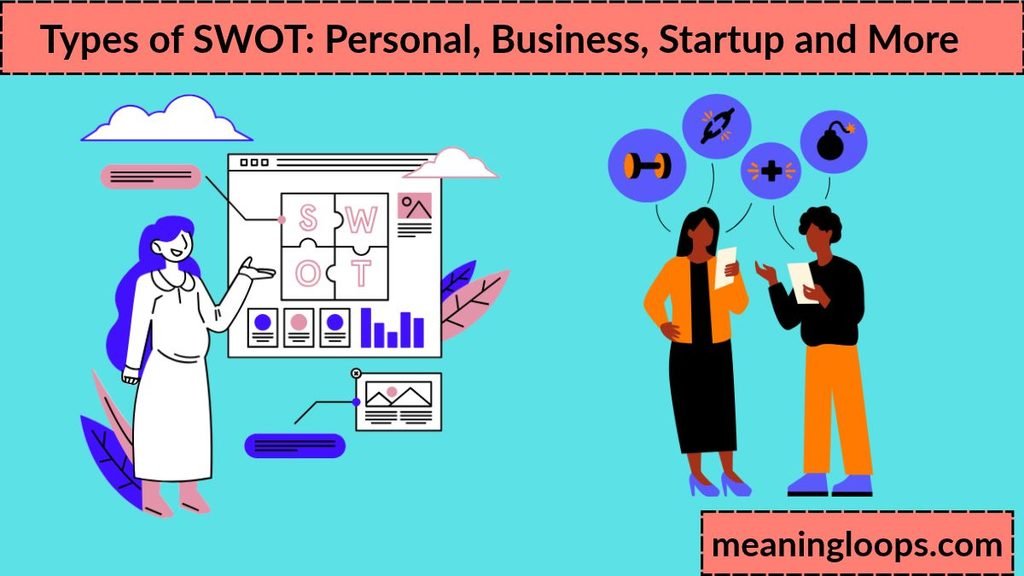
The four-box SWOT framework bends to fit many jobs. Here are the common types of SWOT.
| Type | Best for | Typical question |
|---|---|---|
| Personal SWOT | Self-improvement | What skills should I build? |
| Business SWOT | Company strategy | Where do we stand in the market? |
| Startup SWOT | New ventures | Is this idea ready to launch? |
| Marketing SWOT | Campaign planning | How does our brand compare? |
| Career SWOT | Job moves | Which path fits me best? |
| Academic SWOT | Students | How do I reach my goals? |
| Competitor SWOT | Rival research | Where is the other side weak? |
| Product SWOT | Product launches | Will this product win buyers? |
| Project SWOT | Project reviews | What could derail delivery? |
| Team SWOT | Group performance | How can we work better together? |
A competitor SWOT is especially handy. It turns rivals into an open book and reveals your competitive advantage.
Difference Between Strengths and Opportunities
People mix these up all the time. The difference between strengths and opportunities comes down to location.
- A strength lives inside you. Example: a skilled sales team.
- An opportunity lives outside you. Example: a new market that needs your product.
Here’s a simple test. Ask, “Do we own this?” If yes then it’s a strength. If no it’s probably an opportunity.
The same logic splits weaknesses from threats. This internal vs external analysis keeps your boxes clean.
SWOT vs PEST Analysis and Other Planning Frameworks
These related tools fill its gaps.
| Tool | What it does |
|---|---|
| PEST analysis | Scans political, economic, social, and technological forces |
| PESTLE | Adds legal and environmental factors |
| Porter’s Five Forces | Measures industry competition |
| TOWS matrix | Crosses SWOT categories to build concrete strategies |
Many analysts run PEST first. They then feed those findings into the opportunities and threats boxes. That step makes your situation analysis far richer.
SWOT Meaning in Text: Does SWOT Work as Slang?
Let’s clear up a common question. SWOT meaning in text isn’t slang like “LOL” or “BRB.” No texting dictionary lists it.
Still, people do use it as a verb. You might hear “Let’s SWOT this idea” in a startup chat. A friend might say “SWOT yourself” when you’re torn about a move. Some even advise you to “do a SWOT analysis first” before a big purchase.
That’s SWOT in casual conversation. It’s playful business buzzword usage. You’ll mostly see it in startup culture and corporate environments. It can pop up in a SWOT in WhatsApp chat between founders too.
How to Respond to SWOT in a Chat
Not sure how to answer? These SWOT replies work well:
- Casual: “Good idea. Let’s list the pros and cons together.”
- Funny: “Sure. Just don’t let the weaknesses box get too long.”
- Confident: “Already did one. My top strength is my network.”
- Private: “I’d like to think about it first. Can we talk later?”
Knowing how to respond to SWOT keeps the conversation friendly. It also shows maturity.
How to Use SWOT in Daily Life
You don’t need a boardroom. Here’s how to use SWOT in daily life:
- Weigh a job offer against your current role.
- Decide whether to move to a new city.
- Plan a freelance side hustle. Freelancers often run a quick SWOT before pricing services.
- Compare two college majors.
Each use builds personal growth and self-improvement habits. The method asks for honest evaluation. It balances logic vs emotion and brings emotional balance to hard choices.
The payoff is real. You reduce uncertainty. You gain clarity. And you feel in control again.
Common SWOT Mistakes to Avoid
Even smart teams fumble this tool. Watch for these traps.
- Mixing internal and external items. A rival’s new store is a threat. It isn’t a weakness.
- Writing vague entries. “Good brand” says nothing. “4.8 stars across 2,000 reviews” says plenty.
- Stopping at the list. Analysis without action wastes time.
- Expecting predictions. SWOT describes today and known trends. It can’t see the future.
- Ignoring evidence. Gut feelings need data behind them.
Strategist Roger Martin goes further. He argues that the strengths analysis in SWOT tends to feel bland, generic, and undiscriminating. (Roger Martin) His point is fair. Specific details fix the problem.
Is SWOT Analysis Outdated?
Short answer: no. But it has limits.
Pros:
- Fast and cheap.
- Easy for any team to learn.
- Great for strategic thinking and risk management.
- Works for every size of organization.
Cons:
- Results depend on honest input.
- It can turn into a checklist.
- It doesn’t rank items on its own.
Researchers have raised these concerns for decades. In 1993 and 1994, Terry Hill and Roy Westbrook reviewed SWOT use at 20 UK manufacturing companies. (HotPMO)
So is SWOT analysis outdated? Not really. Modern users just pair it with scoring, PEST, and TOWS. Used well it’s still a dependable planning framework.
FAQs About SWOT Meaning
What does SWOT stand for?
SWOT stands for strengths, weaknesses, opportunities, and threats. It’s a strategic tool for judging any situation.
What is the SWOT full form in business?
The SWOT full form is the same everywhere. In business it guides strategic planning and market research.
Can SWOT help with self-improvement?
Yes. It builds self-awareness and shows you where to grow. Many people revisit it every year.
How often should I update a SWOT analysis?
Review it every quarter for a business. Review it yearly for personal goals. Update it sooner after any big change.
What’s the difference between SWOT and SWAT?
SWOT is a planning tool. SWAT is a police unit. The two names just sound alike.
Conclusion: Put SWOT Meaning Into Action
You now know what SWOT means and how it works. It stands for strengths, weaknesses, opportunities, threats. It splits your situation into internal and external factors. And it turns tangled thoughts into a clear plan.
Remember the five steps: pick a subject, list internal factors, list external factors, rank them, and act. Keep every entry specific. Pair SWOT with PEST analysis when you need more depth.
Here’s your challenge. Choose one decision you face this week. Draw four boxes. Fill them in for ten minutes. You’ll walk away with more clarity and a lot more confidence.
Read
What Does DMS Mean in Text? The Complete 2026 Guide to Understanding “DMS” in Messages
Relentless Meaning in 2026: Psychology, Usage, and Hidden Impact
ATP Meaning in Text Explained: Slang, Uses & Social Media Guide

David Miller is the lead content writer at Meaning Loops, where he creates accurate and easy-to-understand content on word meanings, synonyms, antonyms, idioms, phrases, acronyms, abbreviations, and vocabulary. His goal is to help readers improve their English with reliable, well-researched, and SEO-friendly language resources.