You’re scrolling through a group chat and someone drops “SMFH” in response to a wild news story. You’ve got a rough idea it means something like disbelief or frustration, but you’re not 100% sure — and you definitely don’t want to misuse it in the wrong conversation.
Here’s the quick answer: SMFH stands for “Shaking My F*ing Head.”** It’s an intensified, more emotionally charged version of the more common SMH (“Shaking My Head”), and people use it to express strong disbelief, frustration, annoyance, or disappointment in text messages, social media comments, and casual chats.
That’s the short version. But if you actually want to use SMFH correctly — without accidentally sounding rude in the wrong context — you need to understand where it came from, how tone changes its meaning, and when to leave it out of a conversation entirely. That’s exactly what this guide covers.
What Does SMFH Mean?
SMFH meaning in text: “Shaking My F***ing Head” (sometimes softened to “Shaking My Freaking Head” in more polite contexts).
It’s a texting abbreviation used to express a strong emotional reaction — usually negative — to something someone said, did, or shared. Think of it as SMH with the volume turned all the way up.
| Element | Detail |
|---|---|
| Full form | Shaking My F***ing Head |
| Category | Strong slang / emotional slang |
| Primary emotions | Frustration, disbelief, disappointment, annoyance |
| Common platforms | Twitter/X, TikTok, Instagram, Discord, WhatsApp, Snapchat |
| Tone | Informal, casual, sometimes sarcastic |
| Formality level | Not appropriate for professional communication |
You’ll typically see it written in lowercase (“smfh”) for a casual, almost throwaway reaction, or in ALL CAPS (“SMFH”) when someone wants to signal genuine frustration. That distinction matters more than most people realize, and we’ll break it down later in this guide.
SMFH Origin — Where Did It Come From?
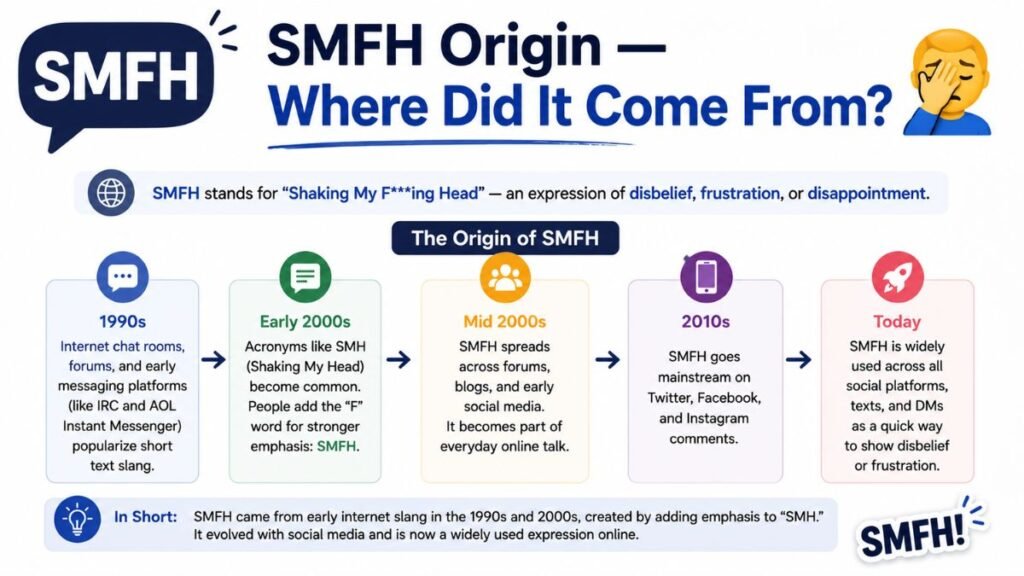
Understanding where SMFH came from helps explain why it hits differently than a simple “wow” or “ugh.”
Roots in Spoken Slang
The head-shake gesture itself long predates texting. Shaking your head is a near-universal physical signal of disapproval, disbelief, or exasperation. When people started translating body language into text-based slang in the early days of instant messaging and internet forums, “shaking my head” became a natural fit for describing that same reaction without actually being able to see the other person’s face.
How It Spread Through Texting, Hip-Hop, and Early Social Media
SMH (the cleaner version) picked up steam first, showing up heavily in early 2000s AOL Instant Messenger conversations, text messages, and hip-hop-influenced online communities where quick, punchy reactions were the norm. As texting culture matured and social media culture exploded on platforms like Twitter (now X), people wanted a way to express something stronger than plain old SMH — something that matched the intensity of genuine frustration or shock rather than mild disapproval.
Why the “F” Got Added to SMH
The added “F” — standing in for a swear word — is a pattern you’ll recognize from other internet abbreviations like WTF or STFU. Inserting profanity into an acronym is a common way online slang ramps up emotional intensity without anyone having to type out the actual curse word. It keeps the message quick, keeps it censored enough to feel casual rather than aggressive, and instantly signals “this bothered me more than usual.”
SMFH vs. SMH — What’s the Real Difference?
This is the single most common point of confusion, so let’s settle it clearly.
SMH (“Shaking My Head”) is the mild, everyday version. You can use it for almost anything — a minor annoyance, a corny joke, a mildly disappointing sports result. It carries a light, often good-natured tone.
SMFH is the stronger cousin. Because it embeds a swear word, it signals real frustration, genuine disbelief, or sharper disapproval. It’s not something you’d casually drop for a minor inconvenience — using SMFH for something trivial can come across as an overreaction.
Side-by-Side Comparison Table
| Feature | SMH | SMFH |
|---|---|---|
| Full meaning | Shaking My Head | Shaking My F***ing Head |
| Intensity | Mild | Strong |
| Contains profanity | No | Yes (implied) |
| Typical use case | Minor annoyance, mild disbelief | Genuine frustration, shock, strong disappointment |
| Formal setting appropriate? | Occasionally acceptable in very casual work chats | Never appropriate |
| Common tone | Light, sometimes humorous | Serious, emotional, sometimes sarcastic |
Key takeaway: If you’re reacting to something mildly funny or slightly annoying, use SMH. If something genuinely frustrates or shocks you, SMFH fits better — as long as the audience and setting allow for casual, unfiltered language.
How to Use SMFH in a Sentence
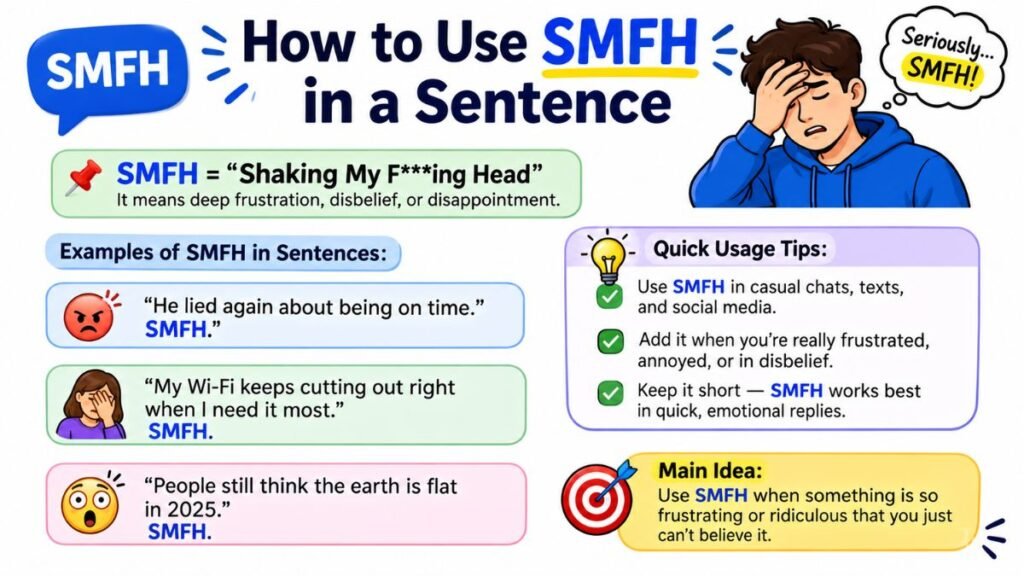
Seeing SMFH in context makes the meaning click faster than any definition. Here’s how it actually shows up across different platforms.
Texting Examples
- “He said he’d be here an hour ago. smfh.”
- “You forgot my order again? SMFH, this is the third time.”
- “She just found out the concert got cancelled last minute smfh.”
Social Media Examples (Twitter/X, TikTok, Instagram, Discord)
- Twitter/X: “The team blew a 20-point lead again. SMFH.”
- TikTok comments: “the way he just walked past that lost dog like nothing… smfh”
- Instagram: “Another price hike from this company smfh when will it end”
Gaming & Group Chat Examples
- Discord: “Bro disconnected right before the boss fight. smfh, typical.”
- Group chat: “Someone ate the last slice of pizza I was saving. SMFH.”
Notice the pattern: SMFH almost always follows a statement describing what triggered the reaction. It rarely stands alone — it’s a reaction tag, not a full sentence.
Tone Signals — How Punctuation and Caps Change the Meaning
This is where a lot of people misjudge SMFH. The exact same three letters can read as playful or genuinely upset depending on formatting.
Lowercase “smfh” (Casual/Playful)
Lowercase versions tend to feel more relaxed, almost thrown in as an afterthought. It’s the digital equivalent of a shrug paired with a head shake — mild exasperation, often between friends who know each other’s sense of humor.
ALL CAPS “SMFH” (Genuine Frustration or Anger)
Capitalizing the whole abbreviation ramps up the emotional weight. In text messages and social media comments, all-caps generally signals raised volume or intensity — the same rule applies here. “SMFH” in caps usually means the person is genuinely annoyed, not just mildly amused.
SMFH + Emoji Combos and What They Signal
- SMFH 😂 — sarcastic, more amused than upset
- SMFH 😤 — genuine frustration
- SMFH 💀 — shock combined with dark humor, often reacting to something absurd
- SMFH 🙄 — eye-roll energy, mild irritation without real anger
Pairing SMFH with an emoji is one of the clearest ways to remove ambiguity, since text alone strips out vocal tone.
When It’s Okay to Use SMFH — and When to Avoid It
Appropriate Contexts
- Casual texting with friends or close family
- Reacting to memes, viral posts, or relatable content
- Commenting on frustrating (but non-serious) news or sports outcomes
- Group chats with an established casual tone
- Gaming chats and Discord servers among peers
Contexts to Avoid
- Workplace chats and formal emails
- Customer service conversations
- First-time conversations with someone you don’t know well
- Serious conversations involving grief, trauma, or sensitive topics
- Any professional communication where tone needs to stay measured
Expert tip: When in doubt, default to a polite alternative like “that’s frustrating” or “I can’t believe that” in formal communication settings. Save SMFH for contexts where casual, unfiltered language is already the norm.
Is SMFH Rude or Offensive?
Whether SMFH reads as rude depends heavily on context, relationship, and tone — not the abbreviation itself.
Friendly/Playful Use
Between friends reacting to something mildly ridiculous, SMFH often reads as friendly teasing rather than genuine offense. Example: “You actually thought the store was open on a holiday? smfh.”
Neutral/Reactive Use
Reacting to shared frustrations — bad news, an inconvenient delay, a shared annoyance — SMFH functions as a quick reaction that doesn’t target anyone directly. Example: “The flight got delayed again smfh.”
When It Can Come Across as Rude or Dismissive
If SMFH is directed at a specific person’s statement or opinion, it can feel dismissive or condescending — like you’re shaking your head at them, not just at a situation. Example: replying “smfh” directly to someone’s genuine question or vulnerable comment can come across as mocking, even if that wasn’t the intent.
Rule of thumb: SMFH aimed at a situation tends to feel neutral or even bonding. SMFH aimed at a person’s words can easily feel condescending.
A Quick Real-World Example
Picture two coworkers texting after hours about a shared frustration. One says, “the printer’s been broken for a week and nobody’s fixed it.” The other replies “smfh, of course.” That’s a low-stakes, relatable exchange — nobody feels attacked.
Now picture a different scenario: someone shares that they’re nervous about a job interview, and the reply is “smfh, why are you stressed about that.” Same three letters, completely different effect. In the second case, SMFH minimizes what the other person is feeling instead of reacting to a shared annoyance. That contrast is the clearest illustration of why context — not the abbreviation itself — determines whether SMFH lands as playful or dismissive.
How to Respond When Someone Sends You SMFH
If It’s Playful
Match the energy. A quick “lol I know right” or a relatable follow-up keeps the casual tone going without over-explaining.
If It Seems Genuinely Frustrated
Acknowledge the frustration directly rather than brushing past it. Something like “that’s so annoying, what happened?” shows you’re taking their reaction seriously, which matters more in real-time conversations than people expect.
Common Typos and Variants People Search
Because SMFH isn’t a dictionary word, it gets misspelled constantly in searches and messages. Common variants include:
- “smdh” — a scrambled version, sometimes used interchangeably
- “sfmh” — simple letter-order typo
- “dose smfh mean” — typo for “does smfh mean”
- “what smfh mean in text” — dropped verb, still searched frequently
If you’ve typed any of these into a search bar, you landed in the right place — they all point back to the same core SMFH meaning.
SMFH’s Acronym Family — Related Slang to Know
SMFH doesn’t exist in isolation. It’s part of a broader family of reaction acronyms used across digital communication.
SMH, IFHMFH, FML, and Other Reaction Acronyms
- SMH — Shaking My Head (milder version of SMFH)
- FML — F*** My Life (frustration directed at one’s own situation)
- WTF — What The F*** (shock or confusion)
- OMG — Oh My God (surprise, shock, excitement)
- BRUH — standalone disbelief or exasperation, often used like a full sentence
- LMAO — Laughing My A** Off (amusement, sometimes paired with SMFH for sarcastic reactions)
- IDC — I Don’t Care (dismissiveness, different emotional register than SMFH)
Quick Comparison Table
| Acronym | Meaning | Primary Emotion |
|---|---|---|
| SMH | Shaking My Head | Mild disapproval |
| SMFH | Shaking My F***ing Head | Strong frustration/disbelief |
| WTF | What The F*** | Shock, confusion |
| FML | F*** My Life | Self-directed frustration |
| OMG | Oh My God | Surprise |
| BRUH | (standalone) | Disbelief, exasperation |
Recognizing this family of terms helps you read the emotional temperature of a conversation faster, since people often mix and match them depending on how strong their reaction is.
It also helps to think of these acronyms as sitting on a rough intensity scale rather than as isolated, unrelated terms. On the mild end, you have things like SMH or a simple “lol” — low-stakes reactions that barely register as strong emotion. In the middle, terms like BRUH or OMG signal genuine surprise without necessarily implying frustration. On the higher end, SMFH, WTF, and FML all lean on implied or explicit profanity to communicate that something crossed from “mildly annoying” into “genuinely frustrating.” Understanding where a term sits on that scale makes it much easier to pick the right one for how strongly you actually feel about something, rather than defaulting to whichever acronym is most familiar.
Is SMFH Still Popular in 2026?
Yes — SMFH remains widely used across text messages, messaging apps, and social media comments, particularly on platforms like X, TikTok, and Discord where quick, punchy reactions dominate the comment sections. Reaction-based slang like SMFH tends to have staying power precisely because it fills a specific gap: expressing strong emotion in as few characters as possible. As long as fast-paced texting and short-form social media content stay dominant, abbreviations like SMFH aren’t going anywhere.
Common Mistakes People Make With SMFH
- Using it in professional settings. Even a casual work Slack channel isn’t necessarily the right place — read the room first.
- Confusing it with SMH in serious situations. Using the stronger, profanity-based version when someone shares genuinely sad or serious news can feel jarring or dismissive.
- Overusing it until it loses impact. If every message ends in “smfh,” the emotional weight wears off and it starts to read as filler rather than a genuine reaction.
- Directing it at a person instead of a situation. This is the fastest way for SMFH to come across as rude rather than relatable.
Best Practices for Using SMFH
- Match the tone to your audience — casual friend groups are fine; coworkers and new acquaintances are not.
- Use lowercase for mild reactions, caps for genuine frustration.
- Pair with emoji when you want to remove ambiguity about your tone.
- Save it for situations that actually warrant a strong reaction — save the milder SMH for everyday mild annoyances.
Frequently Asked Questions
What does SMFH mean in text?
SMFH stands for “Shaking My F***ing Head.” It’s used to express strong frustration, disbelief, annoyance, or disappointment in text messages and casual chats.
Is SMFH the same as SMH?
No. SMH (“Shaking My Head”) is a milder expression of disapproval, while SMFH is a stronger, more emotionally charged version that implies genuine frustration or shock.
Can I use SMFH in a formal or professional chat?
No. SMFH contains implied profanity and casual strong language, making it unsuitable for workplace chats, formal emails, or professional communication.
What’s the difference between SMFH and SMDH?
They’re generally used interchangeably, with SMDH simply being a scrambled letter variant of SMFH. Both carry the same intensified meaning compared to plain SMH.
Is SMFH considered rude?
It depends on context. Directed at a situation, it usually reads as relatable or neutral. Directed at a specific person’s comment or question, it can come across as dismissive or condescending.
How do you pronounce or say SMFH out loud?
Most people simply spell it out letter by letter (“ess-em-eff-aitch”) in conversation rather than pronouncing it as a word, similar to how SMH or WTF are typically said aloud.
Final Thoughts
SMFH is a compact but emotionally loaded piece of texting slang — a stronger, more intense sibling of the everyday SMH. Once you understand its origin, its tone signals, and where it does (and doesn’t) belong, you can use it the way it’s meant to be used: as a quick, honest reaction to something genuinely frustrating, shocking, or hard to believe.
The short version to remember: keep it casual, keep it among people who share your sense of humor, and save it for reactions that actually warrant the intensity. Get those three things right, and you’ll never misuse SMFH again.
Read more:
Fillet vs. Filet: The Complete Guide to Meaning, Pronunciation, and Proper Use
Ask a Question vs. Pose a Question: The Real Difference and How to Use Each Correctly
What Does LMC Mean in Text? Meaning, Uses & Examples (2026)

Hi, I’m Andrew Wilson, the founder of Meaning Loops. I created this website to help people understand English words in a simple and easy way. Here, I share word meanings, synonyms, antonyms, idioms, phrases, grammar tips, and vocabulary guides. My goal is to provide clear, accurate, and useful content that helps students, writers, and English learners improve their language skills. Thank you for visiting Meaning Loops and being part of this journey.






1 thought on “What Does SMFH Mean in Text? Full Meaning, Origin, Uses & Examples (2026 Guide)”