Stand at a butcher counter in London, then fly to New York and do the same thing. You’ll hear two different words for what’s basically the same boneless cut of meat. One says “FILL-it.” The other says “fi-LAY.” Neither is wrong. That’s the strange thing about fillet vs. filet — it’s not a spelling error waiting to be corrected. It’s a genuine split in the English language, and it happened for real historical reasons.
This guide breaks down where each word comes from, how to pronounce them, when to use which one, and how to actually fillet a fish or trim a beef tenderloin like you know what you’re doing. No fluff. Just the facts, the technique, and the grammar rules that style guides actually enforce.
The Quick Answer
Here’s the short version, if you’re in a hurry:
Fillet is the standard spelling in British English, and it’s used for both meat and fish, as a noun and as a verb. Filet is the American English variant, mostly reserved for beef (especially filet mignon) and dishes with French culinary roots, while Americans still often write “fillet” for fish.
| Fillet | Filet | |
|---|---|---|
| Region | UK, Australia, Canada, most Commonwealth countries | United States |
| Pronunciation | “FILL-it” | “fi-LAY” |
| Typical use | Fish, chicken, beef — all contexts | Beef and French-derived dishes; fish sometimes still “fillet” |
| Word origin | Anglicized from Old French | Kept closer to French spelling and sound |
| Verb form | “to fillet a fish” | “to filet a steak” |
Both words trace back to the same French root. English just split the difference, and depending on which side of the Atlantic you’re standing on, you’ll pick a side without even realizing it.
Where the Words Come From
Neither “fillet” nor “filet” is a modern invention. Both descend from the Old French word fillet vs. filet, a diminutive of fil, meaning “thread” or “string.” The idea was simple: a fillet is a thin strip, cut clean and free of bone, resembling a length of thread laid flat.
English absorbed this word back in the 14th century, and like a lot of French loanwords that crossed the Channel, it got anglicized over time. The spelling shifted to “fillet,” the pronunciation flattened out to match English speech patterns, and it settled into British usage that way for centuries.
American English took a different path. Because American cuisine leaned more heavily on French culinary influence — especially in fine dining, where French terminology carried (and still carries) a certain prestige — the original French spelling and pronunciation stuck around longer for certain dishes. That’s why “filet mignon” never became “fillet mignon” on American menus, ven though “fish fillet” is common right alongside it.
So really, you’re looking at one word that took two different roads depending on which country adopted it and how strongly French cooking influenced local food culture. Neither version is more “correct.” They’re parallel developments of the same root.
Fillet vs. Filet: Pronunciation Differences

This is where things get genuinely confusing for a lot of people, because the pronunciation doesn’t always match the spelling the way you’d expect.
In British English, “fillet” is pronounced “FILL-it” — the T is fully sounded, and it rhymes with “skillet.” Simple, no surprises, said exactly how it looks.
In American English, “filet” is pronounced “fi-LAY” — the T is silent, following French pronunciation rules, and it rhymes with “relay” or “delay.” This is a case of the spelling changing to partially reflect the French sound, even though the T stayed in the written word.
Here’s the twist: even when Americans write “fillet” (as in “fish fillet”), they usually still pronounce it the French way — “fi-LAY” — dropping the T sound. Meanwhile, British speakers pronounce “fillet” with a hard T no matter what the dish is, even in high-end French restaurants.
Quick test: if you’re reading a recipe out loud and you say the T sound, you’re using British pronunciation. If you drop it, you’re using American pronunciation. The spelling on the page won’t always tell you which one to use.
This mismatch between spelling and sound trips up a lot of home cooks and even professional writers. It’s worth remembering that pronunciation and spelling in English don’t always travel together, especially with loanwords.
Spelling Rules by Region
Different English-speaking countries have settled on different conventions, and knowing them will save you from looking uninformed on a menu, in a cookbook, or in a piece of content you’re publishing.
British and Commonwealth English (UK, Australia, New Zealand, South Africa, most of Canada) uses “fillet” across the board. Fish fillet, chicken fillet, beef fillet, filleting a salmon — it’s all one spelling, no exceptions carved out for specific cuts.
American English splits the difference. “Filet” shows up specifically for beef tenderloin cuts and French-derived preparations — filet mignon being the obvious example. But fish is still commonly labeled “fillet” in American grocery stores and on American menus. So an American diner might order a “filet” of beef and a “fillet vs. filet” of salmon in the same sitting, and both spellings would be considered correct.
Canada leans toward British spelling in most formal writing, following Canadian English conventions generally, though French-Canadian influence (especially in Quebec) sometimes brings the French spelling and pronunciation into play for beef dishes specifically.
Here’s a regional cheat sheet:
| Country | Standard Spelling | Beef Cut | Fish Cut |
|---|---|---|---|
| United Kingdom | Fillet | Fillet steak | Fish fillet |
| United States | Mixed | Filet (filet mignon) | Fillet (fish fillet) |
| Australia | Fillet | Fillet steak | Fish fillet |
| Canada | Mostly Fillet | Filet or Fillet (regional) | Fillet |
| France | Filet | Filet | Filet |
France, notably, doesn’t have this problem at all — it’s “filet” for everything, since that’s the original word and there’s no anglicized version to compete with it.
Fillet vs. Filet in Meat: What Each Word Actually Means
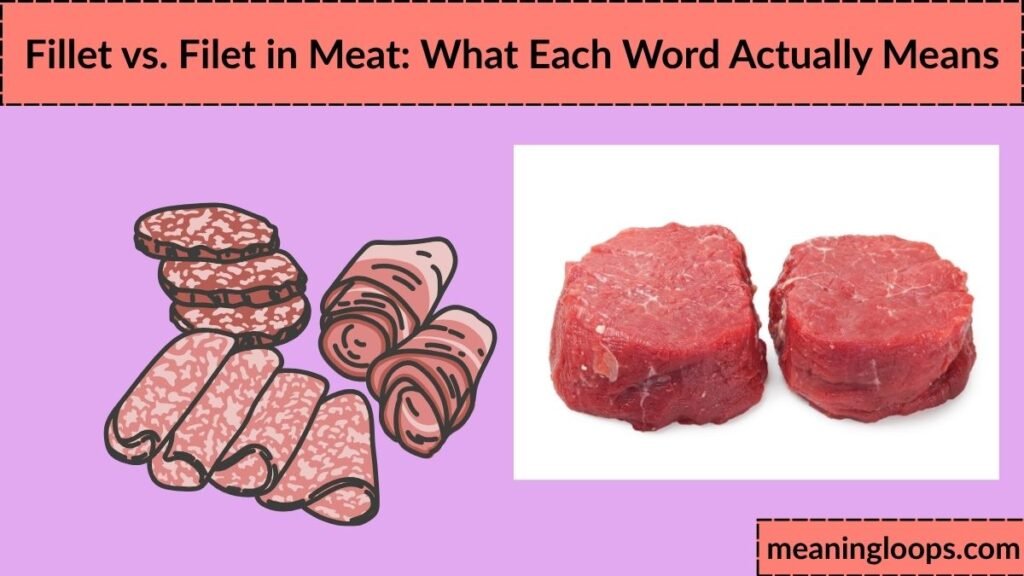
Beyond spelling, it helps to know what the word is actually describing, because “fillet” and “filet” do double duty as both a noun and a verb.
As a noun, a fillet (or filet) refers to a boneless piece of meat or fish, typically cut from a specific muscle group known for tenderness and minimal connective tissue. It’s lean, it cooks quickly and evenly, and it’s usually one of the more expensive cuts on any menu because of how little waste is involved in producing it.
As a verb, “to fillet” or “to filet” describes the actual technique of removing bones from meat or fish using a sharp knife, separating the flesh cleanly from the skeletal structure without tearing or wasting meat.
Some examples across proteins:
- Fish fillet — the boneless side of a fish, skin on or off, cut lengthwise away from the spine
- Chicken fillet — usually refers to the chicken breast, sometimes the tenderloin strip underneath it
- Beef fillet — cut from the tenderloin, the least-used muscle in the cow, which is why it’s so tender
The common thread across all of these: no bones, minimal connective tissue, and a cut prized for its texture over its flavor intensity (tenderloin, for instance, is milder in flavor than a ribeye, precisely because it’s a muscle the animal barely uses).
Filet Mignon: Why It Keeps the French Spelling

Deserves its own section because it’s the one term that almost never changes spelling, regardless of which country you’re in. Even British menus that use “fillet” everywhere else will usually write “filet mignon” in the French form when referring to this specific cut.
The phrase translates literally to “dainty fillet” or “tender fillet” — mignon meaning small, cute, or delicate in French. It refers to a small, round cut taken from the narrow end of the beef tenderloin, the most tender muscle on the entire animal because it does almost no weight-bearing work.
A few facts worth knowing about this cut:
- Location: Filet mignon comes from the psoas major muscle, located under the ribs near the spine, on the interior side of the short loin
- Tenderness: It’s widely regarded as the most tender cut of beef available, due to minimal muscle use and low connective tissue
- Flavor profile: Because it’s lean and low in fat marbling, it has a milder flavor than cuts like ribeye or New York strip, which is why it’s often served with a sauce or wrapped in bacon
- Price: It typically commands one of the highest per-pound prices in a butcher shop, since each cow yields a relatively small quantity of this cut
Why does English never anglicize the spelling to “fillet mignon”? Mostly tradition and branding. The phrase entered fine dining vocabulary as a whole unit, tied closely to French culinary prestige, and changing the spelling would have diluted that association. Menus that write “fillet mignon” instead of “filet mignon” are technically making an inconsistency error, since the phrase is generally treated as a fixed French borrowing, not a translatable term.
As one culinary instructor at a well-known cooking school put it during a knife skills demonstration: “You can call it whatever you want on the menu, but the moment you spell it wrong, the regulars notice.” Reputation in fine dining runs on small details like this.
Fish Fillets vs. Meat Filets: Does the Spelling Change by Food Type?
There’s a popular myth floating around that says “fillet” is always used for fish and “filet” is always used for meat. That’s not accurate, and it’s worth debunking directly, since a lot of blog posts repeat this claim without checking it.
In reality, the spelling depends far more on region than on food type. British English uses “fillet” for fish, chicken, and beef alike. American English uses “filet” mainly for beef and French dishes, while still defaulting to “fillet” for fish in most everyday contexts — think “fillet of sole” or “fish fillet” on a grocery store label.
A few real-world examples that show this pattern in action:
- Filet mignon — beef, American spelling, French dish
- Fillet of sole — fish, used in both American and British English despite the American convention leaning toward “filet” for meat
- Chicken fillet — used in the UK; Americans more commonly say “chicken breast” or “chicken tenderloin” instead of “chicken fillet” at all
- Filet de saumon — French for salmon fillet, sometimes borrowed directly into upscale American menu language
So the food-type theory holds up loosely for beef specifically (mostly because of filet mignon’s dominance in American vocabulary), but it breaks down everywhere else. Region remains the stronger predictor of spelling than the type of protein on the plate.
How to Fillet a Fish (Step-by-Step Technique)
Knowing the word is one thing. Knowing the technique is another, and it’s genuinely useful in the kitchen, whether you’re working with a whole trout you caught yourself or a salmon side from the fish counter.
Tools you’ll need:
- A flexible fillet knife (thin, sharp blade, ideally 6–8 inches long)
- A sturdy, non-slip cutting board
- Fish tweezers or needle-nose pliers for pin bones
- A clean kitchen towel for grip
Step-by-step process:
- Scale and gut the fish first, if it hasn’t been done already. Rinse it and pat it dry — a wet fish is a slippery fish, and slippery is how accidents happen.
- Make the first cut behind the gills, angling the knife down toward the spine but not through it. This marks where the fillet will separate from the head.
- Turn the blade flat and slide it along the backbone, using long, smooth strokes from head to tail. Keep the blade pressed gently against the bones so you waste as little meat as possible.
- Lift the fillet away once you’ve worked the full length of the spine, and repeat on the other side.
Common mistakes to avoid:
- Using a dull knife, which tears the flesh instead of slicing cleanly through it
- Cutting too close to the bones (wastes meat) or too far away (leaves bones behind)
- Rushing the pin bone removal step, which is easy to skip but noticeable the moment someone bites into a bone at dinner
- Applying too much downward pressure, which crushes delicate fish flesh instead of separating it cleanly
How to Prepare a Beef Filet/Fillet
Beef tenderloin requires a different kind of prep, since you’re not working around a bone structure the same way — the tenderloin itself is already boneless once removed from the carcass.
Trimming the silver skin: Beef tenderloin comes wrapped in a tough, silvery membrane called silver skin, which doesn’t break down with cooking and needs to be removed before serving. Slide a thin knife just underneath it, angle the blade slightly upward, and slice it away in long strips, keeping the blade angled to avoid removing extra meat.
Recommended cooking methods:
- Pan-searing then roasting — sear on all sides in a hot pan, then finish in the oven for even doneness throughout
- Sous-vide — cook in a temperature-controlled water bath for precise doneness, then sear briefly for color and crust
- Grilling — direct high heat, ideal for individual filet mignon steaks rather than a whole tenderloin
- Pan-frying — quick, high-heat method suited to smaller, thinner cuts
Internal temperature guide for doneness:
| Doneness | Internal Temperature | Description |
|---|---|---|
| Rare | 120–125°F (49–52°C) | Cool red center |
| Medium-rare | 130–135°F (54–57°C) | Warm red center |
| Medium | 140–145°F (60–63°C) | Warm pink center |
| Medium-well | 150–155°F (66–68°C) | Slightly pink center |
| Well-done | 160°F+ (71°C+) | No pink remaining |
Since filet mignon is such a lean cut, it’s easy to overcook it into dryness, so most steakhouses recommend pulling it a few degrees before your target temperature, since it will continue to cook briefly while resting.
Grammar and Style Guide Rules: AP, Chicago, and Culinary Style
If you write professionally — recipes, menus, food blogs, journalism — the spelling you choose isn’t just a matter of taste. Style guides actually weigh in on this.
AP Style generally follows American convention: “filet mignon” for the beef cut, but “fillet” for fish and general filleting as a verb. AP tends to favor consistency with common American usage over strict etymological purity.
Chicago Manual of Style doesn’t mandate one spelling universally but defers to context and publication consistency — meaning if you start an article with “fillet,” you should stay with “fillet” throughout, rather than switching spellings mid-piece.
Food publications like Bon Appétit and Serious Eats generally follow the American convention: “filet mignon” stays French-spelled, fish and chicken get “fillet,” and the publication stays internally consistent rather than mixing spellings within a single article.
Practical rule of thumb for anyone writing recipes, menus, or food content: match your audience’s regional expectation, stay consistent throughout the piece, and always keep “filet mignon” in its French spelling regardless of which convention you’re otherwise following — that particular phrase functions almost like a proper noun at this point.
Common Mistakes People Make With These Words
A few errors show up again and again, whether on menus, in recipe blogs, or in casual writing:
- Writing “fillet mignon” instead of “filet mignon” — this is probably the single most common mistake, since writers default to “fillet” out of habit and forget the phrase is a fixed French borrowing
- Using “filet” in British English contexts, which reads as an Americanism to UK audiences and can look like a typo to British editors
- Mispronouncing “fillet” the American way in the UK, dropping the T sound when British convention keeps it fully sounded
- Inconsistent spelling within a single piece of writing, switching between “fillet” and “filet” in the same article without a clear reason, which signals sloppy editing
- Assuming fish always gets “fillet” and meat always gets “filet”, which — as covered above — isn’t actually the rule; it’s regional convention, not food-type convention
FAQs About Fillet vs. Filet
Is it “fillet” or “filet” for salmon?
Both are used, but “fillet” is more common overall, even in American English, where fish generally keeps the anglicized spelling despite beef leaning toward “filet.”
Why is filet mignon never spelled “fillet mignon”?
Because the phrase was borrowed directly from French as a fixed culinary term, and English never anglicized it the way it did with general fish and meat terminology. Changing the spelling would break with over a century of established menu and cookbook convention.
Do Americans say “fillet” or “filet”?
It depends on context. Americans typically write and say “filet” for beef tenderloin cuts, especially filet mignon, but still commonly write “fillet” for fish, even while pronouncing it the French way (“fi-LAY”).
Is “filet” a French word or an English word?
Both, depending on context. “Filet” is the original French word, and American English borrowed it directly for certain beef and French-derived dishes, while also developing “fillet” as a separate anglicized spelling used elsewhere.
Which spelling should I use on my restaurant menu?
Match your audience and stay consistent. American menus typically use “filet mignon” and “fillet” for fish; British and Commonwealth menus use “fillet” for everything, without exception, including beef.
Conclusion: Which One Should You Use?
At the end of the day, fillet vs. filet isn’t a case of right versus wrong — it’s a case of geography and tradition. If you’re writing for a British or Commonwealth audience, use “fillet” consistently across meat, fish, and chicken, no exceptions. If you’re writing for an American audience, use “filet” for beef tenderloin and French-derived dishes, especially filet mignon, but default to “fillet” for fish.
The one rule that holds steady no matter where you’re writing from: filet mignon stays French-spelled, full stop. Beyond that, pick a convention based on your audience, stay consistent within whatever you’re writing, and you’ll never look like you made a typo — because you didn’t. You just picked a side of a centuries-old linguistic split, same as everyone else who’s ever written a menu.

David Miller is the lead content writer at Meaning Loops, where he creates accurate and easy-to-understand content on word meanings, synonyms, antonyms, idioms, phrases, acronyms, abbreviations, and vocabulary. His goal is to help readers improve their English with reliable, well-researched, and SEO-friendly language resources.