You got a text that just says “CYB” and now you’re stuck staring at your phone wondering what it means. Here’s the short version: it depends entirely on who sent it and why.
CYB is one of those rare texting abbreviations that carries five completely different meanings, and picking the wrong one can genuinely confuse a conversation. Your coworker texting “CYB” about a client email means something very different from your friend texting “CYB” before disappearing into a meeting.
By the end of this guide, you’ll know exactly what CYB stands for in every context — texting, workplace chats, cybersecurity discussions, and casual social media — plus how to figure out which meaning applies to your specific conversation and how to reply.
What CYB Means in Text
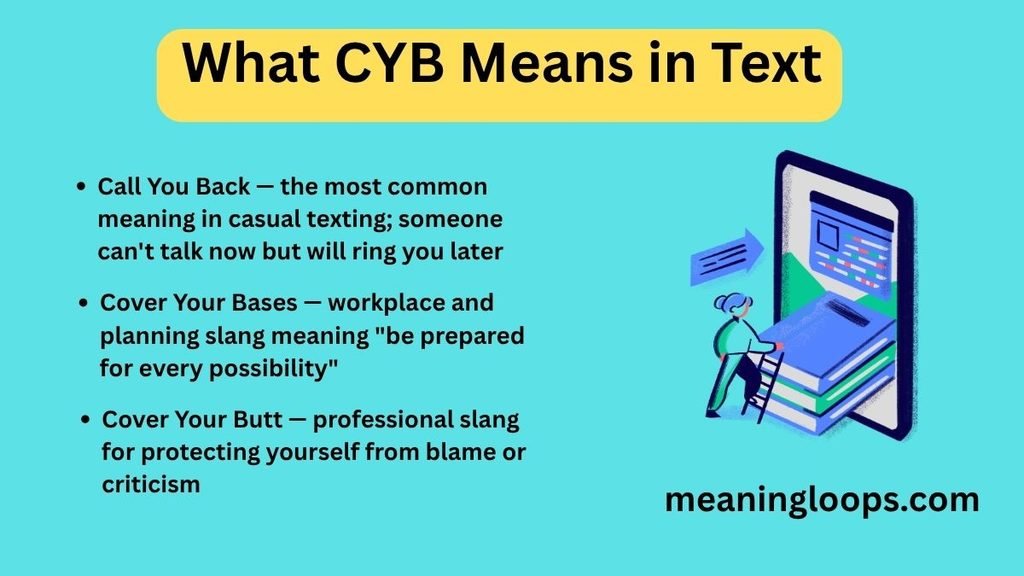
CYB doesn’t have one fixed meaning. It’s a context-dependent abbreviation, which is exactly why so many people get confused by it. The letters stay the same, but the intent behind them shifts based on who’s texting, what they’re talking about, and where the conversation is happening.
The 5 Real Meanings of CYB (At a Glance)
- Call You Back — the most common meaning in casual texting; someone can’t talk now but will ring you later
- Cover Your Bases — workplace and planning slang meaning “be prepared for every possibility”
- Cover Your Butt — professional slang for protecting yourself from blame or criticism
- Cyber — shorthand used in tech, security, and business contexts (cybersecurity, cyber defense, Cyber Monday)
- Count Your Blessings — a motivational phrase used in supportive or reflective conversations
Comparison Table: CYB Meaning by Context
| Meaning | Common Setting | Tone | Typical Sender |
|---|---|---|---|
| Call You Back | Personal texting, social media | Casual, quick | Friends, family |
| Cover Your Bases | Planning, project discussions | Neutral, practical | Coworkers, managers |
| Cover Your Butt | Workplace, HR, accountability talk | Cautious, sometimes joking | Colleagues |
| Cyber | Tech, IT, security teams | Technical, formal | IT staff, analysts |
| Count Your Blessings | Personal, emotional support | Warm, reflective | Family, close friends |
Key takeaway: if you remember nothing else from this article, remember this — context is doing all the work. The abbreviation itself gives you almost no information on its own.
How to Tell Which CYB Meaning Someone Means
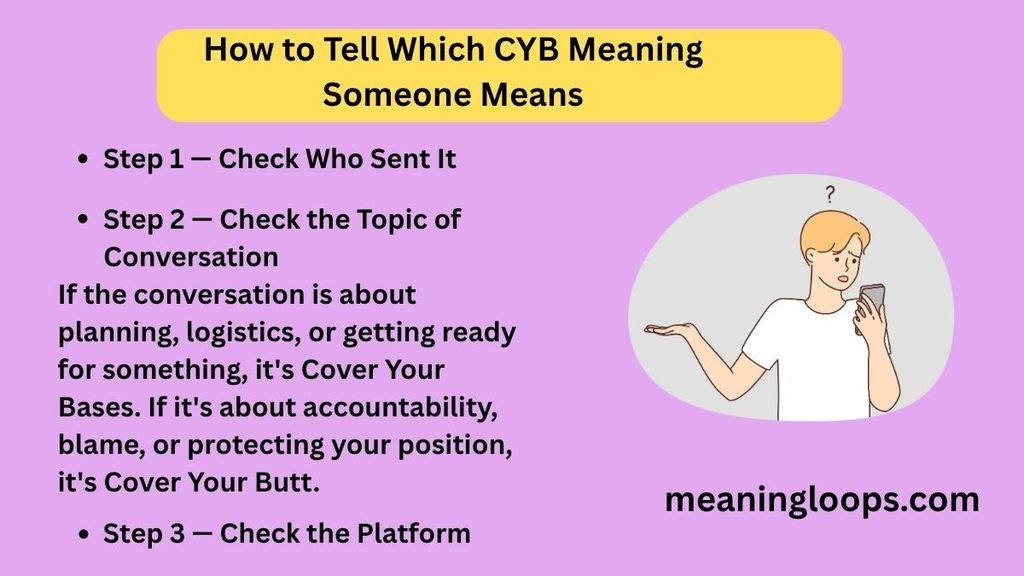
Figuring out the right meaning isn’t guesswork if you know what to look for. Here’s a simple three-step process that works almost every time.
Step 1 — Check Who Sent It
A close friend or family member is far more likely to mean “Call You Back” or “Count Your Blessings.” A coworker, manager, or anyone in a professional thread is almost always using “Cover Your Bases” or “Cover Your Butt.” Someone in IT, security, or tech support is talking about “Cyber.”
Step 2 — Check the Topic of Conversation
If the conversation is about planning, logistics, or getting ready for something, it’s Cover Your Bases. If it’s about accountability, blame, or protecting your position, it’s Cover Your Butt. And if the topic is hacking, data breaches, passwords, or online safety, it’s Cyber. If someone just said they’re busy or driving, it’s Call You Back.
Step 3 — Check the Platform
Casual platforms like Snapchat, TikTok, and Instagram DMs lean heavily toward the “Call You Back” and “Count Your Blessings” meanings. Slack, Microsoft Teams, and work email threads almost always mean “Cover Your Bases” or “Cover Your Butt.” Cybersecurity forums, IT tickets, and business compliance documents point to “Cyber.”
Quick Decision Chart
- Is this a work conversation? → Likely Cover Your Bases or Cover Your Butt
- Is this about hacking, security, or IT? → Cyber
- Is this a casual chat with a friend? → Likely Call You Back
- Is someone going through something emotional? → Likely Count Your Blessings
“Context is everything with slang like this. The words never change, but the meaning shifts the moment the setting does.” — a pattern confirmed across nearly every major slang dictionary that tracks CYB usage.
Meaning 1 — Call You Back
This is the meaning you’ll run into most often in everyday, casual texting. It’s a quick, practical way to acknowledge a message without stopping to have a full conversation right then.
When People Use This
People send “CYB” when they’re driving, in a meeting, at work, or simply too busy to type out a full reply. It signals that the conversation isn’t over — it’s just paused.
Real Text Examples
- “In the middle of something important. CYB in 20.”
- “Can’t talk, driving. CYB when I get home.”
- “At the gym. CYB in an hour!”
How to Respond
You don’t need to do much. A simple “okay” or “sounds good” is enough. If it’s urgent, you can reply with “Actually, can you call now?” to signal that the wait isn’t ideal.
Meaning 2 — Cover Your Bases
“Cover your bases” is a phrase borrowed from baseball, where a player needs to make sure every base is protected before the play happens. Outside of the sport, it means being thoroughly prepared for something — thinking ahead so nothing catches you off guard.
When People Use This
This meaning shows up constantly in project planning, event coordination, and team communication. It’s a reminder to prepare for multiple outcomes rather than assume everything will go smoothly.
Real Text Examples
- “Let’s CYB and have a backup vendor just in case.”
- “Send the file twice, once by email and once on Slack. CYB.”
- “Before the presentation, CYB and print physical copies too.”
How to Respond
Treat it as a practical suggestion. A good reply acknowledges the precaution: “Good call, I’ll get a backup ready” or “Already on it, sending a second copy now.”
Meaning 3 — Cover Your Butt (Workplace Slang)
This is the meaning most closely tied to office culture, and it comes from a much older, blunter phrase: “cover your ass” (CYA). The expression describes protecting yourself from criticism, blame, or legal consequences, usually in a professional or bureaucratic setting. CYB is the softer, more text-friendly version of that same idea.
When People Use This
Coworkers use it when advising each other to document decisions, save email chains, or get written approval before moving forward — essentially, protecting yourself before something can go wrong.
Real Text Examples
- “Get that approval in writing. CYB.”
- “I’d CYB and cc your manager on this.”
- “Save the receipts just in case — always CYB.”
How to Respond
This is advice, not a request, so respond by confirming you’ll take the precaution: “Good idea, I’ll get it in writing” or “Already emailed myself a copy, just in case.”
Common Mistake: People sometimes assume Cover Your Butt is rude or dismissive because of its origin. In practice, it’s almost always meant as genuinely helpful, protective advice between coworkers — not an insult.
Meaning 4 — Cyber
In technology and business contexts, CYB is shorthand for “cyber,” used the same way people shorten “professional” to “pro” or “definitely” to “def.” It’s less a slang phrase and more a clipped version of an everyday tech term.
When People Use This (Cybersecurity, Cyber Monday, Cyberbullying, etc.)
You’ll see this usage most in IT departments, security teams, and business communications discussing cybersecurity, cyber defense, cyber risk management, or digital security programs. It also occasionally appears in casual shorthand for things like Cyber Monday sales or cyberbullying discussions, though less frequently than the formal tech usage.
Real Text Examples
- “The CYB team flagged a phishing attempt this morning.”
- “We need better CYB training before the audit.”
- “IT is running a CYB security review next week.”
How to Respond
In these conversations, treat CYB exactly as you would the full word “cyber.” A reply like “Got it, I’ll join the training” works fine.
Meaning 5 — Count Your Blessings
This meaning shows up least often in day-to-day texting, but it’s a real and documented use — typically in motivational, supportive, or reflective conversations between close friends or family.
When People Use This
It’s used to encourage gratitude, usually after someone shares good news or after a difficult moment passes. It carries a warmer, more personal tone than the other four meanings.
Real Text Examples
- “Things could’ve been so much worse. CYB, honestly.”
- “New job, healthy family — CYB this year.”
- “Rough week, but CYB, things are looking up.”
How to Respond
A short, sincere reply fits best: “You’re right, I really am grateful” or a simple “Facts. CYB.”
Where CYB Shows Up Most
Understanding where CYB appears helps confirm which meaning you’re dealing with, since different platforms tend to favor different meanings.
Texting & iMessage
Personal texting is where “Call You Back” and “Count Your Blessings” dominate, since these are the most emotionally casual meanings.
Workplace Chats (Slack, Email, Teams)
This is CYB’s professional home turf. “Cover Your Bases” and “Cover Your Butt” appear constantly in project threads, status updates, and manager-to-employee communication.
Social Media (TikTok, Instagram, Snapchat)
CYB on Snapchat, CYB on TikTok, and CYB on Instagram overwhelmingly lean toward the casual “Call You Back” meaning, along with occasional playful or ambiguous usage in captions and comments.
Business & Compliance Contexts
In formal business writing, audits, and technology departments, CYB almost always refers to cyber — cybersecurity programs, cyber risk assessments, and digital security policy.
CYB vs. Similar Acronyms People Confuse It With
Because CYB looks and sounds like a handful of other acronyms, mix-ups are common. Here’s how to keep them straight.
CYB vs. CYA (Cover Your Ass)
CYA is the older, more direct version of the Cover Your Butt meaning of CYB. CYA describes the same self-protective workplace behavior — documenting decisions and deflecting blame in advance — but CYB is generally considered the more polite, text-friendly substitute for the same idea.
CYB vs. KYB (Know Your Business)
These look similar but mean completely different things. KYB (Know Your Business) is a formal regulatory compliance process where companies verify the identity and legitimacy of other businesses before entering financial relationships. It has nothing to do with the casual or workplace meanings of CYB, though the two acronyms sometimes appear in overlapping professional conversations, which is exactly why people mix them up.
Other Lookalikes Worth Knowing
| Acronym | Meaning |
|---|---|
| FYI | For Your Information |
| IMO | In My Opinion |
| BRB | Be Right Back |
| TBF | To Be Fair |
| ICYMI | In Case You Missed It |
Common Mistakes People Make with CYB
Using It in Formal or Client-Facing Writing
CYB is texting slang and workplace shorthand — it doesn’t belong in client emails, reports, or formal business writing. Spell out the intended phrase instead.
Misreading Tone (Dismissive vs. Practical)
Because CYB can be clipped and quick, especially in the “Call You Back” sense, it can come across as dismissive if you’re not used to texting slang. In most cases, it’s simply efficient, not rude.
Assuming One Universal Meaning
The single biggest mistake is assuming CYB always means the same thing. As this guide shows, the correct meaning changes with context almost every time.
Best Practices for Using CYB Yourself
When It’s Appropriate
CYB works well in casual texting, internal workplace chats, and social media DMs where the tone is already informal and the recipient is likely to understand slang.
When to Spell It Out Instead
If you’re texting someone unfamiliar with the abbreviation, writing a formal email, or communicating with a client, spell out the full phrase to avoid confusion — “I’ll call you back” costs you a few extra seconds and eliminates any ambiguity.
Frequently Asked Questions About CYB in Text
What does CYB mean in a text message?
CYB most often means “Call You Back” in casual texting, though it can also mean Cover Your Bases, Cover Your Butt, Cyber, or Count Your Blessings depending on context.
What does CYB mean at work?
In workplace conversations, CYB usually means Cover Your Bases (being prepared) or Cover Your Butt (protecting yourself from blame).
What does CYB mean in cybersecurity?
In technology and security discussions, CYB is shorthand for “cyber,” referring to cybersecurity, cyber defense, or digital security programs.
Is CYB the same as CYA?
Not exactly. CYA (Cover Your Ass) is the original, blunter phrase; CYB’s “Cover Your Butt” meaning is a softer, more text-friendly version of the same idea.
Is CYB rude to send?
No. Despite its casual, clipped tone, CYB is almost always meant practically rather than rudely — whether it’s signaling you’ll call back later or advising a coworker to protect themselves.
What does CYB mean on TikTok or Snapchat?
On social platforms like TikTok, Snapchat, and Instagram, CYB is most commonly used to mean “Call You Back.”
How do I know which meaning someone intended?
Look at who sent it, what the conversation is about, and which platform you’re on. Personal chats usually mean Call You Back; workplace chats usually mean Cover Your Bases or Cover Your Butt; tech conversations mean Cyber.
Final Thoughts
CYB is a perfect example of how flexible texting slang has become — the same three letters can mean five genuinely different things depending on who’s typing them and why. Once you get comfortable checking the sender, the topic, and the platform, figuring out the right meaning takes seconds, not guesswork.
The next time “CYB” shows up in your messages, you’ll know exactly what’s being said — and exactly how to reply.
Read more:
What Does HYB Mean in Text? Slang Meaning Explained (2026)
What Does VM Mean in Text? Meaning, Uses, and Examples
DND Meaning in WhatsApp 📴: How and When to Use It (2026)

Hi, I’m Andrew Wilson, the founder of Meaning Loops. I created this website to help people understand English words in a simple and easy way. Here, I share word meanings, synonyms, antonyms, idioms, phrases, grammar tips, and vocabulary guides. My goal is to provide clear, accurate, and useful content that helps students, writers, and English learners improve their language skills. Thank you for visiting Meaning Loops and being part of this journey.









4 thoughts on “What Does CYB Mean in Text? Meaning, Uses & Examples (2026)”