You’ve typed it a hundred times. Then, right as you hit send, that little squiggly red line shows up under the word, and you freeze. Is it “favorite” vs “favourite”? Did you spell your own preference wrong?
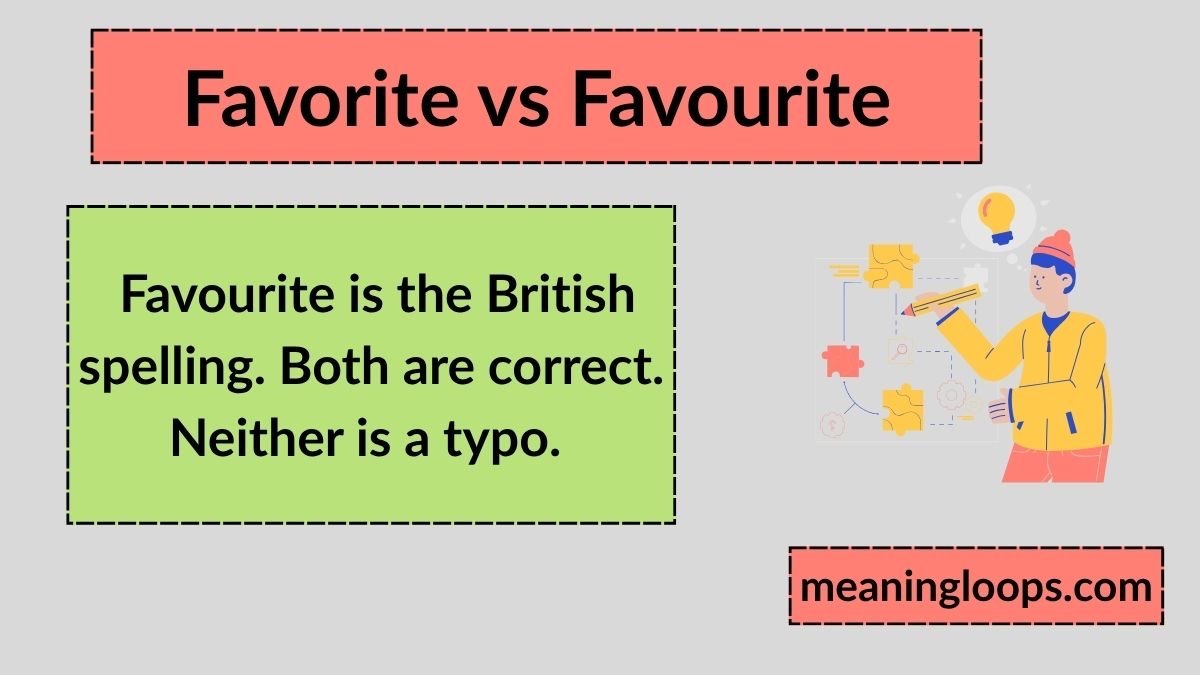
Here’s the good news: you didn’t make a mistake. You just landed in the middle of one of the oldest disagreements in the English-speaking world. Favorite is the American spelling. Favourite is the British spelling. Both are correct. Neither is a typo. And once you understand why they split in the first place, you’ll never second-guess yourself again.
This guide walks through the history, the grammar, the style-guide rules, and the practical decisions that matter if you write for a living, run a website, or just want to sound polished in an email. Let’s get into it.
The Core Difference at a Glance
Before diving into the history, here’s the short version, because sometimes you just need the answer fast.
| Spelling | Region | Used In |
|---|---|---|
| Favorite | United States | American English, US publications, US-based websites |
| Favourite | United Kingdom, Australia, Canada (mostly), New Zealand, Ireland, South Africa, India | British English and most of the Commonwealth |
Both words mean exactly the same thing: something preferred above all others. They’re pronounced identically. The only difference is that one letter, the “u,” sitting quietly in the middle of the word.
That single letter, though, carries a surprising amount of history.
Where the Spellings Diverged
To understand why English has two spellings for the same word, you have to go back almost a thousand years, to 1066 and the Norman Conquest.
When the Normans invaded England, they brought Old French with them, and it fused with Old English to eventually form what we now call Middle English. Thousands of French words entered the language during this period, and “favorit” (Old French) was one of them. Its root traces further back to the Latin word favor, meaning goodwill or approval.
For centuries afterward, English spelling was, frankly, a mess. There was no dictionary standardizing anything, no agreed-upon rulebook, and writers spelled words however they felt like spelling them. You could find “favourite,” “favorite,” and even “favoret” in different documents from the same era. Spelling wasn’t fixed; it was fluid.
Things started to change in the 1600s and 1700s as English dictionaries began appearing, most famously Samuel Johnson’s A Dictionary of the English Language, published in 1755 in London. Johnson kept the French-influenced “-our” spellings for words like colour, honour, and favourite, largely because he believed they preserved the words’ etymological roots. His dictionary became the reference point for British English for generations.
Then America happened. And America, as it often does, decided to do things differently.
Noah Webster’s Impact on American Spelling

If you want to know who’s responsible for “favorite” losing its “u,” the answer is one man: Noah Webster.
Webster was an American lexicographer, and after the United States gained independence, he set out on a mission that was as much political as it was linguistic. He believed a newly independent nation needed its own distinct identity, and that included its own version of the English language. In his view, American spelling should be simpler, more phonetic, and free from what he saw as unnecessary British conventions.
In 1828, Webster published An American Dictionary of the English Language, and it changed the shape of American writing forever. He deliberately dropped the “u” from words like:
- Colour → Color
- Honour → Honor
- Labour → Labor
- Favourite → Favorite
- Flavour → Flavor
He also simplified other spelling patterns, changing “theatre” to “theater,” “centre” to “center,” and “cheque” to “check.” Webster wasn’t correcting errors. He was reforming the language on purpose, driven by a belief that American English should reflect American independence and practicality.
It worked. Webster’s dictionary became hugely influential in American schools throughout the 19th century, and his spelling conventions stuck. Today, they’re simply “American English,” even though they started as one man’s deliberate campaign for linguistic separation from Britain.
As Webster himself put it in his writings on spelling reform, a national language was, in his eyes, a bond of national union, and he wanted America’s version of English to look and feel distinctly American.
That’s the entire reason you’re staring at “favorite” without a “u” right now. One dictionary maker, one nationalist mission, and 200 years of habit.
Why British English Kept “Favourite”
Britain, understandably, felt no pressure to simplify its own spelling to match a former colony. British English continued following the conventions set by Johnson’s dictionary and centuries of French-influenced spelling, and “favourite” remained untouched.
This isn’t just a UK thing, either. Because of the British Empire’s global reach, British spelling spread to and stuck in a long list of countries:
- United Kingdom
- Ireland
- Australia
- New Zealand
- South Africa
- India
- Most Caribbean nations
- Most African English-speaking countries
That means “favourite” is actually the more widely used spelling globally, even though “favorite” often feels more dominant online because of the sheer size of American media and tech companies.
Canada deserves its own mention here because it’s genuinely a special case. Canadian English is a hybrid. Canadians generally keep British spellings for words like colour,Favorite vs Favourite and honour, but they follow American conventions in other areas, like preferring “tire” over “tyre” and using American-style punctuation rules. If you’re writing for a Canadian audience, Favorite vs Favourite” is the safer default, though you’ll see both spellings depending on the publication and the writer’s personal habits.
Modern Usage Rules You Actually Need

Beyond the spelling itself, “favorite” vs “favourite” follow identical grammar rules, since they’re the same word wearing different regional outfits.
As a noun: “Pizza is my favorite.” / “Pizza is my favourite.”
As an adjective: “This is my favorite book.” / “This is my favourite book.”
A few rules worth locking in:
- Never write “more favorite” or “most favorite.” The word already carries the sense of “preferred above all others,” so adding a comparative or superlative modifier is redundant. Just say “my favorite” or, if you need comparison, “I like this one more.”
- Capitalize only in titles, headings, or brand names. In regular sentences, keep it lowercase.
- Don’t switch spellings mid-document. If you start with Favorite vs Favourite,” stay with American spelling throughout, including related words like “color” and “honor.” Mixing regional spellings in the same piece looks careless, even though each individual word is technically correct.
Style Guides and Editorial Standards
If you write professionally, whether for a newspaper, a company blog, or an academic journal, your choice usually isn’t really a choice. It’s dictated by whichever style guide your publication follows.
| Style Guide | Region | Spelling Used |
|---|---|---|
| AP Stylebook | United States | Favorite |
| Chicago Manual of Style | United States | Favorite |
| Oxford Style Manual | United Kingdom | Favourite |
| Cambridge Guide to English Usage | United Kingdom | Favourite |
| Australian Government Style Manual | Australia | Favourite |
Academic publishing has its own quirks worth knowing. A journal’s spelling convention typically depends on where it’s published, not where the author lives. An American academic submitting to a British-based journal will often be asked to convert their manuscript to British spelling before publication, and vice versa. It has nothing to do with correctness and everything to do with house style.
The practical takeaway: match the style guide of whoever you’re writing for. If you’re freelancing for a UK-based client, use “Favorite vs Favourite.” If you’re writing for a US audience, use “favorite.” Your personal preference matters far less than consistency with your publication’s established standard.
Common Mistakes and Misconceptions
A few myths about this topic refuse to die, so let’s clear them up.
Myth: One spelling is more “correct” than the other. False. Neither spelling is more formal, more proper, or more accurate. They’re regional variants, full stop. Claiming one is superior is a matter of opinion, not linguistics.
Myth: British spelling is the “original” and American spelling is “wrong.” Not quite. Both spellings existed in various forms before either country standardized its dictionary. Webster’s version is a deliberate simplification, but that doesn’t make it incorrect; it just makes it different.
Real mistakes to actually watch for:
- Mixing spellings within one document. “My favorite colour” combines American and British spelling in the same sentence, and it reads as inconsistent rather than intentional.
- Autocorrect switching your spelling without you noticing. This happens constantly when writers switch between devices or accounts set to different regional language settings.
- Misspellings that aren’t regional variants at all, like “favorate” or “favourate.” These aren’t accepted anywhere; they’re just typos.
Favorite vs Favourite in Digital Content and SEO
If you create content online, this section matters more than any grammar rule.
Search engines like Google do a reasonably good job of reconciling regional spelling variants, meaning a UK searcher typing “favourite” will often still see relevant results containing “favorite,” and vice versa. That said, “reasonably good” isn’t “perfect,” and regional spelling still influences search behavior in measurable ways.
Here’s what to actually do about it:
Write for your primary audience’s region first. If your site serves mostly American readers, use “favorite” consistently across your content, including in headers, meta descriptions, and URLs. If your audience is primarily British, Australian, or otherwise Commonwealth-based, “favourite” is the safer choice.
Consider both spellings for global content. If your site draws meaningful traffic from both American and international audiences, it’s worth naturally including both spelling variants somewhere in your content, since this can help you rank in both regional search markets without forcing awkward keyword stuffing.
Use hreflang tags for multi-regional sites. If you’re running localized versions of a site for different English-speaking markets, hreflang tags tell search engines which spelling and content version to serve to which regional audience. This is standard practice for larger publishers and e-commerce sites operating across the US, UK, and Australian markets simultaneously.
Stay consistent within a single page. Even if your site uses both spellings across different regional pages, never mix them within a single article. It undermines credibility and can look like the content wasn’t properly edited.
Case in point: many major global brands run entirely separate versions of their websites for US versus UK audiences, adjusting spelling, currency, and even product names accordingly. That level of localization signals professionalism, and it’s a big part of why large e-commerce and media companies invest in region-specific content teams rather than relying on a single spelling for everyone.
Related Word Forms That Follow the Same Rule
Once you understand the “favorite vs favourite” pattern, you’ve basically unlocked an entire family of words that follow the exact same American-versus-British rule.
| American English | British English |
|---|---|
| Favorite | Favourite |
| Favor | Favour |
| Favorable | Favourable |
| Favoritism | Favouritism |
| Color | Colour |
| Honor | Honour |
| Labor | Labour |
| Flavor | Flavour |
| Humor | Humour |
| Neighbor | Neighbour |
| Rumor | Rumour |
| Armor | Armour |
Notice the pattern: American English tends to drop the “u” in words ending in “-our,” simplifying it to “-or.” That single rule, once memorized, saves you from having to look up dozens of individual words. If you know “color” is American and “colour” is British, you already know “favorite” and “favourite” without needing a separate explanation.
Quick Decision Guide for Writers and Editors
Not sure which spelling to use in a given situation? Run through this quick checklist:
- Who’s your primary audience? American readers get “favorite.” British, Australian, or Commonwealth readers get “favourite.”
- Does your publication or employer have a style guide? Follow it, regardless of your personal preference.
- Are you writing for school? Match whatever spelling convention your institution or professor requires, especially in academic papers.
- Are you localizing content for multiple regions? Use separate versions of your content with region-appropriate spelling, rather than picking one variant for everyone.
- Are you writing something informal, like a personal blog or social post? Either spelling works fine; just stay consistent throughout.
The single most important rule, above all others: pick one and stick with it. Consistency matters far more than which variant you choose.
FAQs
What is the difference between favorite and favourite?
There’s no difference in meaning, pronunciation, or grammar. “Favorite” is the American English spelling, and “favourite” is the British English spelling used across most of the Commonwealth, including the UK, Australia, and Canada.
Can I use both spellings interchangeably?
Within a single piece of writing, no. While both spellings are individually correct, mixing them in the same document looks inconsistent and unpolished. Pick one spelling based on your audience or style guide, and use it consistently throughout.
Why does British English use the “ou” in favourite?
British English preserved the French-influenced spelling that entered the language after the Norman Conquest in 1066, later reinforced by Samuel Johnson’s 1755 dictionary. American English dropped the “u” later, largely due to Noah Webster’s spelling reforms in the early 1800s.
Does using the wrong spelling affect meaning?
Not at all. Whether you write “favorite” or “favourite,” readers everywhere understand the word identically. The only real consequence of using the “wrong” regional spelling is that it might look slightly out of place to readers in that specific region, similar to using British punctuation conventions in an American document.
Does Canada use favorite or favourite?
Canadian English generally favors British-style spelling, so “favourite” is more common in Canada, alongside other British-influenced spellings like “colour” and “honour.” That said, American spelling also shows up frequently due to Canada’s close proximity to and media overlap with the United States.
Will using the “wrong” spelling hurt my SEO rankings?
Not in a major way for a single word, but consistency across your site matters for user experience and regional targeting. If most of your traffic comes from one English-speaking region, using that region’s spelling convention consistently helps your content feel native to that audience, which can indirectly support engagement and trust signals.
Conclusion
At the end of the day, “favorite” and “favourite” are the same word separated by geography, history, and one determined lexicographer with a nationalist streak. Neither spelling is more correct, more formal, or more proper than the other. They’re simply regional cousins, shaped by the Norman Conquest, refined by dictionary makers on both sides of the Atlantic, and preserved today through habit, education, and style guides.
What actually matters isn’t which spelling you choose. It’s whether you stay consistent, match the expectations of your audience, and follow the style guide relevant to your writing context. Get that right, and you’ll never need to second-guess that little red squiggly line again.
Read
What Does BTW Mean in Text? Meaning, Uses & Examples (2026)
Years of Experience vs Years’ Experience: The Complete Guide to Getting It Right
Twin Meaning Slang: What Does “Twin” Mean in Text? (2026 Guide)

David Miller is the lead content writer at Meaning Loops, where he creates accurate and easy-to-understand content on word meanings, synonyms, antonyms, idioms, phrases, acronyms, abbreviations, and vocabulary. His goal is to help readers improve their English with reliable, well-researched, and SEO-friendly language resources.










2 thoughts on “Favorite vs Favourite: The Real Story Behind English’s Most Common Spelling Fork”