You’ve typed “orientated” into an email, and something felt off. Orientated vs Oriented. Maybe spellcheck underlined it. Maybe a colleague raised an eyebrow. So now you’re here, wondering if you just committed a grammar crime.
Relax. You didn’t.
Orientated vs oriented are both real, dictionary-approved words. They mean the same thing. The difference between them isn’t about right and wrong — it’s about geography, habit, and a little bit of linguistic history. By the end of this article, you’ll know exactly which one to reach for, why the other one exists at all, and how to sound confident no matter which side of the Atlantic your reader is on.
Let’s clear up the confusion for good.
What “Oriented” and “Orientated” Actually Mean
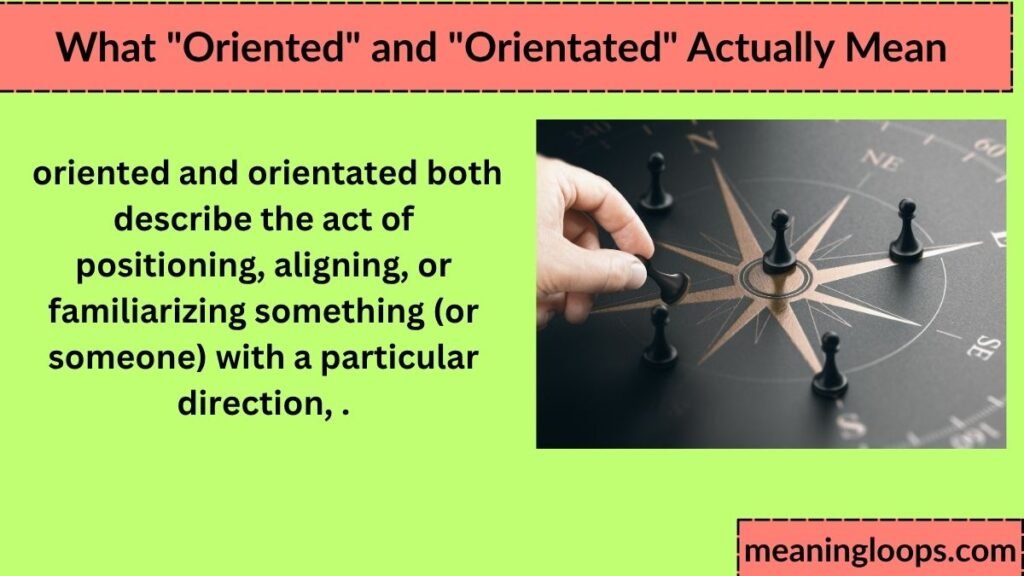
Here’s the short version: oriented vs orientated both describe the act of positioning, aligning, or familiarizing something (or someone) with a particular direction, purpose, or situation.
you’re “oriented,” you know where you stand — literally or figuratively. If a business is “customer-oriented,” it’s built around serving its customers. If a new employee gets “orientated” on their first day, someone walked them through how things work.
A few working examples:
- “The building is oriented toward the south to catch more sunlight.”
- “She’s incredibly career-oriented and always thinking three steps ahead.”
- “It took him a week to get orientated to the new office layout.”
- “New hires attend a two-hour orientation session before their first shift.”
Notice something? The meaning doesn’t shift no matter which form you use. There’s no scenario where “oriented” means one thing and “Orientated vs Oriented” means something subtly different. This is one of the most persistent myths about the pair, and we’ll tackle it head-on later in this article.
Both words function as the past participle of a verb, and both can act as adjectives. The verbs themselves are “to orient” and “to orientate” — and that small detail is actually where this whole debate begins.
Historical Origins and Etymology
To understand why English ended up with two words for one idea, you have to go back to the root: the Latin word orientem, the present participle of oriri, meaning “to rise.” It originally referred to the direction of the rising sun — the east.
That’s not a coincidence. Centuries ago, church builders literally aligned Christian churches so the altar faced east, toward the rising sun and, symbolically, toward Jerusalem. This practice was called “Orientated vs Oriented” a building. Over time, the term stopped being about compass directions and started meaning any kind of positioning, alignment, or familiarization — which is the sense we use today.
Here’s where it gets interesting for grammar nerds:
| Word | First Recorded Use | Origin |
|---|---|---|
| Orient (verb) | Early 18th century | Directly from French orienter, from Latin orientem |
| Orientate (verb) | Mid-19th century | A back-formation from the noun orientation |
| Oriented (adjective/participle) | Follows “orient” | Past participle of “orient” |
| Orientated (adjective/participle) | Follows “orientate” | Past participle of “orientate” |
The key fact most articles skip: “Orientated vs Oriented” wasn’t the original verb. It came later, formed by taking the noun “orientation” and trimming it back down into a verb — a process linguists call back-formation. “Oriented,” on the other hand, is the straightforward past participle of “orient,” which had already existed as a verb for over a century before “orientate” showed up.
This is why some grammar purists argue “oriented” is technically the more “correct” or “original” form. It’s not that “orientate” is broken English — it’s that it’s a newer, longer route to the same destination.
Regional Preferences: American English vs. British English
This is the heart of the debate, and it comes down to one simple fact: Americans overwhelmingly prefer “Orientated vs Oriented,” while British English speakers use both, leaning noticeably more toward “orientated” than Americans do.
Language data backs this up clearly. Studies using corpus tools like Google Ngram Viewer, which tracks word frequency across millions of published books, show that “oriented” outpaces “orientated” by a wide margin globally — and the gap is even more dramatic when you isolate American English texts specifically.
Here’s how the regional split generally breaks down:
| Region | Preferred Form | Notes |
|---|---|---|
| United States | Oriented | “Orientated” is rare and often read as a mistake |
| United Kingdom | Both, but oriented is rising | “Orientated” is standard but increasingly seen as old-fashioned in formal writing |
| Australia | Both, leaning orientated | Follows British conventions more closely |
| Canada | Oriented | Follows American conventions in most professional writing |
| International/Global English | Oriented | Safest default for mixed audiences |
Examples of Regional Use
To see this in action, compare how the same sentence might appear depending on the audience:
- 🇺🇸 American: “We’re a customer-oriented company that puts service first.”
- 🇬🇧 British: “The new hire seems well Orientated vs Oriented to office procedures.”
- 🇺🇸 American: “This program is goal-oriented, tracking measurable outcomes.”
- 🇬🇧 British: “Students are orientated during their first week on campus.”
Why does British English keep “orientated” around at all? Part of the answer lies in pattern recognition. English has plenty of verbs that follow the “-ate” pattern — think necessitate, orchestrate, and facilitate — and to a British ear, “orientate” simply fits that familiar rhythm. It doesn’t sound wrong; it sounds consistent with a whole family of similar words.
“Language is fluid, and what feels ‘correct’ often has more to do with what we’re used to hearing than with any fixed rule.” — a sentiment echoed across most modern style guides.
Even so, momentum is shifting. Major British publications, editorial style guides, and academic journals increasingly favor “oriented” even in UK contexts, particularly in professional and formal writing. The trend line points toward “oriented” becoming the dominant global form over time, even on British soil.
Practical Usage in Modern English
Knowing the history is one thing. Knowing what to actually type in your next email is another. Let’s break usage down by context.
Everyday Writing
In casual writing — texts, social posts, personal blogs — either word will be understood. But if you’re writing for a general or international audience, oriented is the safer bet. It reads as more modern and doesn’t risk looking like a typo to American readers, who make up a huge share of English-language internet traffic.
Professional and Academic Writing
This is where word choice actually matters. Most American style guides, including the Associated Press (AP) Stylebook and the Chicago Manual of Style, favor “oriented” without exception. If you’re writing a resume, a business report, or academic paper for a U.S. audience, “orientated” will likely stand out — and not in a good way.
In the UK, style guides are more permissive. Publications like The Guardian and reference sources like the Oxford English Dictionary acknowledge “orientated” as standard British usage, though even there, formal and professional writing increasingly defaults to “oriented” for its brevity and cross-market consistency.
Quick rule of thumb for professional writing:
- Writing for a U.S. company, client, or publication? Use oriented.
- Writing for a UK-based audience? Either works, but oriented is safer for anything formal.
- Writing for an international or unknown audience? Default to oriented.
- Writing a resume or cover letter for a global company? Use oriented — it’s the version applicant tracking systems and hiring managers are used to seeing.
Idiomatic Usage
Certain compound adjectives have become so common they’re practically fixed phrases. And here’s a detail most articles miss: even in British English, these compound forms skew toward “-oriented” more heavily than the standalone verb does.
Common examples include:
- Career-oriented — focused on professional advancement
- Customer-oriented — built around client needs
- Market-oriented — driven by market demand and trends
- Goal-oriented — focused on achieving specific outcomes
- Detail-oriented — attentive to precision and accuracy
- Family-oriented — centered around family values or needs
You’ll rarely see “career-orientated” or “customer-orientated” outside of UK writing, and even there, “oriented” is creeping in. If you’re building a compound adjective, “oriented” is almost always the safer, more universally recognized choice.
Common Misconceptions
Let’s kill a few myths that keep this debate more confusing than it needs to be.
Myth 1: “Oriented” Is the Only Correct Form
False. “Orientated” is standard British English, not a grammatical error. Dictionaries on both sides of the Atlantic list it as a legitimate word. It’s regionally less common in the U.S., not incorrect.
Myth 2: “Orientated” Is Always More Formal
False. Formality isn’t the deciding factor here — region is. Plenty of people assume the longer word must be the “proper” or “fancier” choice, but that’s not how this pair works. “Orientated” isn’t dressed up; it’s just British.
Myth 3: The Meaning Changes Between the Two Words
False. There is no semantic distinction. Both words describe alignment, positioning, or familiarization. If you swap one for the other, the sentence means exactly the same thing — only the regional flavor changes.
Usage Trends and Data
If you look at long-term language data, the trend is unmistakable: “oriented” has been pulling further ahead of “orientated” for decades, and that gap is widening, not narrowing.
A few patterns worth knowing:
- Usage data collected from large text corpora consistently shows “oriented” appearing several times more often than “orientated” across all English-speaking regions combined.
- In American English specifically, “orientated” is rare enough that many U.S. readers genuinely believe it’s a typo when they encounter it.
- In British English, “orientated” remains common in casual and spoken contexts but is losing ground in formal, academic, and corporate writing.
- Search engine and content trends show “oriented” ranking as the more frequently searched and referenced term globally, reinforcing its position as the default modern choice.
The takeaway: language evolves toward efficiency, and “oriented” — being shorter, with a longer verb history, and without the “extra” syllable of “orientate” — has become the global default. That doesn’t erase “orientated” from the language, but it does mean it’s the exception rather than the rule almost everywhere now.
Guidance for Choosing the Right Form
You don’t need to memorize a rulebook. You just need a quick mental checklist.
Step-by-Step Approach
- Identify your audience. Are you writing for American readers, British readers, or a mixed/global audience?
- Check your context. Formal business writing, academic papers, and resumes lean toward “oriented.” Casual UK conversation can go either way.
- Look at your style guide. If your company, publication, or school follows AP or Chicago style, use “oriented.” If it follows a British house style, “orientated” is acceptable.
- Stay consistent. Pick one form and use it throughout the entire piece. Mixing both in a single document looks like an inconsistency, even though neither word is technically wrong.
- When in doubt, go short. “Oriented” works almost everywhere without raising eyebrows. It’s the safer default in nearly every situation.
Quick Reference Table
| Situation | Recommended Word | Why |
|---|---|---|
| U.S. business or academic writing | Oriented | Standard in American English style guides |
| UK casual or spoken English | Either | Both are widely understood and accepted |
| UK formal/professional writing | Oriented (increasingly) | Modern style guides favor brevity |
| Resume or cover letter (global) | Oriented | More universally recognized by employers |
| Compound adjectives (career-, goal-, customer-) | Oriented | Far more common even in British English |
| Writing for an international audience | Oriented | Avoids sounding regionally specific |
| Direct address to a UK-only readership | Either acceptable | “Orientated” won’t confuse a British audience |
Related Word Pairs Worth Knowing
If “oriented vs. orientated” caught your attention, you’ll probably recognize this pattern elsewhere in English. Several verb pairs follow the exact same structure: a shorter, older verb next to a longer version built from a related noun.
- Preventive vs. preventative — “preventive” is shorter and generally preferred in American English; “preventative” is common in British English and medical writing.
- Administer vs. administrate — “administer” is the older, more standard verb; “administrate” is a back-formation from “administration,” much like “orientate” is from “orientation.”
- Commentate vs. comment — “commentate” specifically refers to providing live narration (like a sports commentator), so this pair actually does carry a meaning difference, unlike orient/orientate.
Recognizing this pattern helps you make quick calls on similar word pairs without needing to look each one up individually. When you spot a verb that seems to have grown an extra syllable from a related noun, there’s a good chance the shorter form is the older, more broadly accepted one.
A Real-World Case: Employee Orientation Programs
One place this word pair shows up constantly is workplace onboarding — and it’s a great example of how regional habits play out in real business documents.
Picture two HR teams writing an onboarding handbook. The American team, based in Chicago, writes: “All new hires must be fully oriented before their first shift.” The British team, based in Manchester, drafts a nearly identical line: “All new starters should be fully orientated within their first week.”
Neither team made a mistake. Both sentences are grammatically sound, both would pass a professional editor’s review, and both communicate the exact same expectation. The only thing separating them is geography and house style.
This matters more than it might seem, especially for multinational companies. If a global HR department publishes a single onboarding template used across U.S. and UK offices, inconsistent word choice can quietly signal that a document wasn’t localized carefully — even though nothing is technically incorrect. Smart HR and content teams typically pick one form (usually “oriented,” since it reads naturally in both markets) and apply it across every regional version of their materials, rather than maintaining separate British and American drafts.
The same logic applies to training programs, new-hire orientation sessions, and internal style guides. If your company operates internationally, standardizing on “oriented” removes the guesswork entirely and keeps your documentation looking cohesive no matter which office reads it.
Why This Kind of Word Pair Trips Up Even Skilled Writers
It’s worth pointing out why “oriented vs. orientated” causes so much second-guessing, even among people who write for a living. Unlike classic mix-ups such as “their vs. there,” this isn’t a case of two unrelated words that sound alike. Both forms are legitimate, both show up in respected dictionaries, and both get used by professional publications somewhere in the English-speaking world.
That’s precisely what makes it tricky. Your brain isn’t flagging an error — it’s picking up on inconsistency. If you’ve read mostly American content, “orientated” will look foreign even though it’s perfectly standard elsewhere. If you grew up reading British newspapers, “oriented” might feel clipped or incomplete, even though it’s the historically older form.
Understanding that this is a regional preference, not a grammar rule, takes the pressure off. You’re not trying to remember an arbitrary exception — you’re making a stylistic decision based on your audience, the same way you’d choose “color” over “colour” or “realize” over “realise.”
Frequently Asked Questions
Are “orientated” and “oriented” the same?
Yes, in meaning. Both describe alignment, positioning, or familiarization with something new. The difference is purely regional: “oriented” dominates American English, while “orientated” is more common (though declining) in British English.
Which is correct in a professional setting?
For American businesses, academic institutions, and most global companies, oriented is the standard choice. UK-based organizations may accept “orientated,” but even there, “oriented” is increasingly the safer, more modern option for formal writing.
How do I remember the difference?
Think of “orientate” as carrying an unnecessary extra syllable — similar to saying “conversate” instead of “converse.” When in doubt, go with the shorter word: oriented. It works in nearly every context, region, and register.
Does Microsoft Word or Grammarly flag “orientated” as an error?
Most American-English-set spellcheckers and grammar tools will flag “orientated” as non-standard or suggest “oriented” as a correction, since they’re calibrated to U.S. English by default. If your software is set to British or Australian English, “orientated” typically won’t be flagged.
What about “reorient” vs. “reorientate”?
The same regional pattern applies. “Reorient” is standard in American English, while “reorientate” appears more often in British English, following the exact same logic as the base word pair.
Conclusion
Here’s the bottom line: “oriented” and “orientated” mean exactly the same thing — the only real difference is where your reader lives and what they’re used to seeing. American English has settled firmly on “oriented.” British English still uses both, though “oriented” is steadily gaining ground there too.
If you’re ever unsure which one to use, default to oriented. It’s shorter, it’s globally recognized, it’s the standard in professional and academic writing, and it won’t raise questions no matter who’s reading it. “Orientated” isn’t wrong — it’s just increasingly the regional exception rather than the rule.
Next time you catch yourself hesitating over which word to type, you won’t need to guess. You’ll know exactly why both exist, which one fits your audience, and how to write with confidence either way.
Also like
HN Meaning in Text: What It Really Means in Chats & Social Media (2026)
What Does AWLL Mean in Text? Full Meaning Explained (2026)
What Does SMS Mean in Text? A Simple, No-Nonsense Explanation (2026)

David Miller is the lead content writer at Meaning Loops, where he creates accurate and easy-to-understand content on word meanings, synonyms, antonyms, idioms, phrases, acronyms, abbreviations, and vocabulary. His goal is to help readers improve their English with reliable, well-researched, and SEO-friendly language resources.

1 thought on “Orientated vs Oriented: Understanding the Difference (And Which One to Actually Use)”