Ever caught a whiff of a familiar smell and suddenly you’re eight years old again, sitting in your grandma’s kitchen? That’s nostalgia doing its thing. And when you try to describe it, you probably say something like, “I’m feeling nostalgic right now.” But is that actually correct English, or just something we’ve all agreed to say because it sounds right?
Good news: it’s correct. Grammatically solid, widely used, and backed by real linguistic logic. But there’s more to this phrase than a quick yes-or-no answer. Let’s dig into where it comes from, why it works the way it does, and how to use it (plus its cousins and alternatives) like someone who actually knows their English.
Quick Answer: Yes, “Feeling Nostalgic” Is Correct
Here’s the short version. “Feeling nostalgic” is grammatically correct and one of the most natural ways to describe the bittersweet pull of past memories in English. It follows a standard sentence pattern where a verb like “feeling” links to an adjective (“nostalgic”) to describe an emotional state — the same structure as “feeling tired,” “feeling hopeful,” or “feeling anxious.”
You’ll hear it everywhere: in casual conversation, song lyrics, movie reviews, and social media captions. A sentence like “This old photo makes me feel so nostalgic” works perfectly in both spoken and written English. No red flags, no grammar police needed.
That said, understanding why it works, and when you might want a different phrase instead, will make your writing sharper. So let’s get into it.
Where “Nostalgic” Comes From
Words carry history, and “nostalgic” has one of the more interesting backstories in the English language. It didn’t start out describing warm, fuzzy memories at all.
The term traces back to two Greek roots: nostos, meaning “homecoming” or “return,” and algos, meaning “pain” or “ache.” Put them together and you get something close to “the pain of longing to return home.” A Swiss physician named Johannes Hofer actually coined the term “nostalgia” in 1688 as a medical diagnosis for homesick soldiers who showed physical symptoms — loss of appetite, insomnia, even fever — from being away from home too long.
For centuries, nostalgia was treated as a disorder, not a feeling worth savoring. Doctors in the 18th and 19th centuries genuinely believed soldiers could die from it. It wasn’t until the 20th century that the meaning softened into what we know today: a wistful, often pleasant longing for the past, rather than a diagnosable illness.
That shift matters. It explains why nostalgia still carries a slightly bittersweet edge, even when we’re smiling while feeling it. The word remembers its own painful origins, even if we don’t consciously think about it every time we say “I’m feeling nostalgic.”
The Grammar Behind “Feeling Nostalgic”
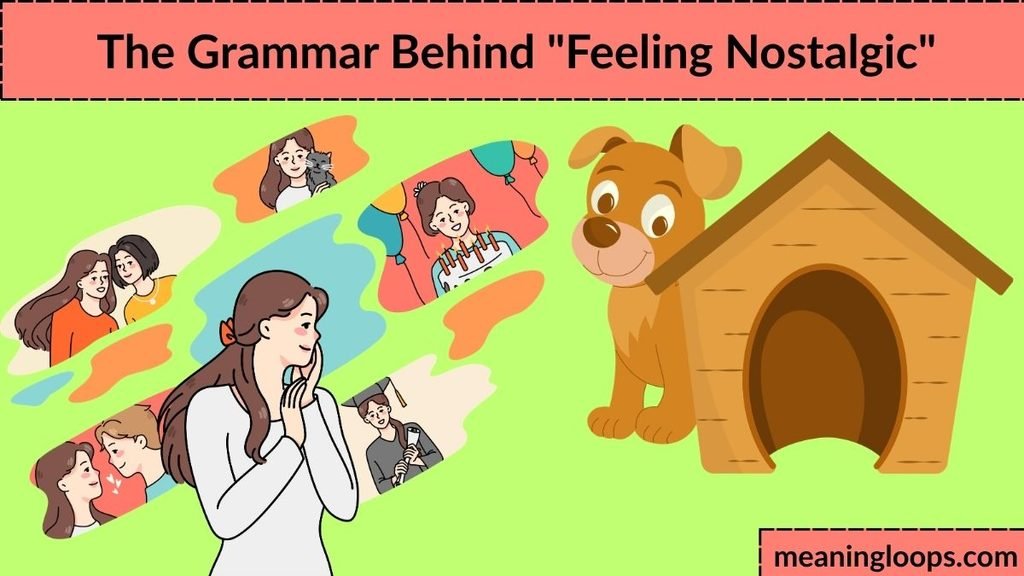
Let’s get technical for a second, but not too technical. Understanding the grammar here isn’t complicated once you see the pattern.
Why “Nostalgic” Is an Adjective, Not a Noun
“Nostalgic” describes a quality or state — it tells you how someone feels. That makes it an adjective. Compare it to “nostalgia,” which is the noun form and names the emotion itself, the way “happiness” names the emotion behind “happy.”
| Word | Part of Speech | Example |
|---|---|---|
| Nostalgia | Noun | “Nostalgia washed over her.” |
| Nostalgic | Adjective | “She felt nostalgic.” |
| Nostalgically | Adverb | “She smiled nostalgically at the photo.” |
The Linking-Verb Pattern
Here’s the grammar trick that makes “feeling nostalgic” click: “feeling” (from the verb “to feel”) acts as a linking verb in this sentence, not an action verb. Linking verbs connect the subject to a description rather than showing an action being done.
Think about other sentences built the same way:
- I’m feeling tired.
- She’s feeling confident.
- They’re feeling hopeful.
- We’re feeling nostalgic.
In every one of these, the adjective after “feeling” describes the subject’s emotional or physical state. You wouldn’t say “I’m feeling tiredness” or “She’s feeling confidence” in casual speech — it sounds stiff and technically off. The same logic applies to nostalgia. “Feeling nostalgic” simply follows the pattern native English speakers use every day without even thinking about it.
Why It Sounds Natural to Native Speakers
This structure is so deeply baked into English that most speakers never question it. It’s the same reason “I feel sick” sounds right but “I feel sickness” sounds odd. Adjectives pair naturally with linking verbs like “feel,” “seem,” “look,” and “sound.” That’s just how the language flows.
“Feeling Nostalgic” vs. “Feeling Nostalgia” — What’s the Real Difference
This is where a lot of English learners (and even native speakers) get tripped up. Both phrases exist, but they’re not interchangeable in every context.
| Phrase | Correct? | Grammatical Role | Example |
|---|---|---|---|
| Feeling nostalgic | ✅ Correct, most common | Adjective describing emotional state | “I’m feeling nostalgic about high school.” |
| Feeling nostalgia | ✅ Correct, but less common | Noun as the direct object of “feeling” | “I’m feeling nostalgia for my hometown.” |
| Feeling nostalgia about | ⚠️ Awkward, rarely used | Mixes noun form with a preposition typically paired with the adjective | Avoid this combination |
Both versions are technically grammatical, but “feeling nostalgic” wins out in everyday speech because adjectives after “feel” are the more natural, more common construction in English. “Feeling nostalgia” isn’t wrong — it just sounds slightly more formal or literary, the kind of phrasing you might spot in a novel or a poem rather than a text message.
Quick rule of thumb: if you want to describe your state of being, use “nostalgic” (the adjective). If you want to talk about the emotion as a thing itself, “nostalgia” (the noun) works better — especially with verbs like “feel,” “experience,” or “trigger.”
Common Mistakes People Make
Even a phrase this natural has its pitfalls. Here are the errors that pop up most often.
- “I’m nostalgia.” Incorrect. This confuses the noun with the adjective. You need “I’m nostalgic” or “I feel nostalgia.”
- “Nostalgic feeling about” used redundantly, like “I have a nostalgic feeling about feeling nostalgic.” Wordy and repetitive — pick one phrasing and stick with it.
- “Nostalgic of” instead of “nostalgic for” or “nostalgic about.” The correct prepositions are “for” and “about,” not “of.” You’d say “nostalgic for the ’90s,” not “nostalgic of the ’90s.”
- Confusing nostalgia with plain sadness. Nostalgia isn’t sadness — it’s a mixed emotion, often leaning positive. Saying “I feel so nostalgic and depressed” misuses the word if you just mean sad. Nostalgia already carries emotional complexity on its own.
Here’s a comparison to keep the prepositions straight:
| Correct | Incorrect |
|---|---|
| Nostalgic for the past | Nostalgic of the past |
| Nostalgic about childhood | Nostalgic on childhood |
| Feeling nostalgic over old photos | Feeling nostalgic at old photos |
What Nostalgia Actually Feels Like
Nostalgia isn’t just remembering something. Plenty of memories come and go without stirring any emotion at all. Nostalgia is different — it’s memory with feeling attached, and usually a very specific kind of feeling.
It’s Not Just Memory — It’s Bittersweet
Psychologists describe nostalgia as a bittersweet emotion, meaning it blends joy and loss in the same moment. You remember something wonderful — your childhood best friend, a summer road trip, your grandmother’s cooking — and alongside the warmth, there’s an ache because that moment is gone and won’t come back exactly the same way.
That combination is what separates nostalgia from plain happy memories. A happy memory alone might just make you smile. A nostalgic memory tugs at something deeper: recognition that time has passed, that things have changed, and that you can’t fully return to that moment, no matter how badly you want to.
What Psychology Research Says
Nostalgia used to have a bad reputation in psychology, much like it did in medicine centuries ago. But research over the past two decades has flipped that narrative entirely.
Dr. Constantine Sedikides, a social psychologist at the University of Southampton, has spent years studying nostalgia’s effects on well-being. His research, published through the University of Southampton’s psychology department, found that nostalgia can boost self-esteem, strengthen a sense of social connectedness, and even help people find meaning in life during difficult periods.
Dr. Krystine Batcho, a psychology professor at Le Moyne College, has also studied nostalgia extensively, developing one of the first psychometric scales to measure nostalgic tendencies. Her work suggests that people who experience nostalgia more frequently often show greater emotional resilience and a stronger sense of identity continuity — basically, nostalgia helps you feel like the same “you” across time, even as life changes around you.
As Sedikides put it in one widely cited interview, nostalgia works like “a psychological resource that people draw on to deal with the present and prepare for the future.”
Why the Brain Treats Nostalgic Memories Differently
Nostalgic memories tend to be more vivid, more emotionally charged, and easier to recall than neutral memories. That’s partly because emotional intensity strengthens memory encoding — the brain essentially tags emotionally significant moments as “important, keep this one.”
Sensory triggers play a huge role too. A song from your teenage years, the smell of a specific meal, an old photograph — these sensory memories bypass a lot of conscious thought and hit straight at the emotional centers of the brain, which is why nostalgia can feel so sudden and overwhelming, almost like a wave.
Nostalgia vs. Similar Emotions (So You Use the Right Word)
English has a whole cluster of emotion words that overlap with nostalgia but aren’t quite the same thing. Mixing them up is an easy mistake to make.
| Emotion | Core Meaning | Example |
|---|---|---|
| Nostalgia | Bittersweet longing for a past time or experience, often triggered by memory | “That song makes me nostalgic for college.” |
| Sentimentality | Excessive or tender emotion, not always tied to the past | “She’s sentimental about her old teddy bear.” |
| Homesickness | Longing specifically for home or a place, usually while physically away | “He felt homesick during his first semester abroad.” |
| Regret | Sadness or disappointment over something that happened (or didn’t) | “I regret not calling her back.” |
Nostalgia vs. Sentimentality
Sentimentality is broader and doesn’t require time or memory at all — you can be sentimental about a gift someone just gave you five minutes ago. Nostalgia, on the other hand, is always rooted in the past. Every nostalgic feeling is somewhat sentimental, but not every sentimental feeling is nostalgic.
Nostalgia vs. Homesickness
Homesickness is about place. Nostalgia is about time. You can feel nostalgic for a place you’ve never left, simply because things have changed there. And you can feel homesick for somewhere you’ve never even lived long-term, just because it currently represents “home” to you.
Nostalgia vs. Regret
Regret carries a heavier weight of “I wish this had gone differently.” Nostalgia doesn’t necessarily wish anything had changed — it just longs to experience the past again, flaws and all. You can feel nostalgic for a rough patch in your life (oddly enough) without regretting that it happened.
Natural Alternatives to “Feeling Nostalgic”
Sometimes “nostalgic” doesn’t quite capture the tone you’re going for. Here are alternatives, along with the shade of meaning each one brings.
| Alternative | Tone | Best Used When… |
|---|---|---|
| Wistful | Soft, quietly sad | You want a gentler, more literary feel |
| Sentimental | Warm, emotionally tender | The moment feels personal or touching |
| Misty-eyed | Emotional, close to tears | The nostalgia is intense enough to bring emotion to the surface |
| Reminiscent | Reflective, slightly formal | You’re comparing something present to the past |
| Longing for the past | Direct, plain English | You want clarity over poetic flair |
| Taken back (in time) | Casual, conversational | Talking with friends, informal writing |
You’ve probably heard phrases like “this song takes me back” or “it brings back memories” — these work as natural substitutes too, especially in spoken English. They carry the same emotional core as “feeling nostalgic” without repeating the word itself, which is useful if you’re writing something longer and want to avoid sounding repetitive.
When should you switch it up?
If you’re writing casually, “feeling nostalgic” is perfectly fine to use as-is. But in creative writing, essays, or anywhere you’re trying to build atmosphere, varying your word choice with alternatives like “wistful” or “reminiscent” adds texture and keeps your sentences from feeling repetitive.
How to Use “Feeling Nostalgic” in Real Sentences
Context changes how you might phrase nostalgia. Here’s how it shows up across different types of writing and speech.
casual conversation:
- “I found my old yearbook and now I’m feeling super nostalgic.”
- “This playlist has me feeling nostalgic for high school road trips.”
In social media captions and creative writing:
- “Feeling nostalgic today. 🌅 Old friends, old photographs, same warm feeling.”
- “The house smelled exactly the way I remembered — familiar smells hit different when they take you straight back to childhood adventures.”
- A short story might lean into imagery: “The creak of the porch swing brought back a flood of nostalgic memories — family traditions, summer evenings, the comfort of knowing exactly where everyone would be.”
In professional or formal writing: Nostalgia still has a place here, just dressed up a bit. Instead of “I’m feeling nostalgic about the company’s early days,” a more polished version might read: “Reflecting on the company’s early days evokes a strong sense of nostalgia among long-time employees.” Formal writing tends to favor the noun form (“nostalgia,” “a nostalgic tone”) over casual constructions, and it often swaps “feeling” for verbs like “evokes,” “reflects,” or “recalls.”
Frequently Asked Questions
Is it correct to say “feeling nostalgic”?
Yes. It’s grammatically correct and widely used in everyday, conversational, and even formal English. It follows the same linking-verb-plus-adjective pattern as phrases like “feeling tired” or “feeling hopeful.”
Is “feeling nostalgia” also correct?
Yes, though it’s less common. “Nostalgia” is the noun form, so “feeling nostalgia” works grammatically but tends to sound a touch more formal or literary than “feeling nostalgic.”
What’s the difference between nostalgic and sentimental?
Nostalgic feelings are always tied to the past, while sentimental feelings can apply to anything emotionally meaningful, past or present. All nostalgia is sentimental in some sense, but not all sentimentality is nostalgic.
Is nostalgia a positive or negative emotion?
Both, really. Nostalgia is what psychologists call a bittersweet emotion — it combines warmth and longing with a touch of sadness over time passed. Most research suggests the overall effect leans positive, boosting mood and social connection more often than it drags people down.
What preposition goes with “nostalgic” — for, about, or of?
Use “for” or “about.” You’d say “nostalgic for the past” or “nostalgic about childhood.” “Nostalgic of” is grammatically incorrect and should be avoided.
Conclusion
So, is it correct to say “feeling nostalgic”? Absolutely. It’s grammatically sound, emotionally rich, and one of the most natural ways English speakers describe that bittersweet pull toward old memories, childhood songs, and familiar faces from the past. Whether you’re texting a friend about an old photograph or writing a heartfelt essay about family traditions, “feeling nostalgic” will always say exactly what you mean. Next time that familiar song comes on and takes you right back, you’ll know exactly the right words for it.
Read
Years of Experience vs Years’ Experience: The Complete Guide to Getting It Right
Height vs. Hight: Which One Should You Actually Use?
Twin Meaning Slang: What Does “Twin” Mean in Text? (2026 Guide)

David Miller is the lead content writer at Meaning Loops, where he creates accurate and easy-to-understand content on word meanings, synonyms, antonyms, idioms, phrases, acronyms, abbreviations, and vocabulary. His goal is to help readers improve their English with reliable, well-researched, and SEO-friendly language resources.